

Nairobi sealed off ahead of Saba Saba protests

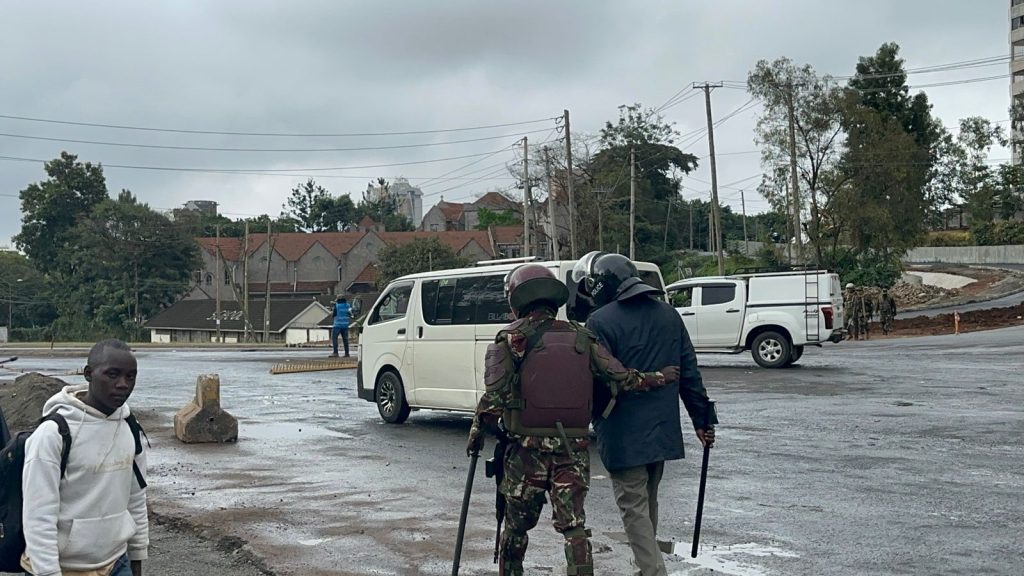
Police blocked all major roads leading into central Nairobi, ahead of planned nationwide protests to mark Saba Saba.
Much of the city centre was deserted, with businesses shut and a heavy security presence on the streets.
Some schools had advised students to stay at home.
Hundreds of early-morning commuters and overnight travellers were stranded at checkpoints, some located more than 10 kilometers from the city centre, with only a few vehicles allowed through.
But that stopped at about 11 am when police stopped allowing the cars to the city center. The police also chased away pedestrians.
Within the city, roads leading to key government sites – including the president’s official residence, State House, and the Kenyan parliament – were barricaded with razor wire.
Around Nairobi, police reported there were chaos in Kitengela, Kiserian, Kahawa West, Kiambu Town, Ngong Town and few satellite towns.
The towns turned into running battles as police tried to contain the riots.
Groups had blocked roads in the areas using stones and twigs.
Police had Sunday evening said it was their constitutional duty to protect lives and property while maintaining public order.
Monday’s protests, dubbed Saba Saba to commemorate the 1990s struggle for multiparty democracy in Kenya.
These demonstrations were organised primarily by the so-called Gen-Z young people, demanding good governance, greater accountability, and justice for victims of police brutality.
They are the latest in a wave of anti-government protests that began last year.
On 25 June, at least 20 people were killed and thousands of businesses looted and destroyed in a day of nationwide protests that were being held in honour of those killed in last year’s anti-tax protests.
Recent demonstrations have turned violent, with reports of infiltration by “goons”, who are accused of looting and attacking protesters.
Civil society groups allege collusion between these groups and the police – accusations the police have strongly denied.
On Sunday, an armed gang attacked the headquarters of a human rights NGO in Nairobi. The Kenya Human Rights Commission (KHRC) had been hosting a press conference organised by women calling for an end to state violence ahead of Monday’s protests.
The KHRC spokesman, Ernest Cornel, said that the gang was made up of at least 25 people on motorbikes chanting that “there will be no protest today”.
“They were carrying stones, they were carrying clubs… they stole laptops, they stole a phone and they also took some valuables from journalists who were there,” he said.
This year marks the 35th anniversary of the original Saba Saba protests – a key moment that helped usher in multiparty democracy in Kenya after years of one-party rule.
The response by the then government under President Daniel arap Moi was brutal.
Many protesters were arrested, while at least 20 people were reportedly killed.
Since then, Saba Saba has come to symbolise civic resistance and the fight for democratic freedom in Kenya.
By mid-day Monday, hundreds of overnight passengers remained stranded outside the city centre, with major roads still closed.
Some long-distance buses were parked at Kabete area, about 13 kilometers from the city centre, with many passengers who could not afford to pay extra money for motorcycle rides to their destinations remaining there.
The Saba Saba movement, named after the date July 7, holds a symbolic place in Kenya’s democratic history.
Kenyans took to the streets for the approval of multiparty democracy, leading to the repealing of Section 2A of the constitution.
Before then, Kenya was a one-party state under Moi’s Kenya African National Union (KANU) regime.
The 1990 protests were violently suppressed, but they eventually helped pave the way for political reforms and multiparty elections.
This year, the anniversary comes amid growing public discontent against the government over the rising cost of living and a spate of police crackdowns on government critics and street protests, many of which have resulted in deaths and injuries.