


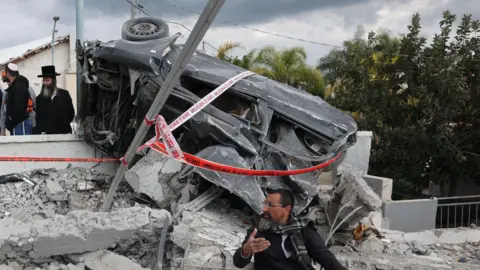
At least nine people have been killed and 27 injured in a missile strike on the Israeli city of Beit Shemesh, emergency services say.
The attack comes as Iran launched strikes across the Middle East in response to a massive and ongoing attack against it by the US and Israel.
One person has been killed in Abu Dhabi, capital of the United Arab Emirates, and and a death has also been reported in Kuwait. Dozens more people have been injured in strikes across the region.
Thousands of flights have been grounded to and from the region, in one of the most serious disruptions to global travel since the Covid-19 pandemic.
Across the Gulf, Iran has used ballistic missiles and drones to launch large-scale attacks on US allies and assets, after Iran’s supreme leader was killed in the ongoing US-Israel air offensive launched on Saturday morning.
In a post on X, the Israel Defense Forces accused Iran of directly firing missiles toward Beit Shemesh, west of Jerusalem, “killing innocent civilians”. Officials say a building where people were sheltering from the air raids was hit.
Dozens of rescuers were at the scene of the attack searching for people feared to be under the rubble.
Magen David Adom paramedic Dror Eini said: “We saw destroyed homes, flames and smoke rising from residential buildings, wrecked cars, and significant chaos at the scene.
Qatar, Bahrain, Jordan and Kuwait – all home to US military bases – said they had intercepted missiles fired towards them, but falling debris appeared to have caused widespread damage.
Kuwait’s Health Ministry said one person had been killed and 32 others – all of them foreigners – had been injured in strikes since Saturday.
Authorities in Abu Dhabi confirmed a drone targeting Zayed International Airport (AUH) was intercepted, leading to “falling debris” killing one person and injuring seven.
Dubai International Airport (DXB) – the world’s busiest by passenger traffic – was damaged in an “incident” that injured four staff, according to authorities, who did not give further details.
“I probably saw about 15 missiles being launched from behind my house yesterday,” Dubai resident Becky Williams told the BBC, referring to missiles fired by UAE authorities aimed at intercepting incoming Iranian projectiles. “You can hear the interceptions happening in the air.”
But she added that she and her family were remaining calm and trusted the UAE military to defend its airspace, saying she believed it would “all blow over soon”.
On the Palm Jumeirah, Dubai’s luxury man-made archipelago, the five-star Fairmont The Palm hotel was struck by a large explosion on Saturday afternoon. Video verified by the BBC shows a fire raging as black smoke rises into the sky.
Authorities also confirmed debris from an intercepted drone had caused a “minor fire” on the outer facade of the five-star Burj Al Arab hotel.
Also in Dubai, debris from an “aerial interception” caused a fire in a berth at the Jebel Ali deep sea port – the world’s ninth busiest.
Another 34-year-old Dubai resident said: “What we’ve lived through over the past 24 hours is a fraction of what others have been living through in areas of conflict so it puts things in perspective”.
In Bahrain, the interior ministry said the airport was damaged after being targeted by a drone. There were unconfirmed reports of continuing attacks on Sunday morning.
On Saturday, Iran’s Islamic Revolutionary Guard Corps (IRGC) said they had struck the headquarters of the US Navy’s Fifth Fleet, located in Bahrain’s capital Manama. Huge plumes of black smoke were seen rising from an area near the base.
Meanwhile, Oman’s state news agency reported Duqm commercial port was targeted by two drones, injuring one worker. Oman has been a key mediator in the US-Iran talks for years and had so far been spared Iranian attacks.
In a press conference overnight, Qatari officials said Iran had launched 65 missiles and 12 drones on Saturday – most of them were intercepted, but there has been some damage and eight people were injured by the fallout.
The Gulf states had made efforts to ease tensions with Iran in recent years,. They have worked hard to mediate a diplomatic solution to the crisis and have refused to let the US launch attacks from its bases in their countries.
But that wasn’t enough to prevent direct military strikes on their territory. And now with the violent death of Iran’s supreme leader, the future looks uncertain not only for Iran, but for the region.
By BBC News
Email your news TIPS to Editor@Kahawatungu.com — this is our only official communication channel
