

Online CPR Certification That Covers Real-Life Emergency Scenarios

Online CPR Certification That Covers Real-Life Emergency Scenarios
Cardiopulmonary Resuscitation (CPR) is a swift and decisive effort, a life-saving technique that revives the victim’s breathing and circulation in cardiac crisis. Nowadays, online CPR programs are integrated with immersive classes and advanced technologies, such as Virtual Reality (VR) and simulators. It delivers practical training experiences that enhance emergency response capabilities remotely. In 2024, 86% learners advocated the use of Virtual Reality techniques to others whose studies were carried out by the National Institutes of Health. These different attributes of online CPR certification make it widely accepted due to flexibility, easy accessibility, and skill-building confidence.
Discover the main attributes of quality online CPR training through this blog, including technological advancements, challenges, and the benefits of scenario-based online CPR training.
Importance of Scenario-Based CPR Training
Learners’ involvement in realistic emergency scenarios shows that scenario-based CPR training enhances confidence and retention of skills. Lifelike situations can connect you to traditional learning to real-world applications, promoting quick, accurate reactions and strengthening muscle memory.
Simulated scenario training was adopted by multiple university-led studies in the U.S., demonstrating CPR competence, subject expertise, and the ability to perform confidently. The National Institutes of Health conducted a study on emergency management for strokes and myocardial infarction in 2024 with the help of the Emergency Scenario-Based Training Curriculum Development. The study revealed that learners improved in symptom assessment, CPR performance, and the use of Automated External Defibrillators or AED.
Learners also learn from scenarios with cultural and situational contexts, making training relevant and meaningful for them due to its inclusivity.
Features of Quality Online CPR Certification Programs
Quality online CPR certification programs provide comprehensive, credible, and convenient training that prepares individuals to respond effectively in emergencies. Outlined below are key points highlighting their benefits and features:
Accreditation and Medical Authorities Recognition
Endorsement by respected organizations validates that the course follows regulated standards and provides credentials that are legitimate for career advancement and legal purposes.
Adult, Child, and Infant CPR techniques, AED use, and Choking First-Aid
The curriculum offers in-depth coverage of CPR for all age groups, proper AED use, and choking relief, ensuring learners are prepared for a wide range of emergencies.
Virtual Reality (VR) and Video Simulations Replicate Real Crisis
Mimicking real-life emergencies must be integrated through VS and VR in training as they enhance engagement, skill retention, and confidence by allowing realistic practice in a safe, virtual setting.
Flexibility and Convenience Advantages
Online training adapts to your schedule, and courses are available 24/7 on multiple devices, offering instant certification and eliminating travel hassles.
Practical Skill Verification in Virtual CPR Courses
The cutting-edge technology, coupled with hands-on practice in virtual CPR programs, develops the skills and confidence in learners for effective emergency response. Below are a few key findings to support this:
Blended Mode CPR Training
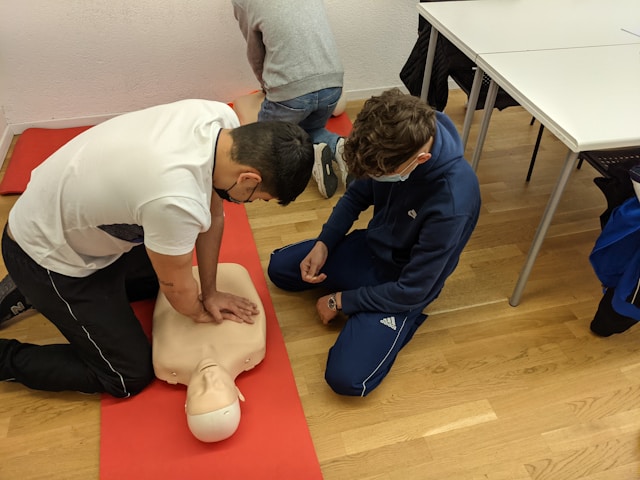
Blended learning models integrate online CPR education with physical skills testing in a live setting. Learners first complete an interactive online module session, then attend practical sessions for physical practice techniques.
The Critical Role of Practical Demonstration in Certification
Practical demonstration is vital to meet CPR certification requirements, whereas hands-on practice verifies that learners can correctly perform compressions, breaths, and AED usage. This builds confidence and muscle memory while confirming competence beyond theoretical knowledge for official certification.
Examples of Successful Hybrid Certification and Skill Validation Methods
Successful hybrid certification programs use various skill validation methods. Candidates may receive live virtual coaching, submit videos demonstrating their abilities, and complete in-person testing at local centers. These approaches ensure both convenience and thorough competency checks.
Technological Innovations Enhancing Online CPR Training
The advent of new technologies has made CPR training more interactive and accessible remotely, and learners develop practical skills and collaborate effectively in real emergencies. The following are the major highlights, achievements, and groundbreaking progress shaping the field:
Live Video Instructor Assessment
Instructors can assess practical skills remotely, providing instant guidance and feedback through real-time video methods. Certification becomes more accessible, accurate, and convenient through this approach, where instructors remotely evaluate practical skills and correct errors, enabling learners to earn certification without attending in person.
Scenario-Based Remote Practice with Feedback and Coaching
Learners can participate in interactive, simulation-style CPR drills remotely, practicing multiple times outside a physical classroom. Automated and instructor-led feedback guides skill improvement by helping to retain knowledge and become calm first responders.
Simulation Technologies for Team Coordination and Communication
Learners practice in an advanced simulated setting in a team and enhance inter-professional collaboration among them. Integration of effective role management and adaptable communication skills enhances response speed and effectiveness during cardiac emergencies.
VR and Online Simulation Influencing Online CPR Training
CPR training online is revolutionized by Virtual Reality (VR), and online simulations create engaging, flexible, and effective learning environments. The chief benefits include:
- Experience realistic, high-pressure CPR scenarios to develop response skills under high-stress, lifelike scenarios.
- Receive instant feedback to correct techniques quickly and improve performance.
- Repeat CPR practice to reinforce skills without time or location restrictions.
- Train in real-world emergencies under stress and pressure in a bound virtual setup for practicing to remain calm.
- Access courses globally, anytime, for maximum flexibility.
- Cost savings as compared to classroom training, as expenses are reduced on equipment, instructors, and commute.
VR and simulation tools have proven to be powerful resources for improving CPR skills, enhancing skill retention, and strengthening learner confidence.
Addressing Challenges in Online CPR Certification
Online CPR certification gives access to innovations that also challenge. The challenges listed here highlight important issues often encountered.
- Limitations in training access due to technological and connectivity disadvantages in rural areas
- Overcoming Preferences for Face-to-Face Interaction
- The role of community context in choosing training methods ensures accessibility and relevance for diverse populations.
- Barriers of High Equipment Cost to Technology Access
- Limited Human Interaction and Instructor Support
- Motion Sickness and Physical Discomfort
- Learning Curve and Technical Issues
These points make it evident that the key challenges and strategic responses are in making online CPR certification more accessible and impactful.
Learn Life-Saving CPR Skills Online Fast and Easy
Scenario-based CPR online certification helps you gain vital, life-saving proficiency exactly when timing is critical. Quality CPR instruction integrates official accreditation, interactive VR experiences, and in-person hands-on evaluations for accuracy in life-saving skills. Flexible delivery methods overcome access barriers, and continuous feedback refines your skills. Such innovative training builds confidence and prepares you to handle a range of emergencies. Enroll now for an online CPR certification to become an officially certified CPR rescuer.
References:
- https://pmc.ncbi.nlm.nih.gov/articles/PMC11096216/
- https://www.northwestcareercollege.edu/blog/can-virtual-reality-technology-be-used-to-enhanced-cpr-training/
- https://lifework.edu/virtual-cpr-first-aid-aed-training

