


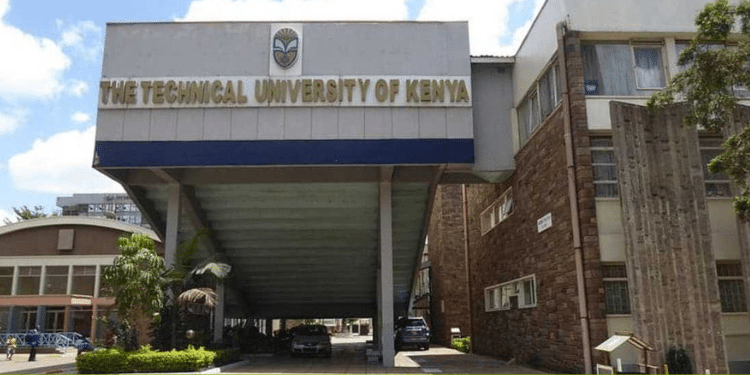
The Parliamentary Committee on Education and Administration declared Technical University of Kenya (TUK) financially insolvent — and directed government auditors to immediately investigate its financial management within three months.
This is as it holds talks with the Ministry of Education on how to handle the TUK crisis that threatens to completely stall all activities at the institution.
The financial rot at the is now under the spotlight, as both past and current administrators faced tough questions over how the institution sank into billions in debt.
The committee was stunned to learn that TUK staff including lecturers have not been paid their full salaries since 2013, the year the institution was awarded full university status and a charter.
TUK Deputy Vice Chancellor Benedict Mutua said since 2013 no TUK employee has received a full salary.
He cited over-employment as the primary reason for the mess.
TUK has hired far more staff than it needs – and the financial strain has made it impossible to meet salary obligations.
“Our biggest challenge is having too many staff. The government gives us Sh63 million monthly, but we need Sh270 million to cover salaries,” Mutua added.
The university has also failed to remit employee deductions for years.
More than Sh5 billion in pension funds cannot be accounted for and overall debts have ballooned beyond Sh12 billion.
Former TUK Deputy Vice Chancellor Francis Oduor said he could not remember the last time they remitted deductions.
“To be honest, we haven’t paid any since the university became a fully chartered institution.”
Meanwhile, the government is yet to disburse Sh33 billion to the National Government Constituency Development Fund (NG-CDF), sparking concern among lawmakers.
This follows the release of Sh7 billion to the NG-CDF board on Wednesday, after Members of Parliament raised alarm over delayed disbursements that have hampered development activities at the constituency level.
Appearing before the National Assembly, Treasury Cabinet Secretary John Mbadi defended the government’s fiscal position, attributing the delays to liquidity constraints experienced in the first quarter of the year. He cited competing statutory obligations, including debt repayments and pressures from the Gen Z movement, which he said had strained the government’s fiscal headroom.
“The months of January, March, and April are particularly difficult for the National Treasury and the economy at large,” Mbadi told MPs.
“These are months we must prioritize payments such as school capitation for first term learning.”
He assured MPs that any delay in NG-CDF disbursements under his tenure was not intentional, but rather a result of the overwhelming pressure to meet critical obligations.
“At times, you have to balance between paying debts and supporting development. If debts are not paid, there will be no economy,” he added.
Mbadi further revealed that the Treasury had defaulted on NG-CDF remittances in January to meet pressing financial obligations, including a Ksh.10.6 billion loan repayment to China for the Standard Gauge Railway, and other commitments totalling Sh75 billion.
This was in addition to a salary wage bill of Sh80 billion.
“It’s not that the Treasury is unwilling to honour the commitments I make in this House. It’s about balancing priorities,” he said.
However, MPs expressed dissatisfaction with the CS’s explanations, citing repeated delays and unfulfilled promises. Bumula MP Wanami Wamboka, who raised the matter in Parliament, criticised Mbadi for failing to follow through on assurances made during previous meetings.
“A lot of what the Minister has said today, he already said in Naivasha,” Wamboka noted. “Hon. Mbadi, we respect you. But when you joined the Treasury as an expert, we expected that any commitment you give this House would be backed by certainty.”
“You’ve put our Speaker in an awkward position. What we expect from you today is a minimum disbursement of Sh21 billion.”
Email your news TIPS to Editor@Kahawatungu.com — this is our only official communication channel
