

Report says 5 tribes occupy 70% of all jobs in State corporations

Report says 5 tribes occupy 70% of all jobs in State corporations
Five of Kenya’s largest ethnic communities continue to dominate government employment opportunities.
A report says the communities hold more than more than 70 percent of all State corporations.
The report by the National Cohesion and Integration Commission (NCIC) reveals that the Kikuyu, Kalenjin, Luo, Luhya, and Kamba communities control majority of senior government jobs, leaving little room for representation among other 38 ethnic groups.
The commission warned that the growing ethnicity in public sector recruitment poses a serious threat to national unity and social cohesion.
The report was released Thursday as the term of the NCIC’s current commissioners comes to an end.
It raised alarm over the persistence of ethnic dominance in Kenya’s parastatals, painting a grim picture of inequality despite years of diversity reforms.
NCIC Commissioner Danvas Makori said the figures are shocking and need to be corrected.
“What is shocking is that eight communities out of 46 control almost 90% of the jobs,” he said.
According to the 2025 ethnic and diversity audit, the five communities, alongside the Kisii, Meru, and Mijikenda, occupy an overwhelming 88 percent of all positions in State corporations, leaving just 12 percent to be shared among 37 minority groups.
“Moi Teaching and Refferal Hospital is absolutely non-compliance by far…with 67%,” Makori added.
NCIC Chairperson Samuel Kobia said there is no equal distribution of opportunities.
“There has been a clear demonstration that we don’t have equitable distribution of opportunities.”
Several government institutions were also flagged for the imbalance.
The report cited political patronage as a key driver of the biased hiring patterns, revealing that the same eight communities control 86 percent of all CEO positions.
The Kikuyu, Kalenjin, Luo, and Luhya alone account for nearly two-thirds of top leadership roles.
The audit also exposed a glaring gender gap with 62 percent of employees in State corporations being men, while women hold just 22 percent of CEO positions, far below the constitutional two-thirds gender requirement.
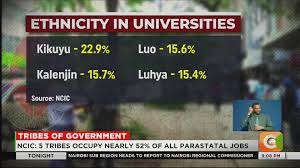
The NCIC report revealed that the same five dominant communities control 85.7 percent of all university jobs, leaving the remaining 38 ethnic groups to share less than 15 percent of opportunities.
The Kikuyu community leads with 22.9 percent representation, followed by the Kalenjin at 15.7 percent, Luo at 15.6 percent, and Luhya at 15.4 percent.
“Where there is no compliance, we launch ethnic audit…even in counties,” noted Kobia.
The commission warned that the ethnic favouritism and gender imbalance in public employment threaten to erode national unity and social cohesion if not urgently addressed.
There is a push for more other communities to be absorbed into the system

