


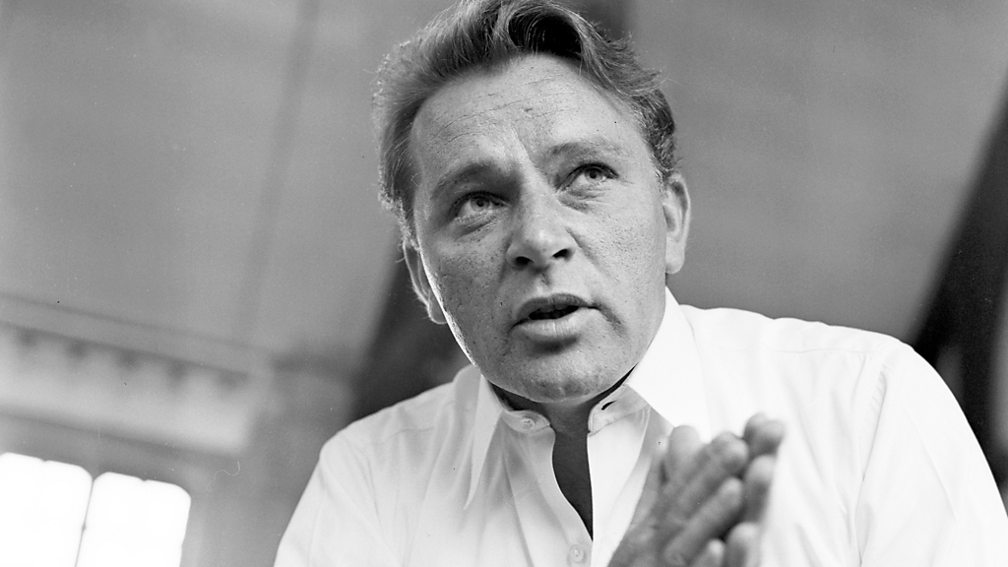
Richard Burton, born Richard Walter Jenkins Jr. on November 10, 1925, in the small Welsh mining village of Pontrhydyfen, Glamorgan, was one of the most charismatic and versatile actors of the 20th century.
Raised in a large, impoverished Welsh-speaking family, he was the twelfth of thirteen children born to coal miner Richard Walter Jenkins Sr. and homemaker Edith Maude Jenkins.
Tragedy struck early when his mother died just weeks after giving birth to his youngest sibling, leaving the family fractured and forcing the children to be raised by older relatives.
Burton’s life was marked by a meteoric rise from humble beginnings to international stardom, fueled by his raw talent, booming baritone voice, and a magnetic presence that captivated audiences on stage and screen.
Yet, his personal life was equally tumultuous, defined by alcoholism, multiple marriages, including two to the iconic Elizabeth Taylor, and a relentless pursuit of artistic excellence amid self-destructive tendencies.
Burton passed away on August 5, 1984, in Geneva, Switzerland, from a cerebral hemorrhage at the age of 58.
Siblings
As the twelfth child, Burton grew up amid the echoes of eleven surviving brothers and sisters, though two infant daughters named Margaret Hannah had tragically passed away young.
His eldest sister, Cecilia Jenkins, affectionately called “Cis”, became a surrogate mother to him after their own mother’s death, raising Burton in her home alongside her own daughters, niece Rhiannon and her sister Marian, who treated him like a cherished little brother.
Cecilia’s husband, Elfed, provided a stable household that offered Burton his first taste of security amid the instability caused by their father’s alcoholism and gambling.
Among his brothers, Ifor Jenkins and Thomas Henry Jenkins were part of the tight-knit group that navigated the Welsh valleys’ harsh realities, with Ifor often recalled in family lore as a steadfast presence.
Burton’s immediate younger brother, Graham Jenkins, born just months before their mother’s death on October 25, 1927, shared an especially close bond with him; Graham later chronicled their sibling connection in his 1988 memoir Richard Burton: My Brother, detailing how he even served as Richard’s stand-in on film sets, once joking about having to kiss Elizabeth Taylor in his stead.
Other siblings, including William, Owen, and several sisters whose names faded into family anecdotes, scattered after.
Career
Burton’s journey from a Welsh schoolboy to a global icon began under the wing of his Port Talbot schoolmaster, Philip Burton, who legally adopted him in 1943 and honed his prodigious talents in elocution and drama.
After a brief stint in the Royal Air Force during World War II, where he served as a navigator-trainee, Burton made his professional stage debut in 1943 in Emlyn Williams’s The Druid’s Rest.
Also Read: Jules Benchetrit Siblings: A Look at the Actor’s Family Tree
His breakthrough came in 1948 with a triumphant performance in Christopher Fry’s The Lady’s Not for Burning, which transferred to Broadway the following year and showcased his commanding stage presence.
Film beckoned soon after; his screen debut in 1949’s The Last Days of Dolwyn was followed by Hollywood’s embrace with roles in My Cousin Rachel (1952), where his brooding intensity opposite Olivia de Havilland hinted at stardom, and the biblical epic The Robe (1953), which catapulted him to leading-man status as a tormented Roman centurion.
The 1950s solidified his reputation as a Shakespearean virtuoso, with electrifying turns as Hamlet and Coriolanus at the Stratford Festival in 1951, earning raves from critics who dubbed him Laurence Olivier’s natural successor.
Transitioning to the “angry young man” ethos of British New Wave cinema, he delivered a searing portrayal of Jimmy Porter in the 1959 adaptation of Look Back in Anger.
The 1960s marked his zenith, ignited by his off-screen romance with Elizabeth Taylor during the filming of Cleopatra (1963), which, despite production woes, grossed millions and spawned a string of collaborations like The V.I.P.s (1963), The Sandpiper (1965), and Who’s Afraid of Virginia Woolf? (1966), where their volatile chemistry electrified audiences.
Burton balanced these with gritty standalone triumphs, including the Cold War thriller The Spy Who Came in from the Cold (1965) and the WWII adventure Where Eagles Dare (1968).
Later decades saw him return to theater with a Tony-winning Camelot (1960) revival and introspective films like Equus (1977), though battles with alcohol led to erratic output, including voice work in 1984 (1984).
Accolades
Despite his towering talent, Burton’s career was defined by near-misses at the pinnacle of recognition, amassing a trove of honors that underscored his peerless artistry without the ultimate validation of an Oscar.
Nominated seven times for the Academy Award for Best Actor—for The Robe (1953), Becket (1964), The Spy Who Came in from the Cold (1965), Who’s Afraid of Virginia Woolf? (1966), Anne of the Thousand Days (1969), The Assassination of Trotsky (1973), and Equus (1977)—he remains one of Hollywood’s most nominated performers never to claim the statuette, a fact often attributed to his own ambivalence toward the industry.
Yet accolades flowed abundantly elsewhere: he secured two Tony Awards for Best Actor in a Musical, first for originating King Arthur in the 1960 Broadway production of Camelot and again for his 1980 revival of the same role.
Burton’s magnetic voice earned him a Grammy Award for Best Spoken Word Album in 1964 for The Richard Burton Poems of Dylan Thomas, a nod to his Welsh roots and literary prowess.
On the international front, he clinched two Golden Globe Awards for Best Actor in a Motion Picture Drama, for Anne of the Thousand Days (1969) and Equus (1977), while a BAFTA Award for Best British Actor followed for The Spy Who Came in from the Cold (1965).
An Emmy nomination came in 1978 for his guest spot on ExxonMobil Masterpiece Theatre.
Email your news TIPS to Editor@Kahawatungu.com — this is our only official communication channel
