


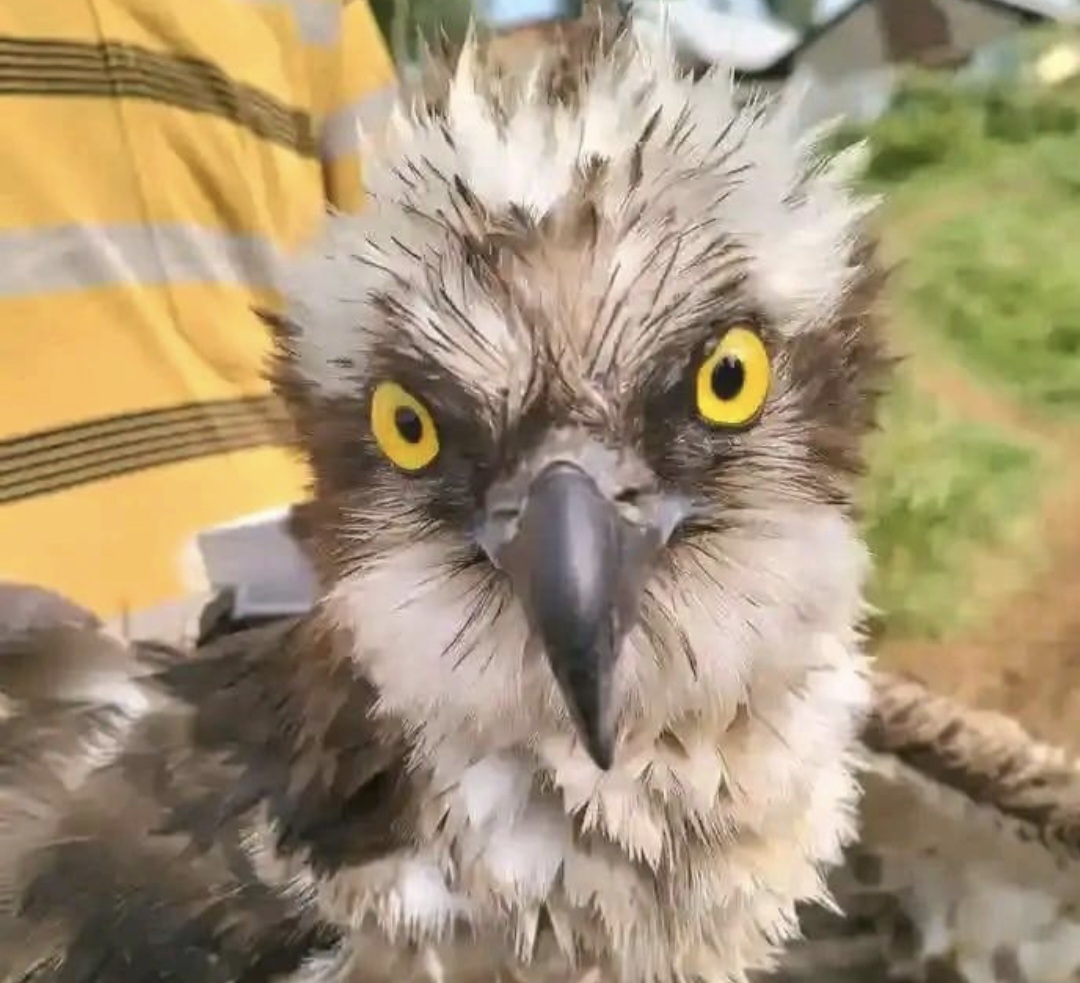
Residents of Ugingo Village in Siaya County were left astonished when an Osprey — a migratory bird of prey known for its long-distance journeys from Europe and Asia — made an unexpected stopover in their area after becoming entangled in a fishing net.
The striking bird, identifiable by a Russian tag on its left leg, was safely rescued on Friday morning by local fishermen who found it struggling near the shores of Lake Victoria.
The fishermen took the exhausted bird to the home of Mr. Joanes Oraro, drawing crowds of curious villagers. The incident was quickly reported to local authorities by Village Elder Eric Omuok.
Responding promptly, a team from the Kenya Wildlife Service (KWS), led by Deputy County Warden Byatt Shikanga, arrived on the scene to secure the Osprey and ensure its welfare.
Experts say the bird is likely part of a population that migrates annually from Russia and northern Europe to Africa, covering thousands of kilometers in search of warmer climates and abundant fishing grounds.
Under the supervision of Dr. Isaac Lekolool, Head of the KWS Veterinary Department, and Dr. Simon Thomsett, a renowned raptor specialist and rehabilitator, the bird was transferred to the Raptor Centre at Soysambu Conservancy for medical examination and rehabilitation.
The Osprey will be closely monitored and, once deemed fit, released back into the wild to continue its remarkable journey.
KWS commended the local community for their vigilance and cooperation, emphasizing the crucial role of public participation in wildlife conservation.
The agency also expressed gratitude to its partners at the National Museums of Kenya (NMK) and the Kenya Bird of Prey Trust (KBPT) for their continued support in conserving Kenya’s avian species.
“This incident reminds us of the incredible endurance and navigational skills of migratory birds,” said a KWS spokesperson. “It also highlights how interconnected our ecosystems are — from Russia to Kenya — and why conservation is a shared global responsibility.”
Members of the public are encouraged to report any injured or distressed wild animals to the Kenya Wildlife Service via the toll-free number 0800 597 000, WhatsApp 0726 610509, or by visiting the nearest KWS station.
Email your news TIPS to Editor@Kahawatungu.com — this is our only official communication channel
