

Ruto leaves for US for DRC-Rwanda peace deal

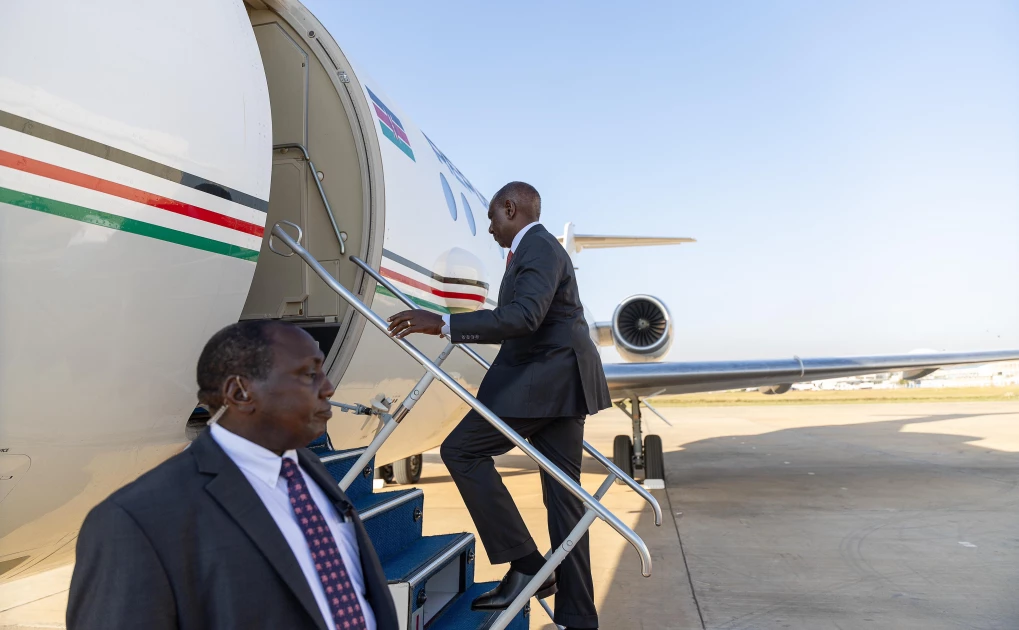
President William Ruto left for Washington, D.C., in the U.S.A Tuesday to join President Paul Kagame and President Félix Tshisekedi in witnessing the official signing of the DR-Rwanda Peace Agreement.
This, according to State House was at the invitation of President Donald J. Trump.
Officials said this is the most significant breakthrough in addressing decades of conflict in Eastern DRC.
Building on the Nairobi and Luanda Peace Processes as well as the joint EAC-SADC initiative, the Washington signing brings together all key parties and is expected to unlock pathways for disarmament, demobilisation, humanitarian access, and long-term stabilisation.
While in Washington, Ruto will participate in engagements aimed at advancing Kenya’s strategic interests in trade, investment, health cooperation, and security.
He will also witness the signing of the Kenya-U.S. Health Cooperation Framework, which shifts the 25-year partnership to a sustainable, government-led model aimed at advancing Universal Health Coverage and supporting a self-reliant health system by 2030.
In all scheduled engagements, according to State House, Ruto will endeavour to outline Kenya’s new economic transformation agenda towards a first-world economy, driven by human capital development, infrastructure expansion, agro-industrial growth, and expanded irrigation through extensive dam construction.
He will seek Public-Private Partnership (PPP) investment in these priority sectors, alongside enhanced energy security initiatives, to support the country’s long-term development aspirations.
The presidents of Democratic Republic of Congo and Rwanda will travel to Washington to sign a peace deal and meet with U.S. President Donald Trump.
This comes as the U.S. tries to broker peace in war-hit eastern Congo and attract Western mining investments to the region.
The Rwanda-backed M23 rebel group staged a lightning advance in eastern Congo this year, seizing the region’s two largest cities and raising fears of a wider war that could draw in more of Congo’s neighbours. The latest cycle of fighting has killed thousands of people and displaced hundreds of thousands more.
The meeting on December 4, 2025 is expected to build on a U.S.-brokered peace deal reached in June and signed by the two countries’ foreign ministers, and a Regional Economic Integration Framework agreed earlier this month.
The Trump administration has talked of facilitating billions of dollars of Western investment in a region rich in tantalum, gold, cobalt, copper, lithium and other minerals.
In September, Congo and Rwanda agreed to implement security measures outlined in the June deal by the end of the year.
These include operations to eliminate the threat from Congo-based armed group Democratic Forces for the Liberation of Rwanda (FDLR) and facilitate the withdrawal of Rwandan troops.
So far there has been no significant progress on the ground.
Rwanda denies backing M23, but a group of United Nations experts said in a July report that Rwanda exercises command and control over the rebels.
Qatar has hosted separate talks between Congo and M23, and this month the two sides signed a framework agreement for a peace deal, but many details have yet to be negotiated.
Tshisekedi told members of the Congolese diaspora in Serbia that he would go to Washington, according to a post on X published on Friday by his office.
But he also said Rwandan troops must withdraw from eastern Congo for there to be true regional economic integration.