

Ruto Meets New AFRICOM Commander General Dagvin Anderson

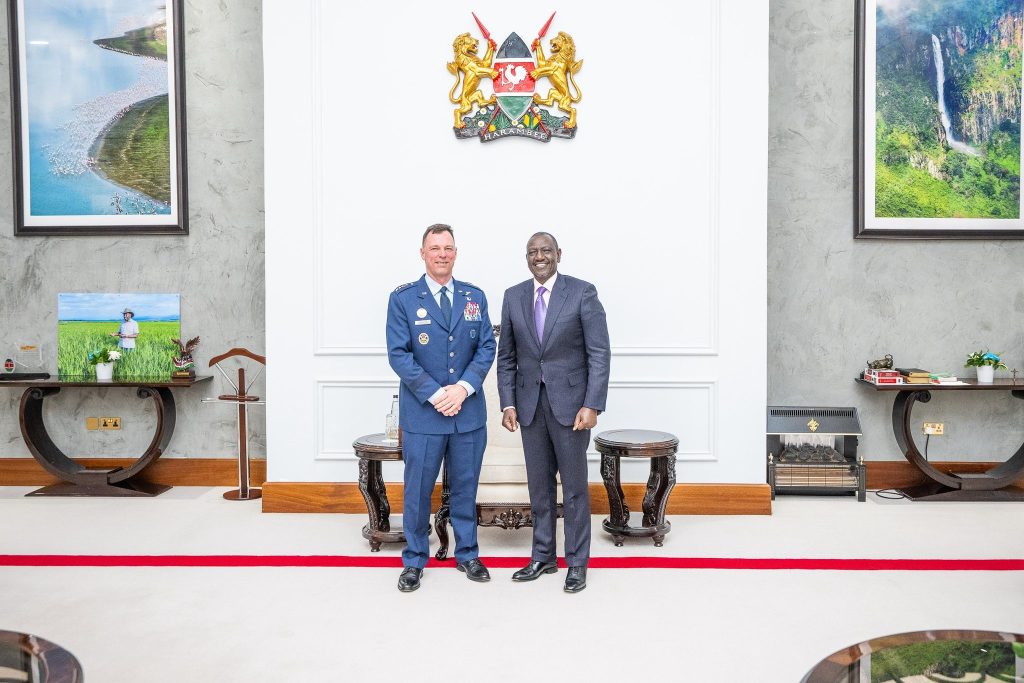
President William Ruto has met with the newly appointed United States Africa Command (AFRICOM) commander, General Dagvin R. M. Anderson, where they discussed strengthening peace and security efforts in the region.
Ruto said the talks focused on consolidating gains made in advancing regional stability and finding more collaborative and innovative ways to address emerging security challenges.
“We also reaffirmed our commitment to building successful partnerships that will safeguard peace and stability for the future,” he said.
He added that Kenya values its strong and enduring relationship with the United States, especially in promoting peace and security across the region.
Kenya is currently contributing troops to peacekeeping missions, including in the Democratic Republic of Congo.
General Anderson, confirmed by the U.S. Senate in August, becomes the first Air Force officer to lead AFRICOM, the command responsible for U.S. military operations across Africa. He succeeds Marine Corps General Michael E. Langley, who has served since 2022.
Before this appointment, Anderson served as Director for Joint Force Development on the Joint Staff and previously commanded Special Operations Command Africa (SOCAFRICA) from 2019 to 2021, giving him direct experience with African security challenges.
During his Senate confirmation, Anderson stressed the importance of keeping U.S. forces prepared to prevent and respond to conflicts, while also strengthening partnerships with African nations to counter terrorism and other threats.
His experience includes overseeing counterterrorism operations against groups like al-Shabaab, Boko Haram, and ISIS, while working with African governments to build local capacity. He also played a role in high-profile missions, including the rescue of an American hostage in Nigeria in 2020.
Anderson’s appointment is seen as a sign of continuity in U.S. military leadership in Africa and comes at a time of increasing security threats, including terrorism, cross-border crime, and competition from global powers such as China and Russia.