

Ruto nominates Supreme Court Judge Njoki Ndung’u for election to ICC

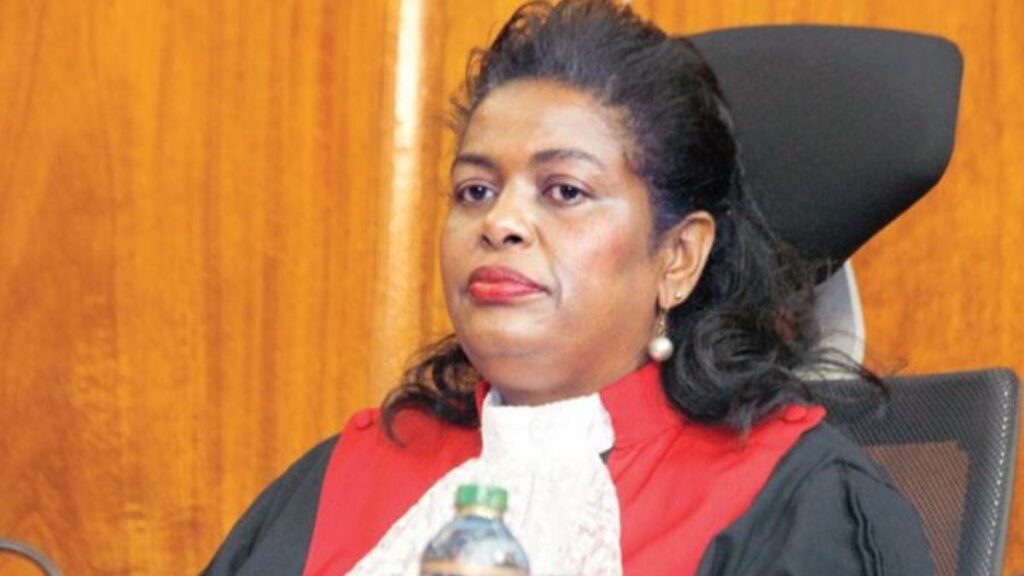
Kenya nominated Supreme Court Judge Njoki Ndung’u for election to the International Criminal Court (ICC), marking a pivotal moment for the country’s judicial sector.
If elected, Justice Ndung’u will be the second Kenyan to join the ICC bench after Judge Joyce Aluoch, who served in The Hague from 2009 to 2018.
If she leaves it means a replacement has to be found to fill her position at the Supreme Court.
This will need reorganization of the court in general.
According to the ICC nominations, Justice Ndung’u joins six other candidates worldwide. These comprise Evelyn Ankumah (Ghana), Guénaël Mettraux (Switzerland), Rosette Muzigo-Morrison (Uganda), Deo John Nangela (Tanzania), Diana Carolina Olarte Bacares (Colombia) and Yoshimitsu Yamauchi (Japan).
The ICC court is set to conduct the elections in December in New York during the 25th Assembly of State Parties.
Under the ICC rules established at The Hague, candidates are nominated based on two criteria List A, which comprises judges who are competent in criminal law and criminal procedure, and List B, which comprises judges with expertise in international law.
Based on her criminal law portfolio, Justice Ndung’u is listed in Category A.
“Judge Njoki Susanna Ndungu is the candidate of the Republic of Kenya for election of a Judge of the International Criminal Court,” read part of Ndung’u’s statement of qualification as read on ICC’s website.
“She is nominated for inclusion in List A, relating to candidates with the qualifications in criminal law and procedure, and the necessary relevant experience, whether as judge, prosecutor, advocate, or in other similar capacity, in criminal proceedings.”
Justice Ndung’u has authored and participated in landmark judicial orders that have significantly shaped the country’s policies.
She has contributed to the development of a victim-centred and constitutionally grounded criminal justice framework in Kenya.
She also served as State Counsel in the Office of the Attorney General, where she advised on and prosecuted serious criminal offences, including capital offences.
In 2003, Justice Ndung’u served as a nominated Member of Parliament for four years and also a Member of Parliament for the Pan-African (PAP) between 2004 and 2007.
During this time, she moved several bills, including the Sexual Offences Bill 2006, Motion on Maternity Benefits, Amendments on Maternity and Paternity Rights in Employment Act 2007 and amendments to the Refugee Bill.
In 2009, she was part of a Committee of Experts on the Constitution Review in Kenya, which was mandated to redesign the constitutional framework to enhance democracy and align it with the Rome Statute.
In 2011, Justice Ndung’u ascended to the Supreme Court, the Apex court that has final appellate jurisdiction over all cases, including criminal matters.

