

Ruto signs Tax Laws Amendment Bill, retains 8pc VAT on fuel for 90 Days

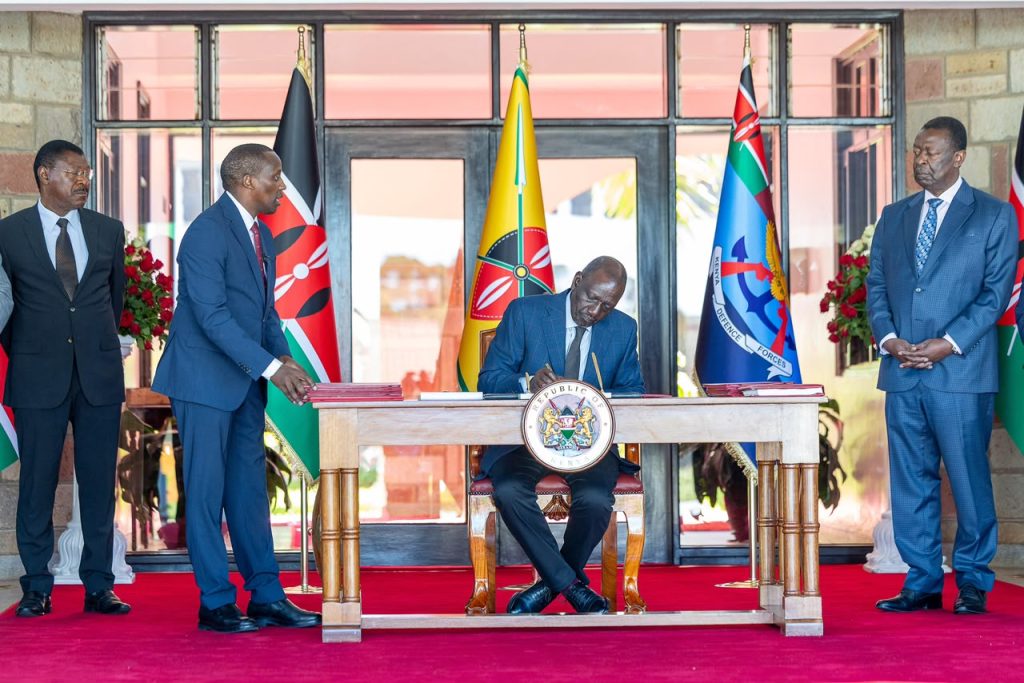
President William Ruto signed the Tax Laws Amendment Bill, 2026, into law, retaining the reduced eight per cent Value Added Tax (VAT) on petroleum products for 90 days to cushion Kenyans against the economic effects of the crisis in the Middle East.
Ruto signed the Bill on Friday, October 16, at the Eldoret State Lodge, formalising the tax relief measure introduced in the National Assembly by Kikuyu MP Kimani Ichung’wah.
The new law amends Section 5 of the Value Added Tax Act, maintaining VAT on petroleum products at eight per cent, down from the standard rate of 16 per cent.
National Assembly Clerk Samuel Njoroge said the measure would remain in force for 90 days, with a provision allowing a further 90-day extension if the situation in the Middle East fails to improve.
“The bill sustains the eight per cent VAT application on petroleum products to ensure that the effect of the crisis that has been seen in the Middle East does not affect the Kenyan economy,” Njoroge said.
He added that the reduced rate could be extended for another 90 days if the crisis persists.
The measure is intended to cushion the Kenyan economy against external shocks that could push up fuel prices, increase transport costs and raise the cost of goods and services.
Fuel prices have a direct bearing on the cost of living because petroleum products are essential to transport, manufacturing, agriculture and the distribution of goods across the country.
The legislation also introduces changes to the taxation of imported tiles and ceramic products.
Under the new law, the basis for taxing tiles shifts from weight in kilograms to area in square metres, with the applicable rate reduced to KSh400 per square metre.
The tax on ceramic instruments has also been reduced from Sh50 to Sh30 per kilogram.
The changes are expected to affect the cost structure of businesses dealing in the products, although the extent to which consumers benefit will depend on how traders and suppliers reflect the lower tax burden in their prices.
The temporary fuel VAT measure comes amid concerns over the potential impact of instability in the Middle East on international energy markets and the cost of petroleum imports.
By retaining the reduced rate for an initial 90-day period, the government is seeking to limit the transmission of external price pressures into the domestic economy while retaining the option of extending the relief if conditions remain unfavourable.
The extension, however, will depend on the prevailing circumstances and the applicable legal provisions.
Ruto also assented to the Kenya Revenue Authority (Amendment) Bill, which provides for the Kenya Ports Authority (KPA) Managing Director to sit on the KRA Board.
“It recognizes the symbiotic relationship between the management of the Kenya Ports Authority and revenue collection. It therefore brings the Managing Director of KPA into the board of the Kenya Revenue Authority so that decisions made in KRA are also felt in KPA.
The legislation also makes the Attorney-General, the Principal Secretary for Finance and the KRA Commissioners substantive members of the KRA Board, rather than serving as ex-officio members as previously provided.
The KRA law paves the way for reforms aimed at strengthening the tax agency’s operations, improving revenue collection and reducing pressure for further tax increases.
The legislation, sponsored by Ichung’wah, introduces changes to KRA’s board composition, funding arrangements and performance incentives.
A key provision guarantees KRA funding equivalent to at least two per cent of the revenue estimated to be collected by the Authority in each financial year.
The law also provides for an incentive under which KRA will receive three per cent of revenue collected in any quarter above the amount estimated for that period.
The measures are intended to improve the agency’s operational capacity and motivate stronger revenue collection without necessarily imposing additional taxes on Kenyans.
Under the new law, all members of the KRA board will serve as substantive members, eliminating ex officio membership.
The legislation also provides for the Managing Director of the Kenya Ports Authority (KPA) to sit on the KRA board, recognising the close relationship between the operations of the two agencies.
The inclusion is expected to strengthen coordination between the tax authority and the ports agency, particularly in areas where their responsibilities intersect.
The law further updates the First Schedule, which lists written laws relating to revenue, by removing repealed legislation and replacing outdated references with applicable laws.
Among the changes is the replacement of the Government Land Act with the Land Act. The Retirement Benefits Act, the Tobacco Control Act and the Tea Act have also been added to the schedule.
The Bill was published on May 19, 2026, and read for the First Time in the National Assembly on May 23. It subsequently underwent the Second Reading on June 17 before being considered by the Committee of the Whole House.
Members of Parliament passed it with amendments on October 7, 2026, before it was presented to the President for assent.
The reforms come as the government seeks to strengthen domestic revenue mobilisation amid pressure to finance public expenditure while addressing concerns over the cost of living and the tax burden on households and businesses.
The government’s position is that improved efficiency at KRA could enable the State to raise more revenue through better tax administration and compliance rather than relying on higher tax rates.
The effectiveness of the new funding framework and performance incentives will depend on implementation, accountability and KRA’s ability to translate additional resources into measurable improvements in revenue collection.
The legislation is therefore expected to shift greater emphasis towards strengthening the tax administration system as a means of supporting government revenue targets without introducing further tax increases.

