

Ruto Signs Three Key Bills into Law

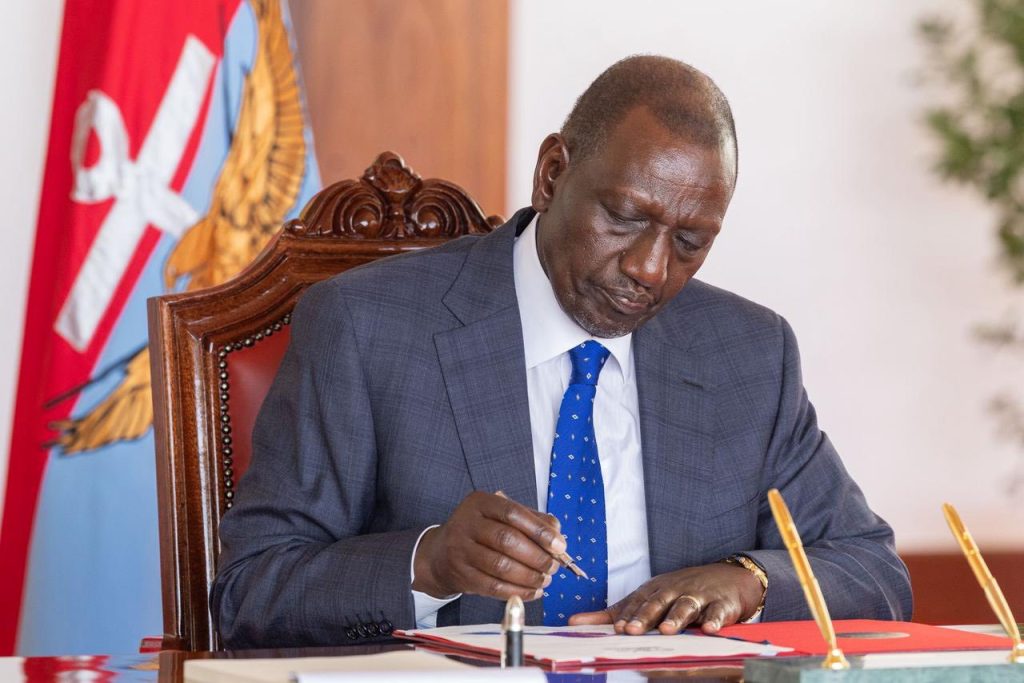
President William Ruto has signed three parliamentary bills into law, including the Meteorology Bill, the Miscellaneous Fees and Levies (Amendment) Bill, 2026, and the Coffee Bill, strengthening Kenya’s regulatory frameworks in key sectors.
The Meteorology Bill, sponsored by Senate Majority Leader Senator Aaron Cheruiyot, establishes a legal framework to regulate meteorological services in Kenya. The law will ensure that Kenya complies with international standards under the Chicago Convention on International Civil Aviation and the Intergovernmental Oceanographic Commission of UNESCO.
Under the new law, the Director of the Kenya Meteorological Department will temporarily assume the role of Director-General for up to six months or until a permanent appointment is made. Existing staff of the Kenya Meteorological Department will become employees of the newly established Authority, with the option, within one year, to either continue working for the Authority or be redeployed within the civil service. Similarly, staff at the Institute for Meteorological Training and Research will join the Authority under the Meteorology Training and Research Directorate.
President Ruto also assented to the Miscellaneous Fees and Levies (Amendment) Bill, 2026, sponsored by Majority Leader Kimani Ichungwa. The law expands the scope of the Railway Development Levy beyond the Standard Gauge Railway (SGR), supporting the government’s aim of mobilizing funds for railway infrastructure.
The Bill creates the Railway Development Levy Fund, which will receive all proceeds from the levy. The Fund will support the development, safety, and economic regulation of railway infrastructure and finance the rehabilitation of existing facilities. The Fund will be managed by the Railway Development Fund Board, which will oversee the allocation of funds, approve programmes and budgets, and ensure efficient use of resources.
The law allows up to 90 percent of the Fund to be used to secure additional financing for railway projects, attracting further investment. Administrative costs are capped at 0.5 percent of the Fund. The Cabinet Secretary for Finance is empowered to issue regulations for managing the Fund, including allocating resources and leveraging the Fund for development financing.
The third law, the Coffee Bill (Senate Bill No. 10 of 2023), sponsored by MP James Kamau Murango, provides for the development and regulation of Kenya’s coffee industry. The Bill transfers regulatory and commercial responsibilities from the Agriculture and Food Authority (AFA) to the Coffee Board of Kenya. It also establishes the Coffee Research and Training Institute, taking over research functions previously handled by the Coffee Research Institute under KALRO.
The Coffee Board of Kenya will oversee the sector, issuing permits and licences, registering coffee dealers, and implementing policies and funding strategies. It will also collect industry data, conduct market surveys, promote Kenyan coffee locally and internationally, and support the Kenya Coffee Mark of Origin.