


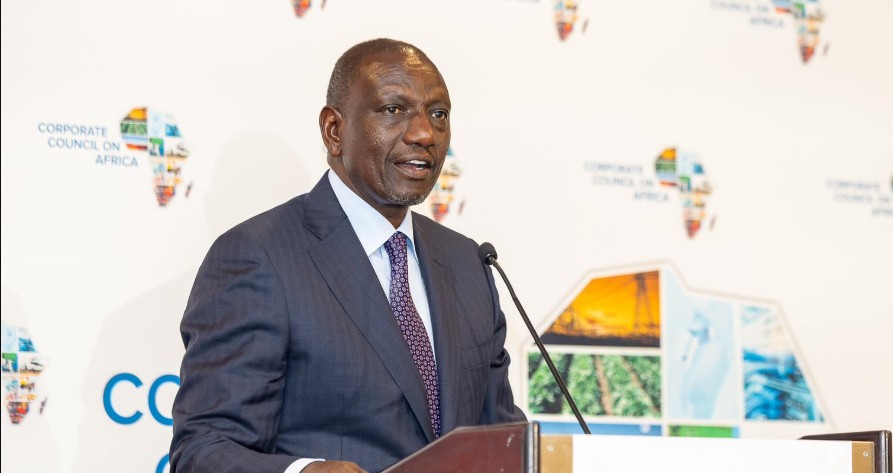
President William Ruto challenged nations to take ownership of their health systems, warning that reliance on external donors weakens resilience.
He said the recent withdrawal of some external funds exposed national vulnerabilities and offered an important lesson for strengthening local health systems.
He said Kenya is steadily cutting dependence on external donors by anchoring its health system on local resources and community-led solutions
“In Kenya, we are deliberately building a system that is less dependent on external
aid and more firmly grounded in domestic solutions and community leadership,” he pointed out.
Ruto spoke during a side event on social participation in health equity and resilient societies co-hosted by Slovenia and the World Health Organisation at the 80th session of the United Nations General Assembly in New York on Monday.
To take control of Kenya’s health systems, the President explained that the country is advancing universal health coverage through reforms anchored in law.
He said four new laws on social health insurance have been enacted to guarantee every Kenyan access to essential medical care.
“We recently enacted four transformative laws to drive universal health coverage reforms, including the rollout of social health insurance that guarantees every Kenyan, regardless of background or status, access to essential medical services,” he said.
Ruto pointed out that Kenya has deployed more than 100,000 community health promoters equipped with medicines, smart devices, and stipends co-financed by National and County governments to deliver services at the last mile.
He said this move has ensured that even the most remote households access basic healthcare.
“We have empowered community health promoters with medicines, smart devices, and stipends to ensure last-mile delivery of essential services,” he said.
Saying participatory budgeting has been strengthened at both national and county levels through digital platforms, the President explained that this had enabled communities to track health resources transparently.
On Primary HealthCare, he noted that it is government policy to reinforce and strengthen community networks so that residents can actively shape planning, implementation, and oversight.
Ruto said health literacy programmes are being expanded to equip citizens with the knowledge to make informed decisions and engage meaningfully in governance.
He also said the government is promoting collaboration across sectors by linking health with education, agriculture, and social protection.
“Together, these strategies are strengthening trust, deepening accountability, and building a health system that truly serves the people,” he said.
The President said health reforms are already making an impact. He said pregnant mothers now have better access to ante-natal care while children are receiving life-saving vaccines, and families are being supported in addressing the rising burden of non-communicable diseases.
Ruto explained that these reforms demonstrate that health equity is inseparable from social justice and sustainable development.
He called on the global community to embed social participation indicators in health frameworks and share innovations that empower citizens to shape their destinies.
He said investment must go beyond medicines and infrastructure to include the democratic right of people to participate in decisions about their health.
“The health of nations depends not only on the strengths of their hospitals, but also on the strength of citizen voices. Kenya aspires to a future where no child is left behind, no community is unheard, and no citizen is denied their right to health,” he said.
[23/09, 16:48] Cyrus Ombati Star: Ruto says global climate financing system unfairly burdening African economies
President William Ruto called out the global climate financing system for unfairly burdening African economies.
He said it was unacceptable for African nations to be expected to raise 60 per cent of climate finance domestically while contributing the least to the climate crisis.
He explained that this is a heavy strain on many countries, especially those already battling high living costs and repeated climate shocks.
“We must not ignore the risks of overtaxing small, vulnerable economies already battling high costs of living and climate shocks. For many of our citizens, the social contract does not allow this to be the ultimate solution,” he said.
Speaking at the High-Level Solutions Dialogue on Climate Finance on the sidelines of the 80th UN General Assembly, President Ruto asked the global community to adopt innovative solutions to address the climate financing challenge.
He pointed out that the solution lies in stopping illicit financial flows, securing a fair global tax system, reducing sovereign debt pressures, and unlocking major investment.
“Africa loses nearly $90 billion every year through leakages that rob us of the very resources we need for climate action. This is why our continent is strongly advocating a fairer global tax system through the proposed UN Tax Convention,” he said.
He explained that what should drive the financing agenda forward is easing debt, mobilising domestic resources, unlocking private finance, scaling international public finance, and anchoring these in country-led strategies.
Saying that Africa is determined to turn climate solutions into engines of growth, he explained that this is positioning the continent as a global hub for green industry that delivers both development and climate action.
“Our greatest opportunity lies in growing and diversifying our economies through climate-positive growth, turning the very solutions to climate change into drivers of development,” he said.
He said Kenya was among four countries that sponsored the Independent Expert Review on Debt, Nature and Climate, adding that the ideas and knowledge already exist; what is missing is action.
He appealed to investors to look beyond outdated stereotypes, saying Africa has vast potential in mineral processing, value addition in agriculture, and alternative fuels.
“Too often, perceptions of risk overshadow reality, yet Africa offers some of the most exciting opportunities for green growth in the world,” Ruto explained.
He cited initiatives such as the Africa Green Industrialisation Initiative (AGII) and the Accelerated Partnership for Renewables in Africa (APRA) as evidence of the continent’s readiness.
“We are reforming our policies, mobilising domestic capital, and building strong project pipelines to attract global investors,” he said.
Pointing out that Africa is showing the way, the President said eight leading African financial institutions had signed a cooperation framework to unlock $100 billion in investment.
He, however, warned that success depends on global partnership.
“We are doing our part but, to succeed, we need global offtake agreements, market access, and foreign investment at scale,” he said.
Ruto urged the global community to act swiftly to reverse the effects of climate change, warning that time is running out.
“Climate change is a global existential threat. What we do, or fail to do, will shape the destiny of humanity. Let us act boldly and together, and match words with deeds if we are to turn the challenge of climate change into the greatest opportunity of our time,” he said.
Email your news TIPS to Editor@Kahawatungu.com — this is our only official communication channel
