


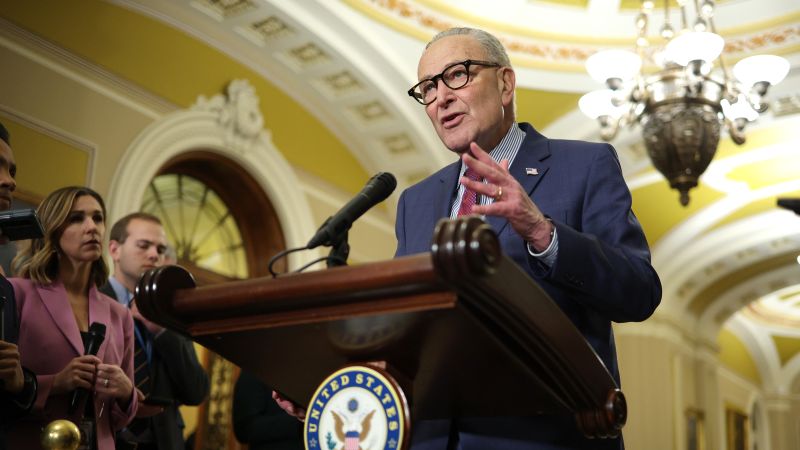
Democrats will block a government spending bill following the fatal shooting of a Minneapolis man by a Border Patrol agent, the Senate minority leader said Saturday – dramatically increasing the chances of a partial government shutdown next week.
“Democrats sought common sense reforms in the Department of Homeland Security spending bill, but because of Republicans’ refusal to stand up to President Trump, the DHS bill is woefully inadequate to rein in the abuses of ICE. I will vote no,” Sen. Chuck Schumer of New York posted on X.
“Senate Democrats will not provide the votes to proceed to the appropriations bill if the DHS funding bill is included,” he added.
The Senate faces a Friday midnight deadline to pass the spending measure, which includes funding for the Department of Homeland Security and avoids a partial government shutdown. The funding package will need 60 votes to advance.
With a 53 seat-majority, Senate Republicans will need at least eight Democrats to vote to advance the measure as GOP Sen. Rand Paul is likely to vote against the bill.
Senate Democrats plan to hold a caucus call Sunday night, according to a Senate Democratic source.
The odds of a partial government shutdown were already rising before Schumer’s post as several Democrats came out against funding for DHS in the wake of Saturday’s shooting. The shooting by a Border Patrol officer was the third carried out by federal agents in Minnesota this month amid anti-Immigration and Customs Enforcement protests. (Border Patrol and ICE are agencies with the Department of Homeland Security.)
Democratic Sen. Catherine Cortez Masto of Nevada, who opposed the government shutdown last year, said on X that she would not support the current DHS funding bill. “The Trump administration and Kristi Noem are putting undertrained, combative federal agents on the streets with no accountability,” she said, also proposing that lawmakers debate DHS funding separately from the larger spending bill.
Sen. Jacky Rosen – Nevada’s junior Democratic senator who also voted to reopen the government last year – saidshe would vote against the funding bill “until we have guardrails in place to curtail these abuses of power and ensure more accountability and transparency.”
Earlier this week, Sen. Tim Kaine of Virginia, another Democrat who voted to end the longest government shutdown, had indicated his opposition to the bill. He argued the spending measure shouldn’t pass “without significant amendment” and called for “effective safeguards against ICE operations.”
Sen. Brian Schatz of Hawaii, widely expected to become the No. 2 Democrat in the Senate, and Sen. Mark Warner of Virginia also said Saturday they would not vote to fund DHS.
The House passed DHS funding separately on Thursday but combined it with the larger funding bill for other agencies.
Should the spending bill fail to advance, other agencies that would shut down include the departments of Defense, Labor, Health and Human Services, Education, Transportation, and Housing and Urban Development.
House funding measure allocates $20 million for body cameras
The House measure passed this week allocates $20 million for the “procurement, deployment, and operations” of body cameras for federal agents enforcing immigration laws amid increased scrutiny of officers in the wake of recent shootings in Minnesota.
House Democrats, already outraged over the earlier killing of Renee Good in Minnesota and other recent conduct by ICE, had pushed for more guardrails, such as a body-camera mandate, to be included in the funding measure for DHS.
But Democrats’ top appropriator, Rosa DeLauro, said Republicans rejected her request for the bill to include a requirement for agents to wear body cameras among other guardrails.
CNN recently reported on federal immigration agents’ use of cellphone cameras to film – rather than using hands-free body cameras – while conducting operations. The ICE agent who fatally shot Good was filming on his cellphone before and during the shooting. It’s unclear whether officers were wearing body cameras in Saturday’s fatal shooting of a Minneapolis man.
DHS spokesperson Tricia McLaughlin recently told CNN in a statement that “providing our ICE law enforcement officers with body cameras is a priority for DHS,” pointing to an uptick in assaults against agents.
She also said the agency plans to expand body-camera access for agents with the funds from President Donald Trump’s sweeping policy agenda bill passed into law last year, which allocated a historic $75 billion to ICE to carry out the president’s mass deportation efforts.
McLaughlin, however, did not address whether new agency policies would require the use of the body cameras.
Federal law enforcement agents, including ICE agents, are not required to wear body cameras, due to an executive order Trump signed last year that rescinded a Joe Biden-era policy.
Last year, the Department of Homeland Security proposed a major scaling-back of Immigration and Customs Enforcement’s body-camera program.
In its budget request to Congress in June 2025 for this fiscal year, DHS sought to cut funding for ICE’s body-camera program by nearly 75% – proposing a $15 million cut from nearly $20.6 million in funding. DHS also aimed to reduce the body-camera program’s full-time employees from 22 down to just three.
“The reduction reflects a streamlined approach to implementing body-worn cameras, maintaining the safety and accountability of Law Enforcement Officers, and building public trust, while focusing on sustaining the 4,200 currently deployed devices,” the agency said in the request.
The proposed cuts to ICE’s body camera program were first reported on by The Washington Post. CNN has reached out to DHS for comment.
By CNN
Email your news TIPS to Editor@Kahawatungu.com — this is our only official communication channel
