

Six suspects including KDF soldiers detained for six days in probe into plot to rob their senior in Kitengela

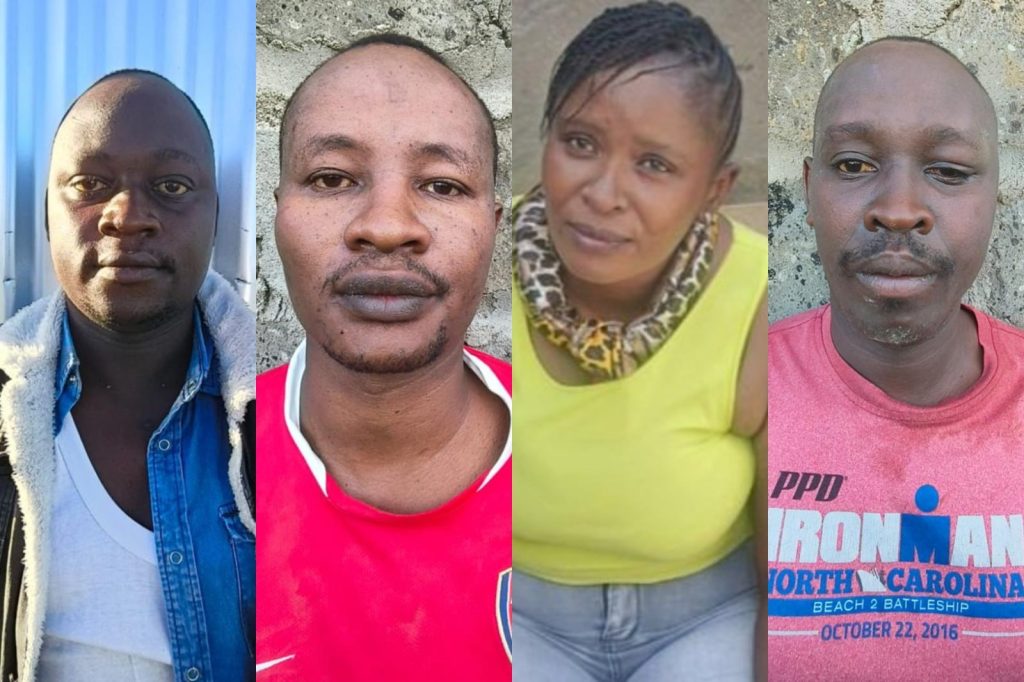
A Milimani Chief Magistrate’s Court granted the Directorate of Criminal Investigations (DCI) 10 days to detain six suspects for 14 days pending investigations into an alleged plot to rob the home of a senior Kenya Defence Forces (KDF) officer.
The six Charles Kiho Matata, David Ng’aa Mwangangi, Samuel Agango Doyo, Alex Mumo Kisilu, Richard Mwania and Stella Nzuki Mweni were presented before senior principal magistrate Paul Mutahi on Thursday after being arrested in Kitengela in connection with what investigators describe as a planned robbery with violence targeting the residence of Major General George Okumu.
In a miscellaneous application, detectives asked the court to allow them to continue holding the suspects at Capitol Hill Police Station to complete investigations.
Police say the six are under investigation for robbery with violence.
Investigating officer George Karanja told the court the arrests followed a week-long surveillance operation after intelligence allegedly indicated that a criminal involving serving military officers and civilian accomplices was planning to strike at the complainant’s home.
The DCI told the court that some of the suspects are believed to have military links, with one said to be a serving KDF officer based at Kahawa Garrison, another a civilian employee working at Kahawa Barracks, and a third KDF officer on interdiction.
Police further said the suspects were arrested while using two vehicles a black Toyota Harrier and a Toyota Ractis.
A search of the vehicles, according to Karanja, allegedly yielded assorted KDF jungle uniforms, military boots, a crowbar, a USA Saber knife, a claw hammer, pliers, Ty-rap seals and several mobile phones.
Karanja also told the court they suspect some of the respondents or their accomplices may be in possession of an AK-47 rifle, which they say is yet to be recovered.
In a supporting affidavit sworn by Inspector Karanja, the DCI argued that the matter remains complex and sensitive, and requires more time to establish the suspects’ military status, trace possible accomplices, conduct further searches, and complete interrogation.
Police also said the file would eventually be forwarded to the Office of the Director of Public Prosecutions (ODPP) for review and directions on whether charges should be brought.
Some suspects did not oppose detention.
Matata told the court he was fine with the 14 days sought by the DCI, while Mwangangi also indicated he had no objection.
Kisilu similarly told the court he had no objection to the 14-day custodial order.
Doyo, however, asked the court to consider releasing him, saying he had no intention of interfering with investigations.
He told the court he has a family that depends on him and said continued detention would hinder his ability to provide for them.
Mweni also pleaded for leniency, telling the court she has been living with her children, but that their home had been closed since last week, forcing the children to stay with a neighbour.
She further told the court that she suffers from chest complications and asthma, and asked the court to consider granting her bond.
Lawyer for 5th respondent opposed 14-day detention.
Through his lawyer, Mwania urged the court to reject the 14-day detention request and instead release him on police bond.
In submissions made before court, the lawyer argued that investigators were merely “ticking boxes” and were acting as though they were certain the court would automatically grant the orders sought.
Counsel said the respondents had only been served with the application about 40 minutes before the hearing, arguing that the unrepresented suspects were being asked to respond to a serious application without adequate time or legal guidance.
He told the court that the respondents were “laymen” and should not be expected to immediately provide substantive legal responses under those circumstances.
The lawyer also described what he said was a confusing and distressing process leading up to the court appearance, saying that after receiving instructions in the morning, he went to Capitol Hill Police Station looking for his client, only to be told he had been moved to Nairobi Area.
He said he later waited at Milimani Law Courts, then returned to Nairobi Area and was informed the suspects were at the Department of Defence (DoD), where he was allegedly told to wait for two hours before they could be arraigned.
He urged the court not to ignore what he described as the duress the suspects had undergone before being brought to court.
Counsel further suggested the application may have been influenced by the status of the complainant, asking whether the request for custodial orders was being made because the alleged target is a senior military officer.
He also challenged parts of the supporting affidavit, saying there appeared to be inconsistencies in the DCI’s account of where the suspects were arrested.
He further took issue with the DCI’s reference to a “multi-agency team”, arguing that if the case was simply one of suspected robbery with violence, investigators should have clearly disclosed which agencies were involved and why.
The lawyer additionally , accused the police of relying on what he described as an unconstitutional charge to justify continued detention.
He urged the court not to aid what he termed an “exploratory fishing expedition” or allow the fifth respondent to be punished before any charge had been properly established.
He also faulted the DCI for failing, in his view, to place before court enough material evidence to justify the deprivation of liberty, arguing that if police were relying on items allegedly recovered from the suspects, they ought to have exhibited those materials more clearly before the court.
While opposing the 14-day request, the lawyer told the court that if it was inclined to grant custodial orders, then the period should be reduced to seven days, arguing that the police had already had sufficient time to organise and assess the matter before making the arrests.

