

Solve African problems, Ruto tells universities

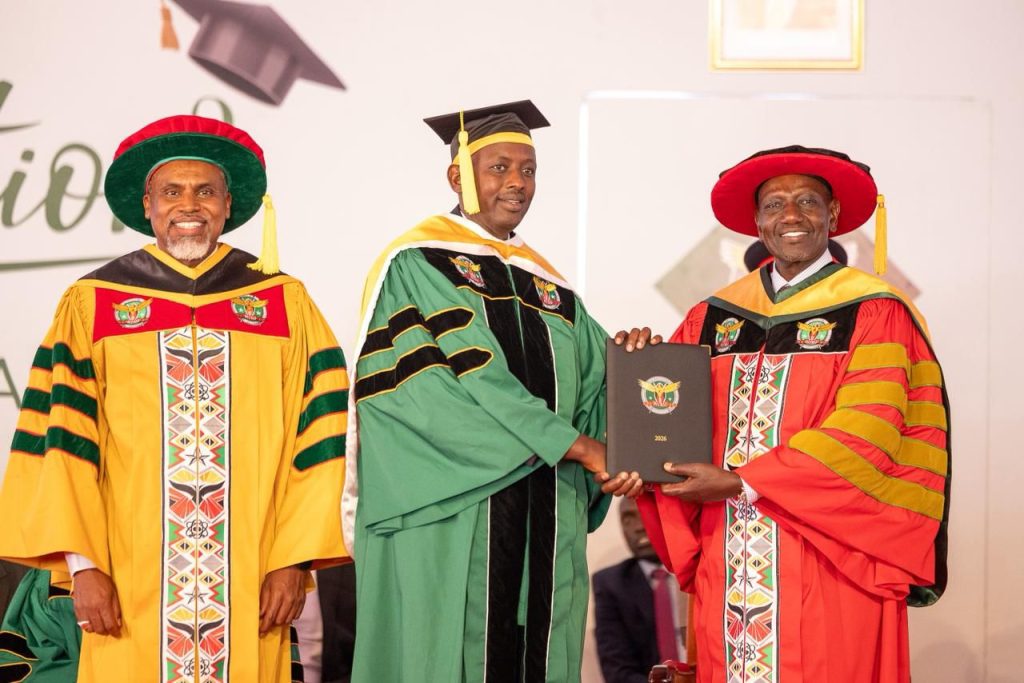
President William Ruto Tuesday, challenged universities not only to be incubators of solutions to local problems, but also those facing the African continent and the world.
He noted that local institutions of higher learning must be active participants in search of solutions to pressing global problems of the day.
He spoke during the first graduation ceremony of the National Intelligence and Research University (NIRU) in Loresho, Nairobi.
“I want to challenge this university to go beyond so that progressively we change from the phase “African Solutions to African Problems” to a new one: “African Solutions to National and Global Problems,” he said.
During the function, Ruto, who is also the Chancellor of the university, presided over the graduation of 31 master’s degree students drawn from Kenya and across Africa.
Present were Cabinet Secretaries Kipchumba Murkomen (Interior) and Julius Ogamba (Education), National Intelligence Director-General and NIRU Chair of the Board of Trustees Noordin Haji, Inspector-General of Police Douglas Kanja, NIRU Vice-Chancellor James Kibon, National Defence University Vice-Chancellor Lieutenant-General David Tarus, and Principal Secretaries, among other guests.
In November 2024, the President awarded NIRU a Charter, and directed the institution to expand its academic reach to the Global South, with a specific focus on Africa.
“I am happy to note that more than half of the graduating class – 17 out of 31- are from African countries, an indication that the university is implementing the directive I gave during the award of Charter,” he said.
The graduates came from Gambia, Rwanda, Tanzania, Burundi, and Uganda, among other countries.
He noted that the enrolment of students from 21 different African countries in the fourth cohort signifies not only growth in numbers, but also the expanding and rich diversity that strengthens NIRU’s role as a strategic hub for knowledge creation, exchange and cooperation.
Ruto said NIRU is uniquely positioned to contribute to Africa’s strategic development priorities, including Agenda 2063’s the Africa We Want.
Equally, the President noted that NIRU can play a role in shaping the new peace and security architecture of the African Union, which has long been crafted along Western lenses.
“Key to this approach is to be proactive in addressing multi-faceted security threats that have consistently held back progress in the continent,” he said.
While emphasising that no nation can transform beyond its capacity to think, President Ruto noted that his administration has continued to sharpen Kenya’s human capital through increased funding to the education sector.
“Education, research and innovation remain powerful drivers of inclusive growth, strong institutions, and strategic competitiveness in an increasingly interconnected world,” he said.
Ruto said although all economic indicators show that Kenya’s economy is on an upward growth trajectory, more needs to be done to make the country a first-world economy, with the assistance of higher institutions such as NIRU.
During the ceremony, the President also witnessed the launch of ‘African Journal of Security and Strategic Studies’, a peer-reviewed publication of the institution addressing present and future challenges.
He also witnessed the launch the Golden Book of NIRU, a document to honour its alumni.
Also in attendance were Rwanda’s National Intelligence and Security Service Secretary-General Aimable Havugiyaremye, Gambia’s State Intelligence Service Director-General Ousman Sowe, and Uganda’s External Security Organisation Director-General Joseph Ocwet.

