

Steve Yzerman Siblings: Meet the Yzerman Siblings Squad

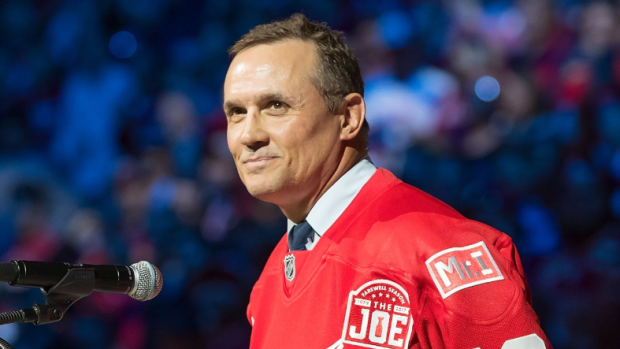
Former Ice Hockey player Steve Yzerman PHOTO/ESPN
Steve Yzerman, born Stephen Gregory Yzerman on May 9, 1965, in Cranbrook, British Columbia, Canada, is widely regarded as one of the greatest players in National Hockey League (NHL) history.
Known as “The Captain” to Detroit Red Wings fans, Yzerman spent his entire 22-season NHL playing career with the Red Wings, earning a reputation as a skilled center, exceptional leader, and Detroit sports icon.
After retiring as a player in 2006, he transitioned into a successful career as a hockey executive, serving as the general manager of the Tampa Bay Lightning and later returning to the Red Wings as executive vice president and general manager.
His leadership on and off the ice, combined with his dedication to the sport, has cemented his legacy as a member of the Hockey Hall of Fame and one of the NHL’s “100 Greatest Players” in 2017.
Siblings
Steve was the third of five children born to Ron Yzerman, an employee of the Canadian government’s health and welfare department, and Jean Yzerman.
The family moved from Cranbrook to Nepean, Ontario, a suburb of Ottawa, when Steve was nine years old.
His siblings include Gray Yzerman, Christopher Yzerman, Ronnie-Jean Yzerman, and Michael Yzerman.
While little public information is available about the personal lives or careers of his siblings, it is known that Steve’s older brother, Mike Yzerman, played a significant role in his early hockey development.
Steve began skating at age three but was too young to join organized hockey with Mike, who was two years older.
Career
Yzerman’s professional career began when he was selected fourth overall by the Detroit Red Wings in the 1983 NHL Entry Draft.
He made an immediate impact as a rookie, recording 87 points in his first season and quickly establishing himself as the cornerstone of the franchise.
Also Read: Luke Mitchell Siblings: Meet the Siblings Squad Behind the Australian Actor
In 1986, at just 21 years old, he was named captain of the Red Wings, a position he would hold for two decades, making him the longest-serving captain in NHL history.
Throughout his career, Yzerman was known for his exceptional playmaking, vision, and leadership, guiding the Red Wings through a period of transformation from a struggling team to one of the league’s most successful franchises.
Under his leadership, Detroit captured three Stanley Cups in 1997, 1998, and 2002, ending a 42-year championship drought for the franchise.
Injuries later in his career tested his resilience, but his dedication and selflessness—often playing through pain—made him a revered figure among teammates and fans alike.
After retiring as a player in 2006, Yzerman transitioned into management, where his hockey knowledge and leadership once again proved invaluable.
As general manager of the Tampa Bay Lightning, he built a powerhouse roster that won the 2020 and 2021 Stanley Cups, solidifying his reputation as one of the most successful executives in the modern game.
In 2019, Yzerman returned to Detroit as executive vice president and general manager, tasked with rebuilding the Red Wings and restoring them to contender status.
Accolades
As a player, Yzerman finished with 692 goals, 1,063 assists, and 1,755 points in 1,514 NHL games, all with Detroit.
He ranked among the league’s top scorers for much of his career and was known for his ability to adapt his game, transitioning from an offensive star to a two-way leader.
He won the Conn Smythe Trophy in 1998 as the most valuable player of the playoffs, leading Detroit to its second consecutive Stanley Cup.
Yzerman also captured the Lester B. Pearson Award (now Ted Lindsay Award) in 1989 as the league’s most outstanding player as voted by his peers.
Internationally, he represented Canada with distinction, winning a gold medal at the 2002 Winter Olympics in Salt Lake City, a highlight of his international career.
Off the ice, Yzerman’s recognition includes being inducted into the Hockey Hall of Fame in 2009 and being named one of the NHL’s “100 Greatest Players” in 2017.
His No. 19 jersey was retired by the Detroit Red Wings in 2007, an honor that permanently cements his status as one of the franchise’s greatest icons.