


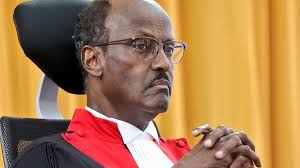
Supreme Court Judge Ibrahim Khadhar Mohammed died Wednesday following an illness.
According to reports, the judge, who was due to proceed on terminal leave ahead of his mandatory retirement on January 1, 2026, died in hospital just after 4:30 p.m.
He had a distinguished 23-year judicial career marked by institutional reform, jurisprudential leadership, and a legacy of advancing access to justice.
He leaves behind a wife and four children
.
Chief Justice Martha Koome confirmed the death of the judge, describing Justice Ibrahim as “a steadfast guardian of constitutionalism, electoral justice, and human dignity.”
She recalled his journey in the corridors of justice before joining the Bench, saying Justice Ibrahim had already distinguished himself as a trailblazing advocate, human rights defender, and public-spirited lawyer.
The late judge was the first member of the Kenyan Somali community to be admitted as an Advocate of the High Court of Kenya in 1982 and was deeply engaged in public interest litigation and civic advocacy, including work with Kituo cha Sheria and the Lawyers Committee for Human Rights.
During Kenya’s struggle for multiparty democracy in the late 1980s and early 1990s, Justice Ibrahim provided legal support to activists and marginalised communities, an advocacy that led to his detention without trial.
His experience shaped his lifelong devotion to constitutionalism, the rule of law, and the protection of human dignity.
Justice Ibrahim joined the Judiciary in 2003 as a High Court judge and was elevated to the Supreme Court in 2011, serving on the inaugural bench responsible for implementing Kenya’s transformative 2010 Constitution.
He also served as Chairperson of the Judiciary Committee on Elections and as the Supreme Court’s representative to the Judicial Service Commission, where he consistently championed transparency, integrity, and judicial independence.
Koome, in her message, noted that Justice Ibrahim “served as a collegial judge, a quiet mentor, and a firm believer in principles over prominence”, adding that his life exemplified fidelity to his oath of office, service to country, and compassion for the voiceless.
The Judiciary, the Supreme Court, and the JSC also expressed profound sorrow at his passing and extended their condolences to his family, friends, colleagues, and the wider legal community.
Law Society of Kenya president Faith Odhiambo said his rare calmness spoke of a man who fully understood the role of judicial authority as an opportunity to serve, and the nuances of justice as a tool for maintaining social order.
“Justice Ibrahim was a towering source of inspiration to all who dared to dream. He was the first person from the Kenyan-Somali community to be admitted to the Bar, at a time when his community was among the most marginalised in Kenyan society.”
“He dedicated much of his early career to the defence of human rights and promoting the ideals of a fair and equal society. He carried his record of excellence and ethical conduct throughout his near-decade-long tenure as a Judge of the High Court,” said Odhiambo.
She added since his appointment to Kenya’s inaugural Supreme Court bench, Justice Ibrahim stood out as an independent, astute voice of reason.
His sound contributions to Kenya’s Jurisprudence portrayed great wealth of knowledge, depth of character and dedication to advancing the law, she added.
Lawyer Gitobu Imanyara said Kenya had lost a principled jurist whose life was marked by courage, restraint, and an abiding commitment to justice and constitutionalism.
“Justice Ibrahim and I shared the painful experience of detention without trial under the Moi regime, united by a refusal to abandon conscience in the face of repression.”
“Those difficult days revealed his quiet strength, moral clarity, and steadfast belief in the rule of law even when the law had been turned against its own people,” he said.
He added his service on the Bench was a continuation of that struggle by judicial means: thoughtful, disciplined, and grounded in integrity.
His Career
Justice Ibrahim was appointed a Judge of the inaugural Supreme Court of Kenya on June 16, 2011 after an open and competitive interview.
He served as the Supreme Court representative to the Judicial Service Commission having been elected on May 17, 2022.
He also served as the Chairperson of the Judiciary Committee on Elections, following his appointment on 16th August 2021 by the Chief Justice.
He studied law at the University of Nairobi before entering private practice.
He joined the firm of Messrs Waruhiu & Muite Advocates in November 1982 and was subsequently admitted to the Roll of Advocates on 11th January 1983.
He was the first from among the Kenyan Somali community to be admitted to the Bar as an Advocate.
He progressed in the firm, becoming a salaried partner in 1985 and a full partner in 1987.
He went on to establish his own practice, Mohammed Ibrahim & Associates, in 1994. The firm subsequently expanded to become Ibrahim & Isaack Advocates in 1997.
The firm litigated civil and constitutional cases and specialized in banking law, company law, bankruptcy, commercial law, property law, conveyancing and insurance law.
The judge invested heavily both personally and professionally in securing rights for minority groups, particularly the Somali community, in Kenya.
He fought against the discrimination of Kenya Somalis when the Government gazetted the use of “pink cards” which were secondary identity cards issued upon provision of further proof of verification of citizenship, and which was used to relegate Somali community to second class citizens.
He has a strong commitment to social justice and while in private practice took on pro bono activities and community service, even in the face of great difficulties.
As a result of his opposition to aspects of the one-party regime, he was detained without trial in July 1990 and spent one month in solitary confinement in Kamiti Prison for giving legal advice and supporting pro-democracy champions.
He was an active member of the Law Society of Kenya and in 1994 he was elected to the Council for a term of one year. He has worked with Kituo Cha Sheria and was a member of the board of the Legal Education and Aid Programme (LEAD).
He was a founding trustee of the human rights organization, Mwangaza Trust, until 1994. He is a past member of Lawyers Committee for Human Rights and a current member of the Kenya Magistrates and Judges Association.
He was appointed as a Judge of the High Court on 221d May 2003 and first served at the Civil Division of the High Court, Milimani, Nairobi from June until July 2003, when he was transferred to the Commercial Division of the High Court at Milimani. In 2004 he was appointed to the newly established Judicial Review and Constitutional Division of the High Court, where he remained until he was transferred to the Eldoret High Court in January 2006.
He was Resident Judge at Eldoret between 2007 and 2009 where he heard matters for the entire North Rift Valley, occasionally assisting the High Court Kisii. In July 2009, he was transferred to the High Court at Mombasa, where he also served as Resident Judge until he was then elevated to the Supreme Court of Kenya.

Email your news TIPS to Editor@Kahawatungu.com — this is our only official communication channel
