

The End of “Gibberish” AI: Why Nano Banana Pro Is the Visual Storyteller We’ve Been Waiting For

Why Nano Banana Pro Is the Visual Storyteller We’ve Been Waiting For
Let’s be honest for a moment about the current state of AI image generation. You have likely been there: You craft the perfect prompt, imagining a sleek cyberpunk coffee shop poster. You hit “generate,” and the lighting is gorgeous, the mood is perfect, but the neon sign in the window reads “C0FF33 SH@P” or some alien hieroglyphics that ruin the entire illusion.
For years, we have accepted this trade-off. We got stunning visuals, but we had to accept that AI was illiterate. We treated these tools like talented but chaotic abstract artists—brilliant at color, terrible at spelling.
But what if you didn’t have to compromise?
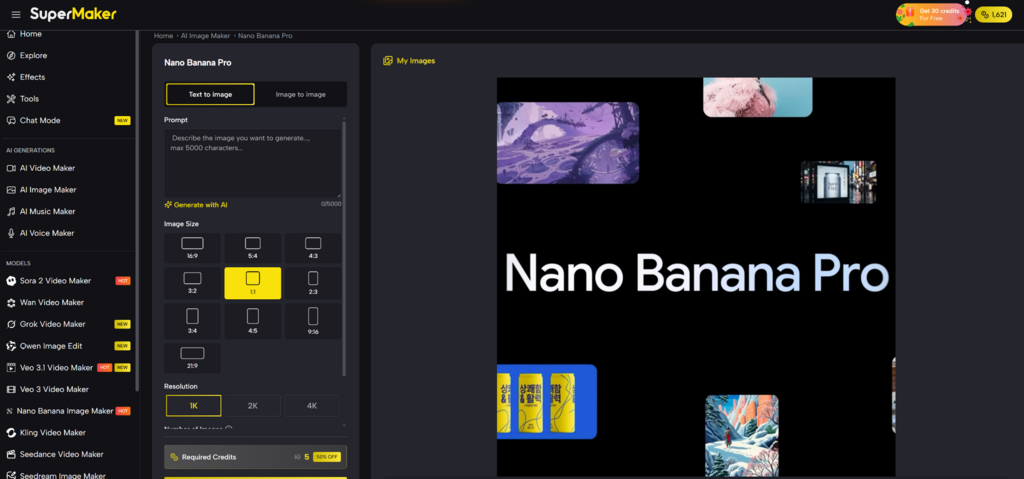
I recently spent a week testing a tool that claims to bridge this gap. It is called Nano Banana Pro. Beneath the playful name lies a serious engine built on Google’s Gemini 3 Pro technology. It is not just another image generator; it is a fundamental shift in how we think about “text-to-image” creation. It moves us from generating random pretty pictures to designing functional, legible, and context-aware assets.
Here is why this specific tool is changing my workflow, and why it might just change yours too.
1. The “Literacy” Revolution: Finally, Text You Can Read
If you work in marketing, branding, or content creation, you know the pain. You need a mockup of a billboard, a package design, or a social media post. Previously, you had to generate the image in one tool, then open Photoshop to scrub out the AI gibberish and overlay your own text. It was a disjointed, two-step dance.
The Problem with Traditional Diffusion
Most AI models treat text like texture. They see letters as shapes—lines and curves—without understanding that “S-T-O-P” on a sign has a semantic meaning. This is why you get hands with six fingers and signs with floating vowels.
The Nano Banana Difference
When I first logged into Nano Banana Pro, I decided to stress-test it immediately. I asked for a vintage travel poster with the specific text: “Visit Mars: The Red Planet Awaits.”
The result stopped me in my tracks. The typography wasn’t just legible; it was stylistically coherent. The font matched the 1950s art deco aesthetic of the poster. It wasn’t pasted on top; it was woven into the texture of the paper.
Think of it this way:
- Old AI is like a painter who tries to copy a page of a book by drawing the shapes of the letters without knowing the language.
- Nano Banana Pro is like a calligrapher who understands the words and paints them with intention.
This capability alone saves hours of post-production time. Whether you are mocking up a book cover or a UI design, the ability to get 90% of the way there in the first shot is a massive productivity unlock.
2. The Brain Behind the Beauty: Gemini 3 Pro & Real-World Context
Visuals do not exist in a vacuum. They need context. This is where the integration of Google’s Gemini 3 Pro creates a “smart” layer that most competitors lack.
From Static Pixels to Live Data
One of the most jarring experiences with standard AI is its hallucination of facts. Ask for a diagram of a solar system, and you might get two suns.
Nano Banana Pro leverages a connection to Google Search. This means you can inject real-time logic into your creative process. During my testing, I asked it to generate an infographic-style image representing “Healthy Breakfast Options.” Because the underlying model understands concepts, not just pixels, it didn’t just draw random food; it composed a balanced scene with recognizable items that made logical sense together.
The “Director” Metaphor
Imagine you are a film director.
- With other tools, you are shouting through a megaphone at a set designer who has never left their basement. They guess what a “modern kitchen” looks like based on old photos.
- With Nano Banana Pro, your set designer has a smartphone and an encyclopedia. They know what current trends look like. They understand that a “weather map” needs specific symbols, not just squiggly lines.
This “reasoning” capability means the tool respects spatial relationships and cultural context far better than earlier generations of models.
3. Consistency: The Holy Grail of Character Design
If you are telling a brand story, you need a recurring character. Maybe it is a mascot for your tech blog or a model for your clothing line. The frustration with AI has always been “Slot Machine Syndrome”—you pull the lever, and you get a new person every time.
The Multi-Image Blend Technique
Nano Banana Pro introduces a feature that feels like magic: Reference Consistency.
You can upload up to 10 reference images. I tried this by uploading three photos of a specific character style I wanted—let’s call him “Cyberpunk Barista.” I then asked the AI to generate this character in five different scenarios: serving coffee, riding a bike, and reading a book.
The facial features, the vibe, and the clothing style remained shockingly consistent. It can track up to 5 distinct people across images. This turns the tool from a “random image generator” into a “storyboard engine.” You can actually build a comic book, a storyboard, or a consistent ad campaign without the character morphing into a stranger in every frame.
4. Visual Comparison: How It Stacks Up
To help you visualize where Nano Banana Pro fits in the current landscape, I have broken down the key differences between it and the standard “diffusion” models you might be used to.
| Feature | Standard AI Image Generators | Nano Banana Pro (Supermaker) |
| Text Rendering | Often garbled, alien symbols, requires Photoshop fix. | High Legibility. Renders specific copy accurately in various fonts/styles. |
| Reasoning Engine | Visual-only. Focuses on aesthetics over logic. | Gemini 3 Pro. Understands complex prompts, spatial logic, and real-world data. |
| Consistency | “Slot Machine” effect. Hard to keep characters the same. | Reference Anchoring. Maintains up to 5 characters across different scenes. |
| Workflow | Generate -> Fix -> Upscale -> Fix again. | All-in-One. High-res (4K) generation with correct text from the start. |
| Accessibility | Often requires Discord or complex installs. | Browser-Based. No download, instant access via Supermaker. |
5. A Direct Experience: The “Coffee Shop” Test
I want to share a specific moment from my time with the tool that sold me on its utility.
I needed to create a concept for a fictional coffee brand called “Nebula Brew.”
- The Prompt: I asked for a “sleek, matte-black coffee bag sitting on a wooden table, with the text ‘Nebula Brew’ in gold foil typography, morning sunlight hitting the bag.
- The Result: The first generation was usable. The text was spelled correctly. The gold foil actually looked like foil—it reacted to the lighting generated in the scene
- The Iteration: I realized I wanted the bag to look more “worn.” I didn’t have to start over. I adjusted the prompt to “add texture of recycled paper,” and the model kept the text perfect while changing the material physics of the bag.
This creates a feedback loop that feels creative rather than corrective. You spend your time refining the art, not fixing the mistakes.
6. Who Is This For?
You might be wondering if this fits your specific needs. Here is who stands to gain the most:
For Social Media Managers
You need speed. You need to create a “Happy Friday” post that matches your brand colors and actually spells “Friday” correctly. This tool allows you to skip Canva templates and generate bespoke assets in seconds.
For E-commerce Owners
You can take a simple photo of your product and use the “Image-to-Image” or reference features to place it in a luxury penthouse, a forest, or a futuristic lab. It democratizes high-end product photography.
For Educators and Presenters
Because of the Google Search integration, you can generate diagrams or educational visuals that are grounded in reality. Need a visual explaining the water cycle? It won’t just be pretty swirls; it will likely have the correct labels.
7. The Verdict: A Tool That Respects Your Intelligence
We are moving past the “wow” phase of AI art. We are no longer impressed simply because a computer drew a cat. We are now in the “utility” phase. We need tools that work, tools that listen, and tools that speak our language—literally
Nano Banana Pro represents this maturity. It respects that you have a specific vision. It respects that text carries meaning. And it respects that you need consistent results, not random luck.
If you are tired of fighting with prompts and fixing typos in Photoshop, it is time to upgrade your toolkit. The future of AI isn’t just about generating pixels; it’s about generating meaning.
Ready to see the difference?
You don’t need to download heavy software or learn complex code. You can experience this shift in creative control right now