

The room that remembers Baba: Inside Raila’s quiet Kisii retreat

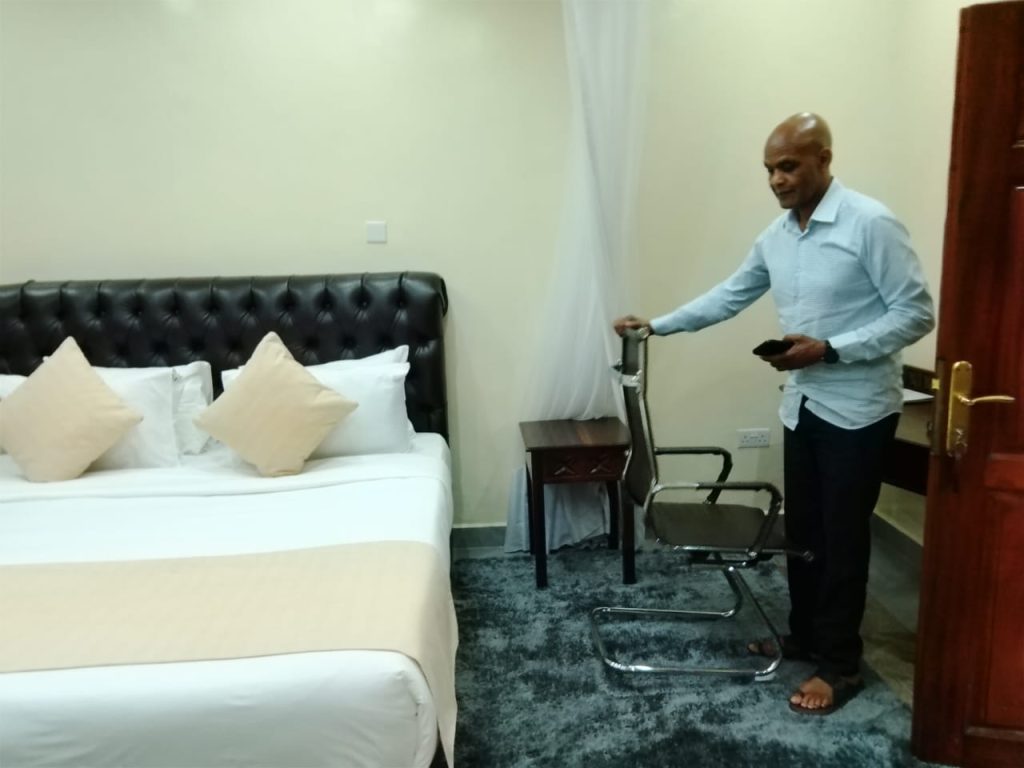
Tucked beneath a thick canopy of foliage on the outskirts of Kisii town is a room that, at first glance, looks like any other hotel unit.
But behind its quiet door lies a small, intimate chapter of Kenya’s political history.
At Ufanisi Resort, a serene establishment surrounded by lush greenery, is the secluded room that became one of the late Raila Amolo Odinga’s preferred retreats whenever his political travels brought him to the Gusii region.
Here, the man known across Kenya as “Baba” could escape the crowds.
Away from chanting supporters.
Away from cameras and microphones.
Away from the endless political conversations that followed him wherever he went.
For a few precious hours, Raila was simply a traveller looking for rest.
Now, one year after his death, the room has become something else — a place of memory.
On Friday, Ufanisi proprietor Patrick Lumumba invited KahawaTungu inside the room. Later that evening, he would light a candle in honour of the late opposition chief.
For Lumumba, the room is not simply a hotel unit.
It is a place filled with memories of a man he welcomed repeatedly.
“Every time I enter this room, I remember Baba walking through that door. I remember the excitement, but I also remember the quiet moments after all the crowds had gone away,” Lumumba says.
He pauses.
The memories appear to weigh heavily on him.
“Raila was a giant out there. People would wait for hours just to see him. But here, he was our guest. He would come tired from his engagements, close the door and rest. That is the Raila I remember.”
Football, food and quiet evenings
Lumumba recalls that Raila would sometimes sit on his bed and watch television, particularly when his favourite team was playing.
“I could join him, but we watched football in silence. To him, watching football was serious business,” Lumumba recalls with a smile.
He also remembers Raila’s preference for traditional vegetables, particularly managu and chinsaga.
“He was a bit choosy with food,” Lumumba says.
The late politician also enjoyed an occasional drink of Rémy Martin, which he would sip quietly during evening conversations with close friends.
Lumumba remembers him as an early riser, despite sometimes going to bed late.
“He could sleep late but still join the breakfast table by 8am,” he says.
The recollections make the room feel less like a hotel unit and more like a time capsule.
For Lumumba, however, the memories have become painful.
“The hardest thing is knowing that he will never walk through that door again,” he says.
It is a simple sentence, but one that captures the weight of loss.
The resort remains.
The greenery remains.
The room remains.
Only the man is missing.
A retreat away from politics
Ufanisi, located along the Nyakongo-Masoso road, describes itself as a tranquil retreat set within landscaped grounds and natural tropical vegetation.
That privacy appears to have been part of its attraction to high-profile guests.
The resort has hosted several dignitaries over the years, among them First Lady Rachel Ruto, who stayed at the facility during political campaigns.
But Raila’s relationship with the resort occupies a special place in Lumumba’s memories.
“We have hosted many important people here, and we are grateful to every one of them,” he says.
“But Baba was different. His visits became part of the history of this place.”
Then comes another pause.
“You could feel his presence even after he had left. The staff would talk about him. People outside would talk about him. His name was everywhere.”
Raila’s visits to the Gusii region often attracted large crowds.
But inside Ufanisi, the political theatre disappeared.
The room offered him something increasingly rare for a politician of his stature — anonymity.
“When he came here, we did not see only the politician,” Lumumba recalls.
“We saw a human being. A father. An elder. A tired traveller who needed somewhere peaceful to put his head down.”
A room in his memory
As they light a candle on Friday evening, Lumumba says the resort is considering renaming the unit “Baba’s Room” in Raila’s memory.
“We can do it as a sign of remembering a person who made a lot of political sense to the country,” he says.
The gesture comes as Kenya marks October as “Mwezi wa Baba”, a month of remembrance following the first anniversary of Raila’s death.
The month-long programme includes candle-lighting ceremonies, regional memorial events and activities around October 15, the anniversary of his death.
Across the country, Kenyans are remembering Raila in different ways.
Some will gather in stadiums.
Others will light candles.
Others will revisit places associated with his long political journey.
In Kisii, there is this room.
A quiet room hidden among trees.
A room where one of Kenya’s most recognisable political figures once slept.
‘How can Lumumba miss out on government?’
Lumumba also recalls what he says was his last significant conversation involving Raila.
Now positioning himself to contest the Kitutu Chache South parliamentary seat, Lumumba says Raila once sought to help him secure a government appointment.
According to Lumumba, during a telephone conversation with then Finance CS Junet Mohamed at Orange House in Nairobi, Raila asked why he had not been considered for a government position.
“How can Lumumba miss out of government, a person who had served us so well?” Lumumba recalls Raila asking Mohamed.
Lumumba says the two exchanged contacts during the call, but the expected follow-up never came.
“No call went through later, to date,” he says.
For Lumumba, the episode captures another side of Raila — a politician who, he says, remembered friends and people who had worked with him.
“Such was Baba, a person who made friends. I don’t know if Junet can recall this, but Baba was different,” he says.
A memory that cannot be replaced
Back inside the room, Lumumba looks around once more.
“You can replace furniture. You can renovate a building. You can plant new trees. But you cannot replace a memory,” he says.
The resort has witnessed many seasons.
Politicians have come and gone.
Campaigns have been won and lost.
Dignitaries have passed through its gates.
But somewhere within its foliage is a room that appears to have preserved a small piece of Raila’s private life.
No cheering crowd.
No political slogan.
No campaign banner.
Just a door.
A bed.
Silence.
And memories.
“I sometimes imagine that he is still here,” Lumumba says softly. “Then reality comes back. Baba is gone.”
Perhaps that is the most poignant thing about the room.
It has not changed nearly as much as the world outside it.
The door can still open.
The bed can still be made.
The trees still whisper in the breeze.
But the footsteps of the man who once walked through the door have fallen silent.
For Lumumba, opening that door now is like opening an old photograph.
And as Kenya lights candles for Baba this October, one does not need a stadium or a political rally to remember him.
Sometimes, all it takes is a quiet room.

