

TIFA: Majority Want ODM to Field Its Own Presidential Candidate

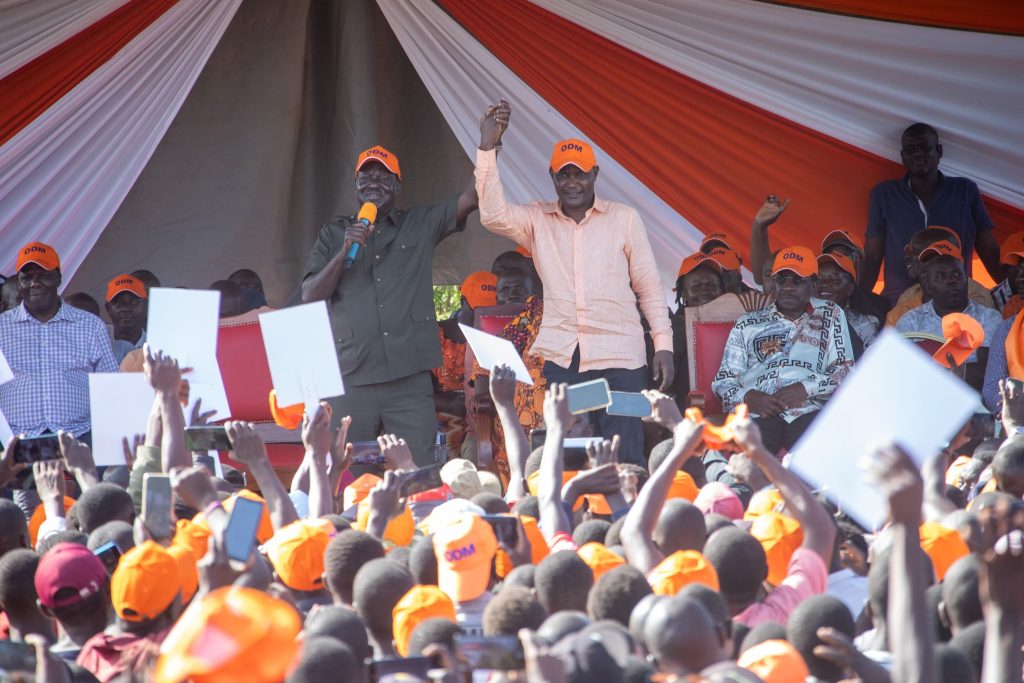
A majority of Kenyans want the Orange Democratic Movement (ODM) to present its own presidential candidate in the 2027 General Election, according to a new survey by research firm TIFA.
The survey shows that a clear plurality of respondents, 34 percent, prefer ODM to field its own presidential candidate. Another 34 percent want the party to back a different candidate from the wider Azimio-Opposition alliance, while 24 percent believe ODM voters should be left to decide individually who to support.
The findings point to growing divisions within the party over its future political direction, especially regarding whether it should back President William Ruto or chart its own path.
“However comfortable most ODM leaders – especially their elected leaders and senior government officials serving in the Kenya Kwanza government – appear to be, only a modest minority of the Orange party’s supporters (though not necessarily party members) appear committed to backing President Ruto for a second term – at least if he joins their party (19%),” the report reads.
The survey notes that ODM supporters are split, with some calling for the party to remain independent and field its own candidates, while others argue it should support President Ruto under the Broad-Based Government (BBG) arrangement.
At the same time, TIFA says ODM’s popularity has grown sharply since its August survey, when the party stood at 13 percent. The latest poll places ODM at 20 percent national support, allowing it to overtake the ruling United Democratic Alliance (UDA), which stands at 16 percent.
Despite remaining the two dominant political parties, both ODM and UDA have lost support compared to the period immediately after the 2022 General Election. TIFA says no party currently enjoys a stable or decisive support base, with voter loyalty increasingly fluid ahead of by-elections and the 2027 polls.
The survey also shows a decline in the number of Kenyans without a party affiliation or who are undecided. Those with no party preference dropped from 31 percent to 22 percent, while undecided voters fell from 10 percent to 6 percent, a trend TIFA links to rising political engagement nationwide.
One of the main beneficiaries of this shift, besides ODM, is the Jubilee Party. Jubilee’s support has nearly tripled from 3 percent in August to 11 percent. According to the report, this increase may be connected to former President Uhuru Kenyatta’s renewed public role in party affairs and his backing of former Interior Cabinet Secretary Fred Matiang’i, now Jubilee’s Deputy Party Leader.
The survey also examined public opinion following the death of former Prime Minister Raila Odinga and its impact on President Ruto’s 2027 re-election prospects. TIFA found that many Kenyans see Raila’s passing as a challenge rather than an advantage for the president.
According to the findings, 41 percent of respondents believe Raila’s death will make it more difficult for President Ruto to secure re-election. In contrast, 30 percent say it will be easier for him to win another term, while 10 percent remain unsure.
Regional views differ sharply. Optimism about President Ruto’s chances is highest in Western Kenya and Nairobi, where 38 percent and 36 percent of respondents respectively say his prospects have improved. However, pessimism is strongest in the Mt Kenya and South Rift regions, where 56 percent and 52 percent believe his re-election bid has become harder.
Even in Raila Odinga’s home region of Nyanza, more people are pessimistic than optimistic. Forty percent of respondents there say President Ruto’s re-election will now be more difficult, compared to 25 percent who believe it will be easier.
“Apparently based at least in part on ‘wishful thinking’, there is a clear correlation between attitudes towards the Broad-Based Government and expectations of the President’s re-election prospects in the wake of Raila’s demise,” the report states.
TIFA adds that supporters of the Broad-Based Government are more likely to believe President Ruto’s chances have improved. About 40 percent of BBG supporters say his prospects are better, compared to 23 percent among BBG opponents. On the other hand, 54 percent of BBG opponents believe his re-election has become more difficult without Raila’s presence, compared to 31 percent of BBG supporters. Among respondents with no opinion on the BBG, 35 percent said they were unsure about the impact of Raila’s absence.
Meanwhile, half of Kenyans believe ODM will return to the Opposition before the 2027 General Election. The survey shows that 50 percent of respondents expect the party to leave the Broad-Based Government arrangement. Expectations vary by political affiliation, with 80 percent of DCP supporters, 75 percent of Wiper supporters and 71 percent of Jubilee supporters saying ODM will rejoin the Opposition. Among UDA supporters, opinions are divided, with 46 percent believing ODM will remain in the BBG.
ODM supporters themselves are split, with 50 percent expecting the party to return to the Opposition and 38 percent believing it will stay within the Broad-Based Government.