

Transforming Everyday Work with Smarter Scheduling and Task Management

Transforming Everyday Work with Smarter Scheduling and Task Management
How well teams manage their time and responsibilities is frequently what makes or breaks a project. A lot of businesses still employ faulty systems, though, where work, timetables, and communication are all in different places. Because of this lack of connection, workers are unhappy, and things don’t get done as quickly because they have to spend more time coordinating. Companies are putting in place project management tools that combine scheduling and task management into one system to remedy this.
When your calendar and tasks are linked, you can do more every day. Teams know what they need to do, when they need to do it, and how to keep track of how far they’ve come. This not only makes things flow more smoothly, but it also gives workers more control and enables them spend less time switching between tools and more time on critical tasks.
Lark Base: Capturing complexity in structured form
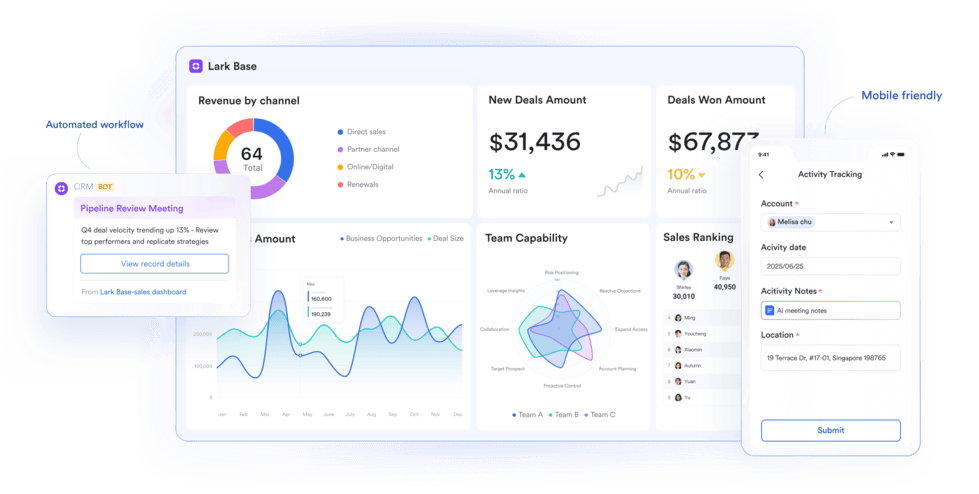
To plan and execute work effectively, teams need access to the right context. Lark Base provides this by consolidating client details, project data, and decision histories into one connected system. Through Lark Base, you can instantly build up a centralized information hub or a comprehensive CRM app that keeps planning, communication, and execution grounded in accurate, reliable information.
With Lark Base, teams design flexible databases that connect people to projects, tasks to approvals, and milestones to larger goals. Dashboards give managers real-time visibility, while filters and tags help employees focus on their top priorities. Instead of piecing details together from scattered platforms, teams work from a single source of truth—saving time and ensuring calendars, tasks, and decisions stay aligned.
Lark Tasks: Accountability supported by automated workflows
You need to do more than just hire people to get things done. You need a system that makes sure everyone is accountable. Lark Tasks provides this by making it obvious who is responsible for what and when it needs to be done. Employees no longer have to rely on handwritten notes or reminders because all of their tasks are now in one spot.
Assignments features an automated workflow that hands out assignments, keeps track of their progress, and sends you reminders without you having to do anything. This makes everything work even better. You can make activities that happen on a regular basis, such weekly reviews or project updates, and then use them again and again. This means you won’t have to set them up over and over. Dashboards for progress display what has been done, what is late, and what has to be done right away. This makes sure that all the work is done without having to check on it again and again. This makes being responsible a normal part of work every day.
Lark Calendar: Smarter scheduling for everyday alignment
The Lark Calendar lets everyone stay on the same page, which is incredibly crucial for how well a team does its work. The calendar helps teams stay on track with their work by making sure that meetings, reviews, and deadlines are consistently clear and the same. In this way, they won’t have to cope with timetables that don’t match.
Smart scheduling helps people from different teams and locales work together, and automatic time zone conversion makes sure that everyone can join in without any hassles. When things happen over and over, it’s easy to check in on them often. You can also connect project data or documents directly to events so that all discussions are based on facts. Built-in reminders help make sure that everyone is ready and on the same page. This makes the job easier and saves time.
Lark Sheets: Data-driven task and time management
You can’t only trust your gut to remember your tasks and schedules. You need to know the truth. Lark Sheets may help teams keep track of their KPIs, workloads, and how things are progressing in real time. Sheets makes sure that information is always true and up to date, so that scheduling and choosing tasks are always based on facts.
Sheets is always a trusted source of project data, so teams can work together without worrying about version conflicts. Managers can observe how work is split up by keeping track of KPIs. This allows them adjust their schedules before problems come up. Visual dashboards help you plan by turning data that is hard to interpret into helpful information. Automated updates keep the numbers right without having to write them in by hand, which speeds up the process of making reports.
Lark Mail: Connecting external inputs to internal tasks
Most of the work that is done every day is done by people who don’t work for the company. For example, clients send in requests, partners send in updates, and compliance issues show up in inboxes. Lark Mail makes sure that this communication from outside doesn’t stay separate; it goes straight into tasks and calendars.
Shared inboxes help teams stay up with client communication as responsibilities change. Smart filtering makes key requests easy to find. You can also turn emails into tasks or connect them to Base data so that they stay connected to projects that are still going on. Employees don’t have to switch between systems to handle outside inputs; they can do it all in the same place as their tasks and calendars. This makes sure that everything is there.
Lark Wiki: Knowledge to support smarter planning
It’s also crucial to know how to make good plans and keep track of what you need to do. Lark Wiki makes sure that workers can always find all the project playbooks, process manuals, and best practices they need in a living knowledge hub. Wiki makes it easier to discover information, so users don’t have to keep asking the same questions or not getting the instructions.
Updating pages together to show new workflows is a good way to make sure that the documentation is always up to date. Teams can send each other Wiki articles over Messenger, attach them to tasks, or link them to projects in Base so that they always have the knowledge they need. This helps people organize their work and finish it without worrying too much about it.
Conclusion
Work will change from being a constant juggling act to a smooth flow of planning, talking, and doing if you learn how to effectively manage your time and tasks. Base organizes things, Tasks makes sure people do what they say they will do, Calendar makes sure schedules line up, Sheets helps with planning based on data, Mail links people who need to talk to each other, and Wiki keeps knowledge protected. All of these things make work move faster and more smoothly.
Companies might work better if they cut down on wasted time and make sure that every meeting and activity is in the right place. More significantly, workers are more sure that their time and tasks are being handled well. If you want to do better in a competitive environment where both speed and accuracy are vital, you should work on your scheduling and job management.