


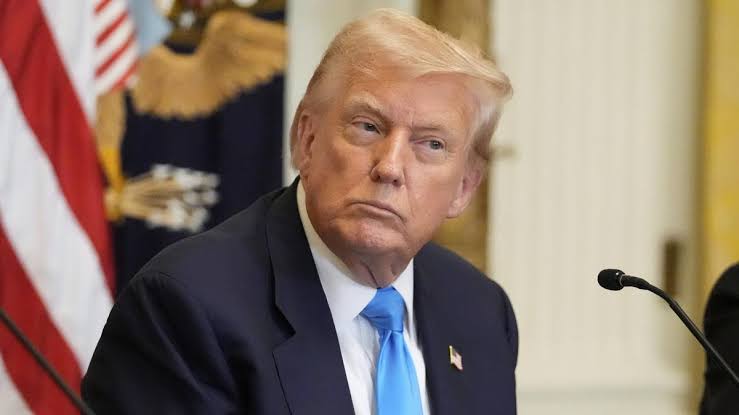
Hours before a midnight deadline, the White House announced its new trade policy, affecting virtually every nation as the US cemented its pivot away from decades of free trade and toward a new protectionist era.
The administration said the “universal” tariff will remain at 10% — the same level implemented on April 2 — for countries the US has a trade surplus with, which is most of them.
Nations with which the US has a trade deficit face a 15% floor. In addition to the overall plan, President Donald Trump said he is raising tariffs on Canada from 25% to 35%, effective Friday.
Goods compliant with the United States-Mexico-Canada Agreement would not be subject to that higher rate, the White House said, which would blunt the impact.
Meanwhile in a notable hearing, a skeptical federal appeals court heard oral arguments about whether the US president overstepped his legal authority to impose many of his sweeping tariffs.
Pakistan has emerged with the lowest tariff rate of any South Asian country after the White House announced the new levies Thursday.
The announcement by the United States to slash Pakistan’s tariff rate from 29% to 19% was already being celebrated widely, with the country’s prime minister releasing a statement on X conveying his “profound thanks to President (Donald) Trump.”
Islamabad on Thursday rolled back a 5% tax on foreign digital services that had been introduced a month earlier, a decision seen locally as a goodwill gesture toward the US.
There is also satisfaction locally that Pakistan’s tariff rate is much lower than neighbor and archrival India’s. Fears in Islamabad that India was trying to isolate Pakistan financially have been somewhat tempered by the 25% tariff rate that the Trump administration hit New Delhi with.
“This deal marks the beginning of a new era of economic collaboration especially in energy, mines and minerals, IT, cryptocurrency and other sectors,” the Pakistani Finance Ministry said in a statement Thursday night.
The US is the biggest market for textiles from Pakistan, which is in direct competition with India, Bangladesh and Vietnam, all of which have been slapped with higher tariffs. The announcement is expected to be a boost for the country’s textile sector, which is responsible for close to 60% of the country’s total exports.
Pakistan has moved closer to the US under the Trump administration, with the country even nominating the president for the Nobel Peace Prize in June.
As nations around the world grapple with higher tariffs, the fate of China’s economic future with the US remains uncertain, leaving one of the world’s most important trade relationships in limbo.
Despite a two-day meeting with Chinese and American negotiators this week in Stockholm, the two economic giants have yet to agree on a deal to prevent tariffs from soaring to significantly elevated levels.
While diplomats from both nations have portrayed the discussions in a positive light, US Treasury Secretary Scott Bessent stressed that any decision to extend a pause on tariffs will come from President Donald Trump.
Why their trade conversations are tricky: Unlike Canada, the European Union, Japan and South Korea — all longtime American allies — the Sino-US relationship is adversarial.
The issues clogging the conversations extend far beyond financial arrangements. Both nations hold resources and technology viewed as crucial to their respective security and stability.
This includes China’s vast reservoirs of rare earth minerals, substances American firms need to build everything from electronic device, lighting and electric vehicles.
China’s manufacturing strength is also leaving a palpable impact on American consumers through higher costs and reduced merchandise, thanks to US tariffs already in place.
American companies, including tech giant Nvidia, hold chip technology that’s crucial in powering AI-related platforms.
Beyond economics, there’s also ego: Chinese leader Xi Jinping is balancing a fragile domestic economy, yet can’t risk any appearance of caving in to Trump and American demands.
And Trump is notoriously mercurial – just look at how he threatened Canada yesterday as soon as Ottawa announced plans to recognize a Palestinian state.
Still, both leaders seem keen on a face-to-face meeting.
How they tackle their deep divides on trade will reshape the global economic system.
Stock markets across the Asia Pacific region were mostly in the red on Friday morning local time after US President Donald Trump unveiled historic new tariffs across the globe.
Japan’s benchmark Nikkei 225 slid 0.6% in the early hours of trading, and South Korea’s KOSPI plunged 3.2%. Taiwan’s TAIEX was down 0.4%, while Australia’s S&P/ASX 200 declined 0.7%. Hong Kong’s Hang Seng Index was up marginally at 0.2%.
The new tariff regime will not go into effect Friday, as expected. Instead, the tariffs will be implemented on August 7 to give Customs and Border Protection sufficient time to make the necessary changes to collect the new duties.
By CNN

Email your news TIPS to Editor@Kahawatungu.com — this is our only official communication channel
