


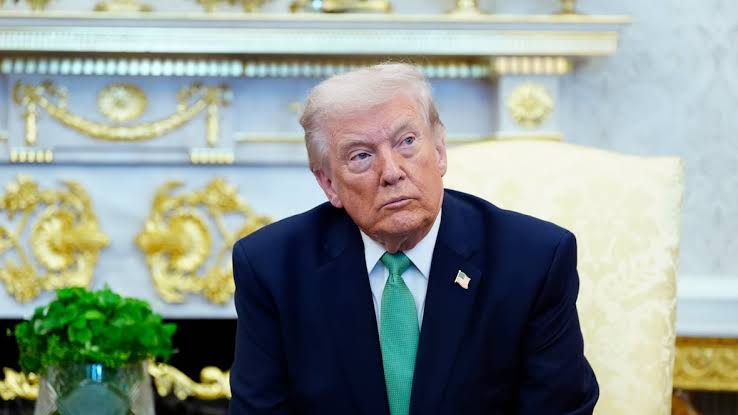
President Donald Trump has accused Nato members of making a “foolish mistake” by refusing to help the US secure the Strait of Hormuz during the war with Iran.
Despite the pressure on oil prices brought about by severe disruption to the critical waterway amid the conflict, he insisted the US does not need help from its allies.
Speaking alongside Irish Prime Minister Micheál Martin at the White House, Trump said he has been informed by most Nato allies that they do not want to get involved in the war, a conflict many of them view as illegal.
While Trump has said some countries are willing to help escort ships through the strait, he has yet to publicly identify them.
In heated remarks in the Oval Office on Tuesday, Trump insisted that “we don’t need any help” from Nato.
“But they should’ve been there,” he added.
The US president said the reluctance to send mine-sweeping vessels to the Gulf was “not a big deal”, but was “unfair” to the US.
He reserved his harshest criticism for the UK, citing its lack of participation and assistance in the US-Israeli strikes on Iran.
Trump said the US-UK relationship was “always the best” until “[Prime Minister] Keir [Starmer] came along”.
He also said the war was a “great test” of the alliance’s relations with the US.
But when asked if he was considering any retaliatory measures, the president said only that he had “nothing currently in mind”.
Trump also complained that Nato allies had benefited from tens of billions of dollars in US backing for Ukraine to fend off Russia’s invasion.
“We will protect them, but they will do nothing for us, in particular, in a time of need,” the president said on social media.
Only a handful of vessels carrying Iranian oil to countries including India and China have managed to pass through the Strait of Hormuz since hostilities began on 28 February.
Several commercial cargo ships have been struck in the waterway, through which about one-fifth of the world’s oil passes.
US officials have still not identified allies willing to help escort ships through the passage.
Many, including the UK, Germany and France – have said they are not ready to make a decision yet.
President Emmanuel Macron said on Tuesday that France did not want to get involved.
“We are not a party to the conflict, and therefore France will never take part in operations to reopen or liberate the Strait of Hormuz,” Macron said.
Kaja Kallas, the European Union’s top diplomat, said on Tuesday: “This is not Europe’s war. We didn’t start the war. We were not consulted.”
“The member states do not have the wish to be dragged into this,” Kallas said, according to AP news agency.
On Tuesday, the director of the US National Counterterrorism Center, Joe Kent, resigned over the war in Iran, urging Trump to “reverse course”.
In a letter, Kent argued that Iran posed no imminent threat to the US, despite the administration’s repeated claims to the contrary.
Kent’s boss, Director of National Intelligence Tulsi Gabbard, defended the president in a social media post.
She said Trump had carefully reviewed the intelligence and concluded that Tehran did pose an imminent threat.
Meanwhile, retaliatory strikes launched by Iran and its allied militias continued.
Israeli officials said two people had been killed near Tel Aviv by an Iranian ballistic missile, while sites in the United Arab Emirates, Iraq, Qatar and Kuwait were also targeted.
In his first policy meeting since his appointment as Iran’s new supreme leader, Mojtaba Khamenei said there were no ceasefire plans, a senior Iranian official told Reuters news agency.
Khamenei said it was not “the right time for peace until the United States and Israel are brought to their knees, accept defeat, and pay compensation”, the official said.
It was unclear whether Khamenei could have attended the meeting in person or remotely. He has not been seen in public since he was reportedly injured in last month’s air strikes that killed his father, Supreme Leader Ali Khamenei.
On Tuesday, Iran officials also acknowledged the deaths of security chief Ali Larijani and Basij militia head Gholamreza Soleimani.
By BBC News

Email your news TIPS to Editor@Kahawatungu.com — this is our only official communication channel
