

Tyrone Hill Net Worth
Tyrone Hill has an estimated net worth of $20 million. The retired American professional basketball player built his fortune during a 14-season NBA career, earning millions of dollars in player salaries while establishing himself as one of the league’s dependable power forwards. He played for the Golden State Warriors, Cleveland Cavaliers, Milwaukee Bucks, Philadelphia 76ers and Miami Heat between 1990 and 2003.
Hill earned approximately $51 million in NBA salary over his playing career, with his highest annual salary reaching about $7.3 million. His financial success was supported by his longevity in professional basketball, including an NBA All-Star selection in 1995 and a key role on the Philadelphia 76ers team that reached the 2001 NBA Finals.
Beyond basketball, Hill ventured into the music industry by establishing All Net Records, an independent hip-hop and R&B record label based in Cincinnati, Ohio. He later returned to the NBA as an assistant coach with the Atlanta Hawks, extending his involvement in professional basketball after retiring as a player.
| Tyrone Hill Net Worth | $20 Million |
| Date of Birth | March 19, 1968 |
| Place of Birth | Cincinnati, Ohio |
Early Life
Tyrone Hill was born on March 19, 1968, in Cincinnati, Ohio. He grew up in the city and attended Withrow High School, where he developed into a promising basketball player. His 6-foot-9 frame, strength and aggressive approach to rebounding helped him stand out among other players.
Hill’s high school performances attracted interest from college basketball programs. He ultimately chose to attend Xavier University in Cincinnati, allowing him to continue his education in his hometown while pursuing his basketball ambitions.
He joined Xavier in 1986 and became an important part of the Musketeers’ basketball program. His development at college level laid the foundation for a professional career that would eventually make him a millionaire.
Xavier University Basketball Career
Hill played for Xavier University from 1986 to 1990 and became one of the most accomplished players in the school’s basketball history. Under head coach Pete Gillen, he helped the Musketeers establish themselves as a competitive college team.
During his four seasons, Xavier recorded a 94-34 overall record, won three Midwestern Collegiate Conference tournament championships and qualified for the NCAA Tournament four consecutive times. Hill also developed a strong frontcourt partnership with teammate Derek Strong.
His statistics improved throughout his college career. During his freshman season, he averaged 8.8 points and 8.4 rebounds per game. As a sophomore, his averages increased to 15.3 points and 10.5 rebounds. He then recorded 18.9 points and 12.2 rebounds per game during his junior season.
Hill delivered his best college performance in 1989-90, averaging 20.2 points and 12.6 rebounds while shooting 58.1% from the field. His performances earned him the Midwestern Collegiate Conference Player of the Year award and third-team All-American recognition from Basketball Times.
That season, Hill helped Xavier reach the Sweet Sixteen for the first time in school history. The Musketeers defeated Kansas State and Georgetown before losing to Texas in the regional semifinals. Hill averaged 21.3 points and 12.3 rebounds across the three NCAA Tournament games.
He completed his college career with 2,003 points and 1,380 rebounds, establishing a school record for rebounds. His achievements earned him induction into the Xavier University Athletics Hall of Fame in 1996. The school retired his No. 42 jersey in February 1997.
His college success attracted NBA scouts and positioned him for a professional career.
NBA Draft and Golden State Warriors Career
The Golden State Warriors selected Hill with the 11th overall pick in the 1990 NBA Draft. He became the first Xavier player to be selected in the NBA Draft lottery, marking a significant milestone for the university.
Golden State was known for its fast-paced offensive approach under coach Don Nelson. The team featured the celebrated Run TMC trio of Tim Hardaway, Mitch Richmond and Chris Mullin. Hill added physical defense, rebounding and interior scoring to a roster recognised for its offensive ability.
During his rookie season, Hill appeared in 74 games, averaging 5.3 points and 5.2 rebounds in approximately 16 minutes per game. His role expanded during his second season, when he started 75 games and averaged 8.2 points and 7.2 rebounds.
By the 1992-93 season, Hill had established himself as a reliable starter, averaging 8.6 points and 10.2 rebounds per game. His ability to secure offensive rebounds and create second-chance scoring opportunities made him a valuable contributor.
Hill’s work in the paint also helped him defend bigger opponents and compete physically against established NBA frontcourt players. After three seasons with Golden State, he was traded to the Cleveland Cavaliers in the summer of 1993.
Cleveland Cavaliers and 1995 NBA All-Star Selection
Hill experienced the most successful individual period of his NBA career with the Cleveland Cavaliers, playing for the team from 1993 to 1997.
Under head coach Mike Fratello, Cleveland relied on disciplined half-court basketball and strong team defense. Hill’s rebounding and physical style made him a natural fit for the system.
During his first season with Cleveland, he averaged 10.6 points and 8.8 rebounds per game while shooting 54.3% from the field. His efficient scoring and consistent rebounding helped establish him as one of the team’s dependable starters.
The 1994-95 season was a career highlight. Hill averaged career highs of 13.8 points and 10.9 rebounds per game, earning selection to the Eastern Conference All-Star team. He became the first former Xavier player to receive NBA All-Star honours.
On November 25, 1994, Hill recorded 25 points, 16 rebounds and seven assists in a 96-94 victory over the Washington Bullets. He later scored a career-high 29 points against the Dallas Mavericks.
An injury limited him to 44 appearances during the 1995-96 season, but he returned strongly the following year. In 1996-97, he averaged 12.9 points and 9.9 rebounds while shooting 60% from the field.
Hill’s scoring came mainly from close-range shots, offensive rebounds and putbacks. Rather than relying on long-range shooting, he focused on using his size, positioning and strength to score around the basket.
His performances in Cleveland strengthened his reputation and helped increase his earning potential as an established NBA starter.
Milwaukee Bucks Career
In September 1997, Cleveland traded Hill to the Milwaukee Bucks in a three-team transaction involving the Seattle SuperSonics. The deal brought Shawn Kemp to Cleveland, while Milwaukee acquired Hill and Terrell Brandon.
Hill immediately became a starter for Milwaukee, providing rebounding, interior defense and experience. During the 1997-98 season, he averaged 10 points and 10.7 rebounds across 57 games.
He also recorded a career-high 1.2 steals per game, demonstrating his defensive contribution beyond rebounding. Although the Bucks struggled to establish themselves among the league’s leading teams, Hill remained a productive frontcourt player.
He began the shortened 1998-99 season with Milwaukee before being traded to Philadelphia in March 1999. The Bucks sent Hill and Jerald Honeycutt to the 76ers in exchange for Tim Thomas and Scott Williams.
The move gave Hill an opportunity to join a Philadelphia team that was building around star guard Allen Iverson and a group of defensive-minded players.
Philadelphia 76ers and the 2001 NBA Finals
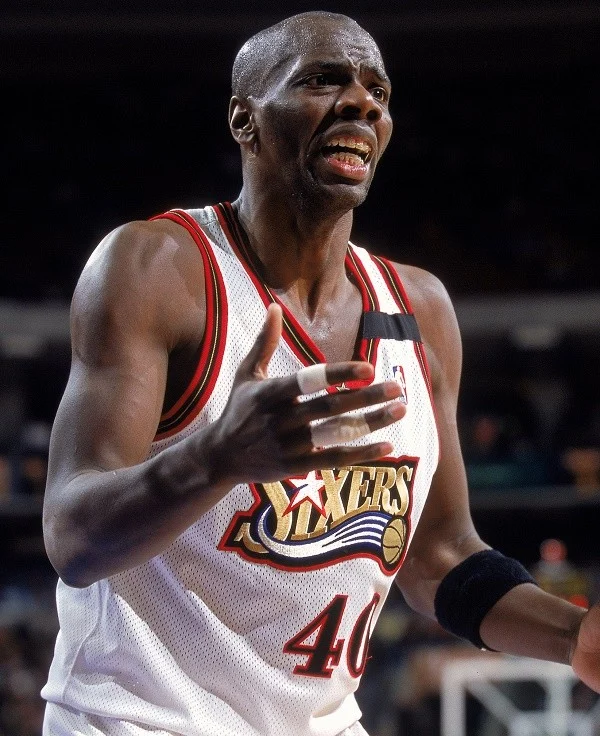
Hill joined the Philadelphia 76ers in March 1999. The team was built around Iverson’s scoring ability, supported by players who contributed through defense, rebounding and physical play.
Under coach Larry Brown, Philadelphia developed into one of the Eastern Conference’s leading teams. Hill fitted into the system because of his ability to defend the paint, collect rebounds and score efficiently near the basket.
During the 1999-2000 season, he started 65 of 68 games and averaged 12 points and 9.2 rebounds per game. He helped the 76ers win 49 games and advance to the Eastern Conference semifinals.
The following season proved even more memorable. Philadelphia finished the 2000-01 regular season with a 56-26 record, securing the best record in the Eastern Conference. Iverson won the NBA Most Valuable Player Award, while Brown was named Coach of the Year.
Hill appeared in 76 regular-season games, starting 75, and averaged 9.6 points and nine rebounds. His contribution became particularly important after Philadelphia acquired centre Dikembe Mutombo from Atlanta in February 2001.
The 76ers defeated the Indiana Pacers in the first playoff round before winning difficult seven-game series against the Toronto Raptors and Milwaukee Bucks. Those victories sent Philadelphia to the NBA Finals for the first time since 1983.
In the Finals, Philadelphia faced the Los Angeles Lakers, led by Shaquille O’Neal and Kobe Bryant. The Lakers had swept their first three playoff opponents and entered the series as favourites.
Philadelphia won Game 1 by 107-101 in overtime, with Iverson scoring 48 points. The victory proved to be the Lakers’ only defeat during that year’s playoffs.
The Lakers ultimately won the series in five games, but Hill had played an important role in Philadelphia’s run. He started all 23 of the team’s playoff games, averaging 7.2 points and 7.3 rebounds while playing more than 32 minutes per game.
Although Hill was not the team’s leading scorer, his rebounding, defense and physical presence helped the 76ers compete against some of the NBA’s strongest teams.
Final NBA Seasons and Retirement
After the 2001 NBA Finals, Philadelphia traded Hill and Jumaine Jones to the Cleveland Cavaliers in exchange for Matt Harpring, Cedric Henderson and Robert Traylor.
Hill returned to Cleveland for the 2001-02 season, but injuries restricted him to 26 games. When available, he remained an effective rebounder, averaging eight points and 10.5 rebounds per game.
He continued with Cleveland during the 2002-03 season before returning to Philadelphia in March 2003. He appeared in 24 regular-season games for the 76ers and contributed during the team’s playoff campaign.
Hill’s final NBA stint came with the Miami Heat during the 2003-04 season. He appeared in five games, averaging 1.8 points and 1.6 rebounds, before bringing his playing career to an end.
Across 14 NBA seasons, Hill appeared in 801 regular-season games, starting 610. He finished with 7,532 points, 6,854 rebounds, 647 assists, 614 steals and 379 blocked shots.
His career averages were 9.4 points, 8.6 rebounds and 0.8 assists per game, with a field-goal percentage of 50.2%. He also appeared in 74 postseason games.
Hill never won an NBA championship, but his consistency as a rebounder and interior defender made him a valuable player for several teams during the 1990s and early 2000s.
Tyrone Hill’s NBA Salary
NBA salaries were the main source of Hill’s wealth. Across his professional playing career, he earned approximately $51 million in NBA salary before taxes, according to the figures provided.
His earnings increased as he moved from being a young player with Golden State to an established starter and All-Star in Cleveland. By the 1996-97 season, his annual salary had reached approximately $3.48 million.
His earnings rose further after his move to Milwaukee. During the 1998-99 season, he earned approximately $5.35 million.
Hill’s highest-paid season came in 2000-01, when he received about $7.3 million while playing for the Philadelphia 76ers. The team reached the NBA Finals that season, further cementing his place among the league’s established veteran players.
His contracts continued to provide substantial income during the final years of his playing career. Following his return to Cleveland in 2001, he was scheduled to earn approximately $6.6 million during the upcoming season, with his contract running through 2002-03.
These salaries represented gross earnings before taxes, agent fees, living expenses and other costs. His current net worth is therefore different from the total amount he earned during his NBA career.
Hill’s long career enabled him to benefit from increasing NBA salaries during the 1990s and early 2000s. His estimated $20 million net worth reflects his playing income and other business activities, although a detailed public breakdown of his assets and investments is not available in the information provided.

All Net Records and Music Business
Outside basketball, Hill pursued an interest in the music industry by establishing All Net Records in Cincinnati.
The independent label focused on hip-hop and R&B and operated primarily during the second half of the 1990s. Hill remained involved in basketball while taking part in artist development, promotion and efforts to secure distribution for the label’s releases.
His brother, Aaron Hill, served as the company’s senior vice president. The label worked with artists including OTR Clique, D’Meka and the R&B group Renaizzance.
Among its releases was OTR Clique’s 1995 album Streets Deeper Than the Grave. The group later released The Rap Game in 1996, while D’Meka released Now… Feel Me! in 1997.
D’Meka’s album featured contributions from musicians and producers including Bootsy Collins and Stevie J. It also included the song “Money Stacks,” featuring UGK members Bun B and Pimp C.
In a 1997 interview about professional athletes entering the recording business, Hill said he devoted two or three days each week during the basketball offseason to promoting his artists. His activities included contacting radio stations, visiting record stores and seeking broader distribution.
The label also pursued distribution opportunities with larger music companies. By 1998, All Net Records had reportedly secured a distribution agreement involving Platinum Entertainment, a company affiliated with PolyGram.
The business released several albums and singles between 1995 and 1999 before ceasing operations. Although its financial performance is not publicly detailed in the information provided, the venture demonstrated Hill’s interest in entrepreneurship beyond professional basketball.
Atlanta Hawks Coaching Career
After retiring as a player, Hill returned to the NBA in a coaching role. In 2008, he joined the Atlanta Hawks coaching staff under head coach Mike Woodson.
Hill brought nearly 14 seasons of professional playing experience to the role. His work included helping frontcourt players improve their rebounding, defensive positioning and scoring around the basket.
The Hawks roster during his time with the team included players such as Joe Johnson, Josh Smith, Al Horford and Marvin Williams. Atlanta qualified for the playoffs in 2009 and 2010, reaching the Eastern Conference semifinals in both seasons.
Hill remained with the organisation after Larry Drew replaced Woodson as head coach in 2010. He continued working with the team before his tenure ended in 2012, when Atlanta reorganised its coaching staff.
His coaching career allowed him to remain connected to the NBA and pass on lessons from his years as a professional player. However, his coaching salary and total earnings from this role are not specified in the information provided.
Awards and Recognition
Hill earned recognition at both college and professional levels. At Xavier University, he was named the Midwestern Collegiate Conference Player of the Year in 1990 and later entered the school’s Athletics Hall of Fame in 1996.
Xavier retired his No. 42 jersey in 1997, recognising his contributions to the university’s basketball programme. He remains the school’s all-time leading rebounder, with 1,380 rebounds during his college career.
In the NBA, his most notable individual honour was his 1995 All-Star selection with Cleveland. He also played an important role in Philadelphia’s run to the 2001 NBA Finals.
In 2024, Hill was inducted into the Ohio Basketball Hall of Fame, recognising his achievements at Withrow High School, Xavier University and in professional basketball.
These honours reflect a career built on consistent performance, rebounding and defense rather than high-volume scoring.
Also Read: Robert Smith Net Worth

