

UDA aspirants in Kisii grow restless as 2027 race takes shape

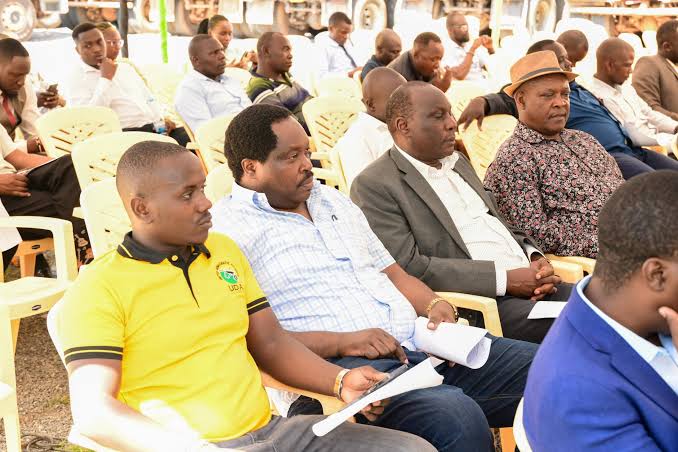
Political aspirants seeking the United Democratic Alliance (UDA) ticket in the 2027 General Election in Kisii are growing increasingly anxious as uncertainty persists over the ruling party’s strategy in Gusii politics.
The unease is being fuelled by fears that UDA could remain non-committal on fielding candidates in some races to avoid what party insiders describe as “friendly fire” with its broad-based government partner, the Orange Democratic Movement (ODM).
By Friday, several aspirants said they remained in limbo, with some privately expressing concern over whether they would be allowed to pursue their ambitions under the UDA banner. Others were already weighing their political options.
By Saturday, at least one female politician had reportedly registered interest in contesting the governorship on a UDA ticket.
Three other aspirants had registered interest in the senatorial race, while five women were said to be seeking the party’s nomination for the Woman Representative seat.
There are also whispers of high-profile entrants in the coming weeks.
A party insider told KahawaTungu that former Kisii Governor James Ongwae was considering a Senate bid, while former State Department administrative official Gideon Oyagi Nyandiricha was being linked to the governorship.
A source close to Mr Nyandiricha did not deny the possibility but said it was too early to discuss his political ambitions because he remains in public service.
“He is currently concentrating on serving Kenyans. More information about his bid, if it shall be there, will come later. It is not an opportune time to talk,” the source said before ending the call.
The source later called back and appeared more categorical.
“It is not a matter of if but when,” the source said.
Some UDA officials, however, insisted that no formal decision had been made regarding the two potential candidates.
“There is information circulating, but we have not keyed their names into the roll. Some are giving verbal intent, but nothing much from there,” a party official said on condition of anonymity.
Mr Ongwae is a board official at the Communications Authority of Kenya, while Mr Nyandiricha is a County Commissioner.
Attempts to obtain comments from the two were unsuccessful.
Arati factor
The uncertainty has been compounded by debate within UDA over whether the party should field a candidate against Kisii Governor Simba Arati.
A UDA official said that although there was agitation from several quarters for the party to field candidates in all elective positions, some sitting UDA-affiliated MPs from the region were opposed to directly challenging Mr Arati.
“The mood, especially from MPs like Sylvanus Osoro, who is also the party chief whip, is that we should not field challengers against him,” the official said late Friday.
Mr Arati is the Deputy ODM party leader and has emerged as one of the most vocal politicians pushing President William Ruto to consider ODM’s demand for the Deputy President position in the 2027 political arrangement.
The UDA official said failure by the party leadership to provide clarity could force some aspirants to seek alternative political vehicles.
“If no communication is forthcoming, especially from the President, who is the ultimate party boss, then the pair may opt for a friendly party outside UDA,” he said.
“Of course they will support the President in his two-term push. There is no doubt about it,” he added.
Behind the scenes, some hopefuls said they had been quietly building grassroots networks while waiting for clearer signals from the party.
The uncertainty is significant because UDA already commands a sizeable parliamentary foothold in the region, with four MPs elected on its ticket.
However, translating that parliamentary presence into dominance in countywide contests could prove more difficult.
Broad-based government
The political arithmetic has also been complicated by the broad-based government arrangement between President Ruto’s Kenya Kwanza administration and ODM.
Caleb Ondieki, a UDA operative in Kisii, said agreements between the two political formations could influence the party’s 2027 calculations, particularly in areas where both parties have significant political interests.
He said he was also waiting for communication on the way forward for aspirants in the Kisii region.
“What we know is that they have been told to join the respective forum for aspirants, and I am seeing most doing so, which is a good pointer of commitment to our party,” Mr Ondieki said by phone.
For many aspirants, however, the central question is whether UDA will compete aggressively for every major seat in Gusii land or make concessions as part of wider political negotiations.
They also want to know how the party intends to deal with hopefuls who are growing frustrated by what they regard as slow communication from the party machinery.
The dilemma is increasingly becoming urgent for those who have to decide whether to continue investing in UDA or explore alternative political platforms.
“You can agree with me that time is not on our side and President William Ruto should know this. We hope he will address this soon when he visits Kisii,” one aspirant said.
For many of them, time is money.
Grassroots networks must be built, campaign teams assembled, alliances negotiated and resources mobilised long before election day.
Every month of uncertainty can therefore leave an aspirant politically exposed and give rivals an opportunity to consolidate their support.
Still, the reassurance from some UDA officials may not settle the bigger question confronting the ruling party in Kisii.
UDA must balance the ambitions of its aspirants with the broader political calculations of its national leadership. It must also prevent internal frustration from turning into defections or open rebellion.
Its four MPs provide a foundation, but county politics is shaped by personalities, grassroots structures, alliances, local loyalties and perceptions of electability.
The coming months could therefore determine whether UDA consolidates its gains in Gusii land or begins losing aspirants to rival political formations.
For voters, the unfolding drama will provide an early test of UDA’s credibility as the ruling party.
The central question is whether it will mount a full-scale electoral assault in Gusii land, negotiate selective arrangements with ODM, or leave some races open as part of a broader national deal.
For now, aspirants remain in the waiting room.
But patience is wearing thin.
Unless UDA moves to define its Gusii strategy, the scramble for tickets could expose deeper fault lines within the party long before the 2027 campaign officially begins.

