

UK government says it’s likely to challenge $110 billion Paramount-Warner Bros. merger

UK government says it’s likely to challenge $110 billion Paramount-Warner Bros. merger
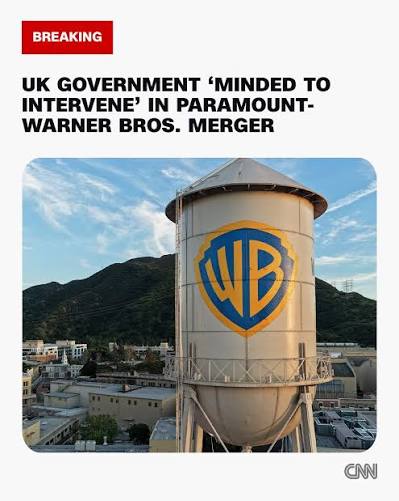
The British government said on Tuesday that it is likely to challenge Paramount Skydance’s takeover of Warner Bros. Discovery, potentially complicating the finalization of the $110 billion merger.
The British culture minister Lisa Nandy said in a statement that she was “minded to intervene” in Paramount’s quest to acquire CNN, HBO, the Warner Bros. movie studio and other Warner Bros. Discovery assets, citing concerns about its potential impact on media diversity.
“Following engagement with the parties and independent research, my Department has today written to the current and proposed owners of Warner Bros Discovery on my behalf to inform them that I am minded to intervene,” Nandy said in a statement.
In the UK, the term “minded to” is used by government officials to announce they will make a move before taking the legal steps to do so.
Nandy said she has not made a “final decision on intervention at this stage.” The companies now have a week to respond to her letter.
But Nandy clearly intends to intervene, and if she moves forward, the probe will be a significant hurdle for Paramount to overcome. The British media regulator, Ofcom, would be tasked with assessing the deal, on top of the Competition and Markets Authority probe that’s already underway.
Nandy said she was considering intervening on public interest grounds, including ensuring there is a “sufficient plurality of views in news media” and a “sufficient plurality of persons with control of the media enterprises.”
A Warner Bros. Discovery spokesperson declined to comment on Nandy’s statement.
A Paramount spokesperson told CNN: “We are grateful for the continued constructive engagement with all interested government bodies and relevant authorities, including in the UK. We are confident that our proposed transaction does not pose any media plurality issues in the UK and remain confident in our stated transaction timeline.”
Paramount has said that it expects the deal to take effect in the third quarter of this year, meaning by the end of September. Corporate meetings about how to integrate Paramount and WBD have been taking place for months already.
If Paramount doesn’t secure all the necessary approvals by the end of September, a deal-sweetener kicks in, adding 25 cents per WBD share per quarter to the cost of the deal until it is approved.
That would add $627 million to the cost of the overall deal each quarter, or roughly $7 million per day, creating even more of a financial incentive for Paramount to get the deal done swiftly.
But a review by Ofcom would take weeks at a minimum, and could wind up taking months.
Regulators in the EU have also been examining the deal, though the European Commission is not expected to stand in the way.
Paramount has already cleared regulatory hurdles in many other countries, including in the US, where the Justice Department signed off on the deal earlier in June without requiring any concessions. Critics have charged Paramount with cozying up to the Trump administration to win favorable treatment from the Justice Department.
The Justice Department said in a statement justifying the approval that “the transaction is not likely to result in harm to competition or American consumers.”
A federal committee in the US is still assessing the deal’s reliance on financing from Middle Eastern countries. FCC chair Brendan Carr said “we will go where the facts take us based on those reviews.”
A coalition of state-level attorneys general in the US are also scrutinizing Paramount-WBD, and analysts expect that they’ll sue to block the merger this summer.
Appearing on MS NOW last weekend, California attorney general Rob Bonta repeated his view that “there are red flags in the air everywhere” with the Paramount deal.
Bonta added, “We’ll make a decision in the coming weeks.”
Paramount executives have argued that an antitrust suit by the states would be meritless.
“This deal is pro-competitive, resulting in a stronger company better positioned to compete against dominant technology platforms in an industry increasingly defined by intense competition for audiences, talent, technology, and investment,” the company said earlier this month.
By CNN