


Unemployment ranked first as the most critical problem facing the country today followed by corruption, poverty and high cost of living.
The other problems are, inadequate health care, poor infrastructure and poor leadership.
The National Ethics and Corruption Survey, 2024 shows giving of bribes (52.1%) was the most common form of corruption witnessed in public offices.
This was followed by receiving of bribes (41.9%), favoritism (22.5%), abuse of office (14.6%), tribalism and nepotism (11.8%) and embezzlement of public funds (11.7%).
The proportion of those who encountered bribery (demanded, expected and offered) was 30.5 percent.
About 19 percent were explicitly asked for a bribe, 10.7 percent were implicitly expected to pay a bribe while 0.9 percent offered to pay a bribe on their own volition.
The report says there is a likelihood that each time one seeks to obtaining placement from Teachers Service Commission (TSC), a service seeker is likely to be asked for a bribe 1.58 times.
Other services where a service seeker is likely to be asked for a bribe 1 time include application for a bursary (CDF), an application for college admission, application for NSSF and SHIF cards; and county inspectorate, land survey and housing, and, public works services among others.
“There is a likelihood that each time a service is sought in the Ministry of Labour and Social Protection and in the Teachers Service Commission (TSC) one is likely to be asked for a bribe 1.25 times and 1.11 times, respectively,” the report says.
Each time a service is sought in Kwale, Kilifi and Wajir counties one is likely to be asked for a bribe 1.09 times, 1.03 times and 1.02 times, respectively.
It added a bribe was paid each time a service seeker sought to apply for college admission, apply for SHIF card, sought for county inspectorate, land survey and housing, and, public works services; among others.
“Assistant County Commissioners’ office and County Administration, Education, Public Works and Transport Departments were institutions where bribery was most prevalent, among others. Each time service seekers sought services from these institutions they paid a bribe.”
Elgeyo-Marakwet, Marsabit and Wajir were counties where bribery was most prevalent with all respondents who sought services in these counties paying a bribe.
The indicator reveals that impact of bribery on service delivery is more evident in seeking payment from county executive. Each time a person paid a bribe for this service, they were twice more likely to receive the service than if they did not pay the bribe;
The indicator revealed that impact of bribery on public institutions is more evident in Nanyuki Water and Sewerage Company. Each time a person paid a bribe in this institution, they were twice more likely to receive a service than if they did not pay the bribe.
The impact indicator revealed that bribe payment had the highest impact in Kakamega, Baringo and Meru counties. Each time a person paid a bribe in Kakamega, Baringo and Meru counties, they were 1.37 times and 1.07 times more likely to receive the service, respectively, than if they did not pay the bribe.
The proportion of respondents who were asked to pay a bribe in order to receive a service increased to 25.4 percent in 2024 from 17.7 percent in 2023;
The national average bribe stood at Sh4,878 in 2024 while on average, services where respondents paid the largest amount of bribes were while seeking employment from the county executive (Sh243,651), followed by obtaining a tender from the national government (Sh100,000) and obtaining a TSC placement (Sh72,665).
On average, institutions where respondents paid the largest amount of bribes were the Kenya Wildlife Service (Sh200,000), followed by the National Social Security Fund (NSSF) (Sh47,129) and the National Treasury (Pensions Department) (Sh40,000).
Further, on average, counties where respondents paid the largest amount of bribes were Uasin-Gishu (Sh25,873), followed by Baringo (Sh16,156), Embu (Sh12,878), Homabay (Sh12,381), Bomet (Sh11,650), Kakamega (Sh10,013), Tana-River (Sh9,582), Kiambu (Sh7,982), Nyamira (Sh7,748) and Wajir (Sh7,275).
Most of the respondents (43.3%) paid a bribe because it was demanded, followed by 23.3 percent who indicated it was the only way to access a service and 18 percent who paid to avoid delay in service; and,
Majority (97.2%) of the respondents who experienced bribery incidences did not complain or report to any authority or person while only 2.8 percent reported.
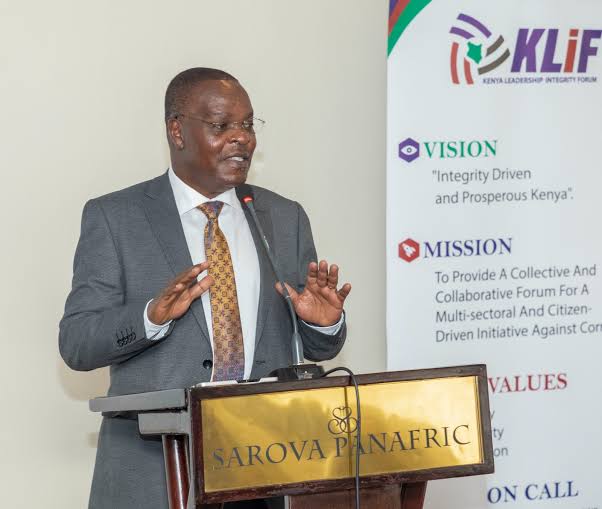
The report was launched by top EACC officials led by the CEO Abdi Mohamud and Chairman David Oginde.
It said the largest share of national bribe was paid in seeking employment from the county executive (30.99%), followed by obtaining a tender from the national government (12.72%), and obtaining a TSC placement (9.24%).
Kenya Wildlife Service received the largest share of national bribe of 35.73 percent, followed by the National Social Security Fund (NSSF) (8.42%) and the National Treasury (Pensions Department) (7.15%) while the largest share of national bribe was paid in Uasin-Gishu County (11.12%), followed by Baringo (6.94%), Embu (5.54%), Homabay (5.32%), Bomet (5.01%), Kakamega (4.30%), Tana-River (4.12%), Kiambu (3.43%), Nyamira (3.33%) and Wajir (3.13%) counties.
The report said about 74 percent of the respondents received information on unethical practices and corruption through the radio, followed by television (64.6%), social media(32.6%) and by word of mouth (16.0%) respectively.
Facebook was the most preferred social media platform for accessing anti-corruption information as mentioned by 45.5% of the respondents, followed by Whatsapp (23.5%), X-Formerly Twitter (9.3%), Tiktok (8.8%), Youtube (7.4%) and Instagram (2.3%).
EACC wants to undertake undertake system examinations in institutions and counties where bribery was either most likely or prevalent including TSC, Pensions Department (National Treasury), KRA, KWS, NLC, and CDF at the national level. At county level, Uasin-Gishu, Baringo, Kakamega, Tana-River, Wajir, Meru, Marsabit and Muranga counties.
“This will ensure anti-corruption measures, including policy reforms, procedures and practices are undertaken and thus proactively addressing risks, strengthen compliance efforts and safeguard institutions and clients from unethical practices,” the commission says.
EACC wants Parliament to fast track the enactment of the whistle blower’s bill, 2021 to encourage reporting of corruption and unethical conduct. since corruption reporting is low due to fear of victimization by the whistle blowers.
“The Ministry of Education should continuously review and enhance training in ethics, integrity and anti-corruption in institutions of learning.”
The commission also wants public institutions to develop robust policies and procedures that help establish clear guidelines, promote ethical decision-making, and ensure accountability in service delivery.
“Foster a speak-up culture in government institutions, private sector and the public. Allow employees and citizens to speak and communicate any malpractices without fear or favour.”
Email your news TIPS to Editor@Kahawatungu.com — this is our only official communication channel
