

What Was J. P. Morgan Net Worth?
- P. Morgan was an American businessman, banker, and financier who had an estimated net worth of $120 million at the time of his death in 1913. In today’s money, his fortune would be worth approximately $25 billion to $45 billion, depending on how his real estate holdings, art collection, and other assets are valued.
Morgan was one of the most powerful financiers of the late 19th and early 20th centuries. He played a major role in shaping American industry and finance by reorganizing struggling companies, financing major corporations, and consolidating entire industries.
A significant portion of his wealth came from his ownership interests in banks in New York and Philadelphia. However, his influence extended far beyond his personal fortune. Through his investment banking firm, J. P. Morgan & Company, he became a central figure in the development of American capitalism.
Morgan was instrumental in the creation of some of the largest corporations in American history, including General Electric and U.S. Steel. In 1901, he helped create U.S. Steel by acquiring and consolidating Andrew Carnegie’s steel business with other companies. The resulting corporation became the world’s first billion-dollar company.
Morgan also played a critical role in the American railroad industry and helped stabilize the country’s financial system during the Panic of 1907.
By the time of his death, J. P. Morgan had become one of the most influential figures in global finance. His name remains associated with one of the world’s largest financial institutions, JPMorgan Chase.
| J. P. Morgan Net Worth | $120 Billion |
| Date of Birth | April 17, 1837 |
| Place of Birth | Hartford, Connecticut |
Early Life
John Pierpont Morgan, commonly known as J. P. Morgan, was born on April 17, 1837, in Hartford, Connecticut.
His father, Junius Spencer Morgan, was a successful financier and a member of the prominent Morgan family.
Morgan received a strong education focused on business and languages. He attended the English High School of Boston before studying French at a school in Switzerland. He later attended the University of Göttingen in Germany, where he studied German.
His education prepared him for a career in international banking.
In 1857, Morgan began working at the London branch of Peabody, Morgan & Co., a financial firm co-founded by his father and businessman George Peabody.
After spending a short period in London, Morgan moved to New York City and joined Duncan, Sherman & Company, a banking firm connected to his father’s business interests.
During the American Civil War, Morgan avoided military service by paying $300 for a substitute to serve in his place, a practice that was legal at the time.
In 1864, his father’s business was renamed J. S. Morgan & Co. following the retirement of George Peabody.
The Creation of J. P. Morgan & Company
Morgan’s career took a major step forward in 1871 when he partnered with the Drexel family of Philadelphia to establish Drexel, Morgan & Company.
The firm specialized in investment banking and quickly became one of the most influential financial institutions in the United States.
Following the death of Anthony Drexel, the company was eventually renamed J. P. Morgan & Company in 1895.
Morgan maintained close relationships with other major financial institutions, including his father’s firm in London and banking houses in Philadelphia and Paris.
His growing influence allowed him to finance major industrial projects and reorganize companies across the United States.
By the beginning of the 20th century, J. P. Morgan & Company had become one of the most powerful investment banking firms in the world.
Morganization and the Railroad Empire
P. Morgan became particularly famous for his work in the American railroad industry.
During the late 19th century, the railroad sector was highly competitive and often financially unstable. Morgan saw an opportunity to consolidate competing companies and improve their management.
He became involved in the restructuring of several major railroads, including the Albany and Susquehanna Railroad, Philadelphia & Reading Railroad, and Chesapeake & Ohio Railroad.
His approach involved reorganizing debt, replacing inefficient management, and bringing in new investors.
Morgan also sought to reduce destructive competition among railroad companies. In 1889 and 1890, he organized meetings involving railroad executives to establish agreements on issues such as maintenance and pricing.
His efforts helped create a more organized railroad industry, although critics argued that his enormous influence gave him excessive control over the American economy.
P. Morgan and U.S. Steel
One of Morgan’s greatest achievements was the creation of U.S. Steel.
In 1900, Morgan negotiated with Andrew Carnegie and Charles M. Schwab to acquire Carnegie’s steel business.
Morgan then combined Carnegie’s operations with several other steel and iron companies to create the United States Steel Corporation.
The new company had an authorized capitalization of approximately $1.4 billion, making it the first billion-dollar corporation in the world.
The creation of U.S. Steel was a landmark moment in American business history.
The deal also transformed Carnegie’s enormous personal fortune. Carnegie reportedly received approximately $225 million in bonds as part of the transaction, making him one of the wealthiest people in history.
For Morgan, the deal demonstrated his ability to bring together competing businesses and create massive industrial corporations.
P. Morgan and General Electric
Morgan also played a significant role in the development of General Electric.
He was involved in financing and consolidating companies connected to Thomas Edison’s electrical businesses.
The consolidation of competing electrical companies helped create General Electric, which became one of the most important industrial corporations in American history.
Morgan’s involvement in the electrical industry demonstrated the breadth of his influence across America’s rapidly expanding industrial economy.
P. Morgan During the Panic of 1907
Morgan’s influence extended beyond individual companies.
In 1907, the United States experienced a severe financial crisis known as the Panic of 1907.
As banks and financial institutions faced a liquidity crisis, Morgan used his wealth, influence, and relationships with other financiers to help stabilize the financial system.
Morgan reportedly gathered leading bankers and financiers in New York and helped coordinate efforts to prevent the collapse of major financial institutions.
At a time when the United States did not yet have a central bank capable of responding to such a crisis, Morgan effectively took on a role similar to that of a central banker.
His intervention helped restore confidence in the financial markets and prevent a wider economic collapse.
The crisis also strengthened calls for the creation of a permanent central banking system in the United States.
The Federal Reserve System was eventually established in 1913, shortly after Morgan’s death.

P. Morgan’s Art Collection
Morgan’s fortune was not limited to financial assets.
He was also an avid collector of art, books, manuscripts, and other valuable objects.
Over the course of his life, he assembled one of the world’s most important private collections.
His collection included paintings, rare books, manuscripts, decorative arts, and historical documents.
Much of the collection eventually became part of the institution now known as the Morgan Library & Museum in New York City.
His passion for collecting contributed significantly to the value of his estate and helped explain why estimates of his modern-day net worth vary widely.
P. Morgan’s Failed Investments
Despite his enormous success, Morgan also experienced business setbacks.
One of his notable unsuccessful ventures involved inventor Nikola Tesla.
Morgan invested $150,000 in Tesla’s efforts to develop a wireless communication system. In return, Morgan was expected to receive control of a significant portion of the associated patents.
However, the project changed significantly as Tesla pursued new ideas and altered his plans.
Morgan eventually declined to provide additional funding, and the project was never completed as originally envisioned.
Morgan also faced setbacks in his efforts to develop a subway project in London. His plans were blocked by competing interests, including those of transportation magnate Charles Tyson Yerkes.
Despite these failures, Morgan’s successful investments and financial deals vastly outweighed his losses.
Personal Life
- P. Morgan married Amelia Sturges, known as Mimi, in 1861. She died from illness the following year.
In 1865, Morgan married Frances Louisa Tracy, known as Fanny.
The couple had four children: Louisa Pierpont Morgan, J. P. Morgan Jr., Juliet Pierpont Morgan, and Anna Tracy Morgan.
Morgan was known for being private and disliked the intense public attention that accompanied his wealth and influence.
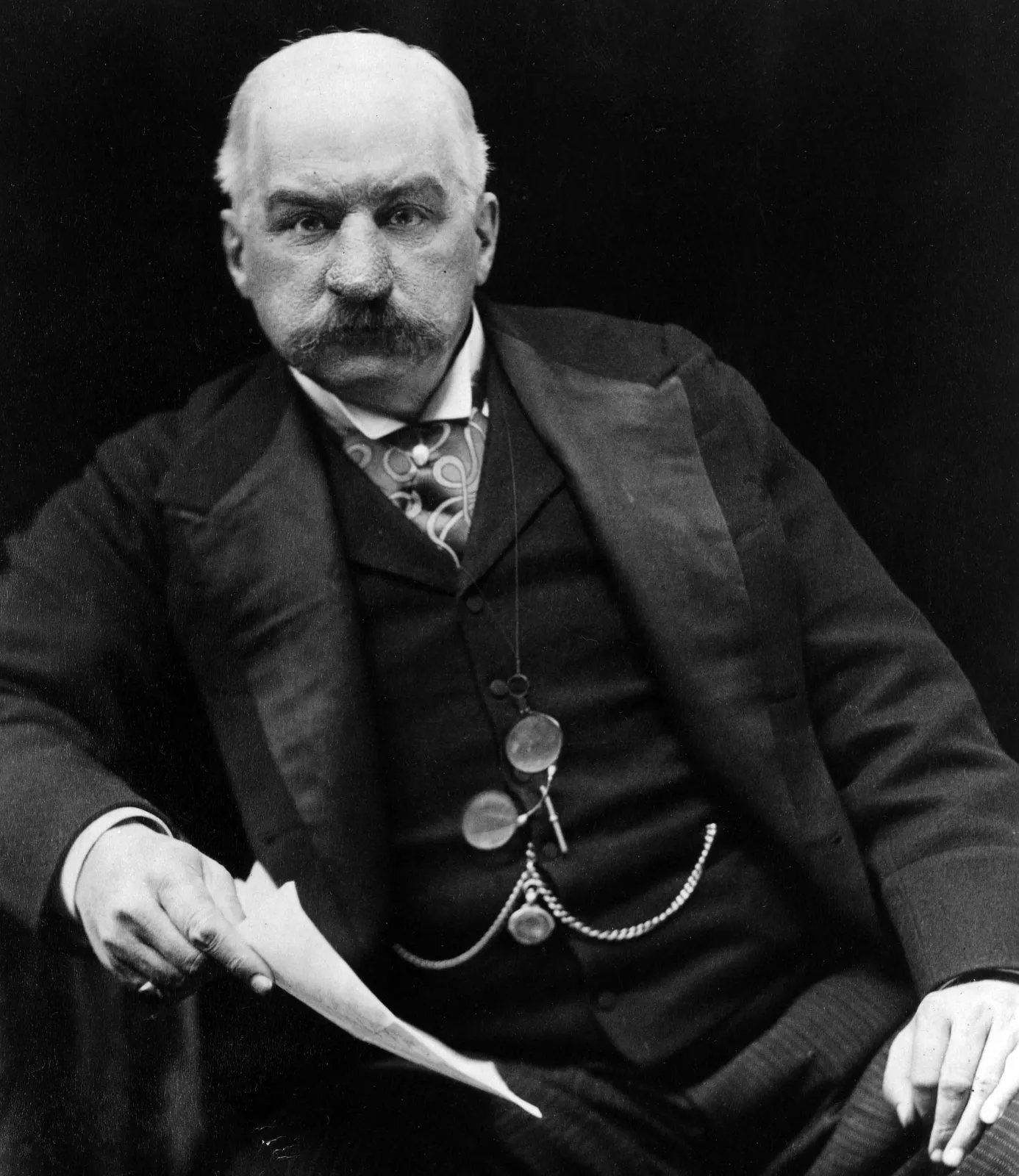
He also suffered from rosacea, a skin condition that caused significant changes to the appearance of his nose. His discomfort with his appearance contributed to his dislike of being photographed.
Morgan was a lifelong member of the Episcopal Church.
P. Morgan’s Death
P. Morgan died on March 31, 1913, while traveling in Europe.
He passed away in his sleep at the Grand Hotel Plaza in Rome, Italy.
He was 75 years old.
Following his death, his body was returned to the United States, where he was buried at Cedar Hill Cemetery in Hartford, Connecticut.
His death came at a major turning point in American financial history. The Federal Reserve System was established later in 1913, marking the beginning of a new era in the country’s banking system.
Also Read: What Was Cornelius Vanderbilt Net Worth?

