

When the springs run dry: Drought pushes Kisii families to the brink

When the springs run dry: Drought pushes Kisii families to the brink
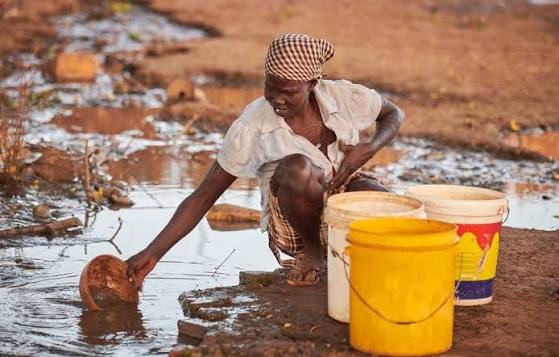
At dawn in Nyamesocho, Masaba South, the quiet of the countryside is increasingly broken by raised voices at the Rianyabicha water springs.
For years, the springs have been a lifeline for families in the area. But as a prolonged dry spell tightens its grip, the precious commodity has become a source of tension — and, increasingly, confrontation.
Two taps at the spring have already dried up, leaving residents to scramble for the little water that remains.
The situation is similar at a spring in neighbouring Ikenye, Gesusu Ward, where women and young girls spend hours in long queues waiting for their turn to collect water.
“It gets more insecure for our girls when night falls,” Jane Kerubo told KahawaTungu.
The water shortage is also disrupting economic activities, with some construction work reportedly slowing down because of inadequate water supplies.
At Nyamesocho, Assistant Chief Geoffrey Makori says the pressure on the remaining water sources has already triggered fights among residents.
“We have already witnessed women fighting at some of the springs as they scramble for water. The situation is becoming serious,” Makori says.
What was once an ordinary household chore has become a daily contest of patience and endurance.
A spot check of several springs across Kisii paints a grim picture.
Women arrive early, carrying jerrycans and buckets, hoping to be among the first to draw water. As the queues grow longer and the springs yield less, tempers sometimes flare.
In some areas, residents blame the planting of eucalyptus trees close to water sources for worsening the situation.
Makori says the trees could be contributing to the declining water levels and has called for better protection of springs and their surroundings.
“Some of these springs have been affected by eucalyptus trees planted near them. We need to rethink how we protect our water sources and the areas around them,” he says.
Wells that have traditionally supplied water to households have also started drying up, forcing residents to look for increasingly expensive alternatives.
For 92-year-old Moraa Obero, accessing water has become both physically and financially demanding.
She says she spends about Sh300 paying a labourer to fetch water for her from the local spring — a source that is itself steadily drying up.
The drought is also being felt in cattle sheds.
Pasture has become scarce, water is harder to find and cows are producing less milk.
For families that depend on milk sales to pay school fees, buy food and meet other household expenses, the decline in production is hitting hard.
“Milk production has gone down because our cows have little pasture and water. What we are producing is not enough even for our families,” says Samson Keronche.
The impact is now being felt by consumers.
With farmers producing less milk, traders say supplies have declined and prices have started rising, adding another burden to households already grappling with the rising cost of living.
“We used to sell several litres of milk every day. Now production has dropped sharply, yet the cost of feeding the animals continues to rise,” says farmer John Nyabicha.
Some shopkeepers say the situation has also affected supplies in the retail market, with milk becoming increasingly difficult to obtain in some outlets.
A packet of milk now retails for between Sh70 and Sh80 in some shops, fuelling frustration among consumers.
But perhaps the greatest concern for residents is what will happen if the rains continue to stay away.
Across the farming community, preparations for planting have been disrupted.
Farmers are caught between planting too early and risking their seeds, or waiting for the rains and possibly missing the planting season.
“We do not know when to plant. If we plant and the rains fail, we will lose our seeds. But if we wait too long, we may also miss the planting season,” says farmer Joyce Omari.
For a region where maize, beans, vegetables and livestock form the backbone of rural livelihoods, the uncertainty is unsettling.
The dry conditions are threatening not only household water supplies but also food production, livestock health and incomes.
And as the water sources shrink, so too does the margin for conflict-free access to the remaining supplies.
The drought is no longer simply about a missing rain cloud.
It is about the queue at the spring, the empty jerrycan, the shrinking milk in the bucket and the farmer staring anxiously at a dry field.
“If we do not protect the little water we have, the conflict will only become worse,” Makori says.
For now, the community waits — and watches the sky.

