

Where the road ends, survival begins in Masaba South, Kisii

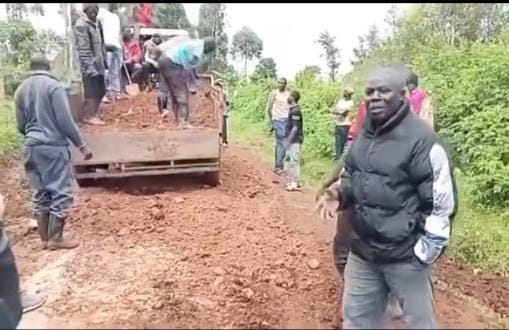
In the rain-battered villages of Masaba South, the familiar hum of motorcycle engines has been silenced—replaced by the scrape of shovels and the dull thud of stones pressed into wet earth.
Bodaboda riders who once earned a living ferrying passengers along the Masimba–Mogweko road are now its reluctant repair crew.
Beneath heavy skies and relentless rain, young men in rubber boots carve trenches through the mud, haul murram in hired trucks, and battle to redirect runoff that threatens to swallow entire sections of road. What should be routine government maintenance has become a daily fight for survival.
“By morning, this place is a swamp,” says John Onchomba, pausing to wipe mud from his hands.
“If we don’t fix it, we don’t work. And if we don’t work, we don’t eat.”
Across the constituency, roads are rapidly deteriorating into impassable stretches. Deep gullies snake across once-navigable paths, forcing residents to abandon vehicles and walk long distances.
Here, roads are not just infrastructure—they are lifelines.
But weeks of pounding rain have severed those lifelines, isolating villages and choking local livelihoods. Tea leaves rot at buying centres as delivery trucks arrive late or fail to arrive at all.
In some homes, children remain indoors, their uniforms untouched, unable to get to school. Expectant mothers are carried on makeshift stretchers when motorcycles can no longer pass. In the most heartbreaking scenes, coffins are borne on shoulders along muddy footpaths where vehicles dare not venture.
“These roads have become death traps,” says Mogire Keraka, a rider from Ramasha. “You can’t tell where the road ends and where danger begins.”
Out of the crisis, however, a quiet movement is emerging.
What began with bodaboda riders has grown into a community-wide effort. Along the Riombaso Junction–Ramasha and Nyanturago–Ramasha routes, residents are mobilising—bringing stones, pooling small contributions, and working side by side to reclaim what remains of their roads.
There is pride in their resolve—but also simmering anger.
Much of it is directed at area MP Daniel Manduku, whom residents accuse of failing to deliver long-promised road upgrades. Key routes, including the Riombaso Junction–Ramasha–Ekona–Getengerie road, were earmarked for tarmacking, but the projects have yet to materialise.
“We were told these roads would be tarmacked. We are still waiting,” says farmer Charles Mokoro, watching as villagers struggle to push a stuck motorcycle out of the mud. “Now we are doing the work that should have been done long ago.”
The frustration deepens as residents look beyond their borders. In neighbouring constituencies, they say, roads are being upgraded and maintained—often in areas represented by legislators aligned with William Ruto.
“We see development elsewhere,” one resident remarks. “It makes you wonder—are we not part of this country?”
Yet even amid the hardship, resilience endures.
Women arrive carrying stones in sacks. Elderly men offer guidance on drainage channels. Young riders, their motorcycles parked nearby, return again and again to reinforce sections washed away by the rain.
For now, the repairs are temporary—each downpour threatens to undo hours of backbreaking work.
Still, the community presses on, driven not by choice, but by necessity.
As one bodaboda rider lifts his shovel for another round, he sums up the spirit of Masaba South:
“No one is coming to save us. So we fix what we can.”

