


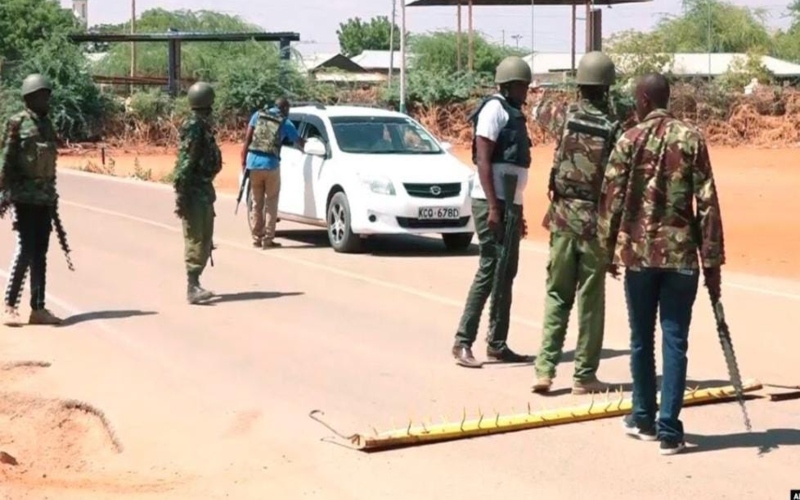
Police Tuesday dawn rescued 10 Chinese workers from an al-Shabaab night raid on a Chinese workers’ residence in Elwak, Mandera County.
Officials said all the 10 Chinese present were rescued in the dramatic attack.
Police said the attackers escaped after a long battle with security teams that were present.
The foreigners are involved in construction of roads in the area.
According to police, the gang had forcefully gained entry into the Chinese contractor’s residence located about a kilometre away from Elwak Police Station.
The incident, which happened at about 1:00 am, led to a heavy exchange of gunfire between the militia and police officers who were on guard at the residence, police and witnesses said.
The militia, who were armed with both crude and sophisticated weapons, demolished the main gate and damaged the perimeter barrier, police said.
Police said the militia had been transported to the area using four Toyota Probox vehicles, which gained entry into Elwak town from Buraache area along the border cutline routes.
The area is near the Kenya-Somalia border.
They positioned themselves on the opposite side of the road facing the main gate of the Chinese residence before opening fire.
The police officers on guard gallantly held their ground and successfully repulsed the attack, police said.
A team from the Border Patrol Unit (BPU) at Elwak reinforced the team on the ground in combined efforts that secured all 10 occupants of the house, police said.
Police said the militia damaged a police vehicle as well as five Toyota Hilux double-cabs, a grader machine and a water bowser that belonged to the Chinese company who are engaged in a project in the area.
Security agencies continue to enhance operations along the Kenya-Somalia border to avert continued attempts by the al-Shabaab militia to infiltrate the country.
Somalia has not had an effective central government since the 1991 overthrow of President Siad Barre’s military regime, which ushered in more than two decades of anarchy and conflict in a country deeply divided along clan lines.
Kenya launched Operation Linda Nchi on October 14, 2011, after gunmen seized tourists at the Coast, which the Government saw as a threat to the country’s sovereignty, as it targeted the nation’s economic lifeline-Tourism.
The latest IGAD analysis of the threat of terrorism in the Horn of Africa region, Kenya faced heightened vulnerability to cross-border spillovers from neighbouring conflict zones between July and September, a challenge now extending to the last quarter of the year.
The report by the IGAD’s Centre of Excellence for Preventing Violent Extremism (ICEPCVE) noted that although the overall scale of attacks declined, targeted and cross-border incidents persisted, underscoring the resilience and adaptability of violent extremist networks in the region.
As such, the quarter saw persistent militant activity across Somalia and Kenya’s border regions, with the conflict shifting toward asymmetric and technology-enhanced warfare amid intensified counterterrorism efforts.
“The use of drones, crypto-financing, and Houthi-linked weapons marked a new level of sophistication on both sides. August recorded a surge in attacks as militants retaliated against joint Somali-UPDF operations and international airstrikes, while by September the overall scale declined, though targeted and symbolic strikes persisted, showing adaptation rather than weakness,” the centre warns.
Kenya has enhanced operations to address the menace.
Email your news TIPS to Editor@Kahawatungu.com — this is our only official communication channel
