


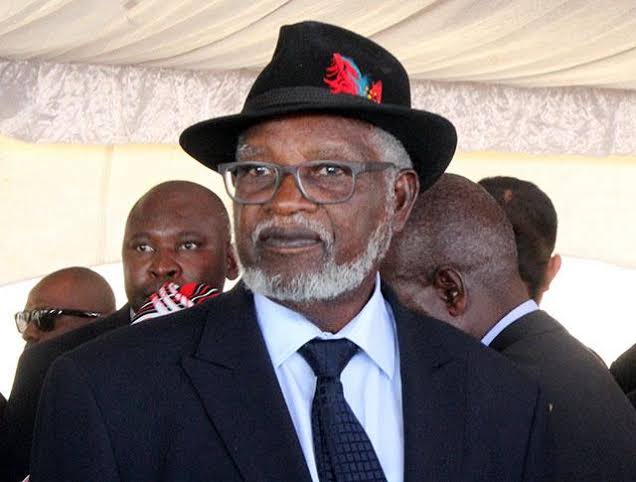
The first president of independent Namibia, Sam Nujoma, died at the age of 95 in the capital Windhoek, the country’s current leader announced.
Nujoma led the long fight for independence from South Africa in 1990 after helping found Namibia’s liberation movement known as the South West Peoples’ Organisation (Swapo) in the 1960s.
After independence, Nujoma became president in 1990 and led the country until 2005.
Nujoma had been hospitalised over the past three weeks with an illness from which he “could not recover”, Namibian President Nangolo Mbumba said in a statement announcing the death with “utmost sorrow and sadness”.
He “inspired us to rise to our feet and to become masters of this vast land of our ancestors,” President Mbumba said.
“Our founding father lived a long and consequential life during which he exceptionally served the people of his beloved country.”
Nujoma retired as head of state in 2005, but continued to lead the party before stepping down in 2007 as president of the ruling Swapo party after 47 years at the helm.
He was a longtime ally of Zimbabwean strongman Robert Mugabe, backing Mugabe’s land seizures from white farmers, though at home Nujoma stuck to a “willing buyer, willing seller” policy.
Nujoma served his three terms as president from 1990 to 2005 and sought to project himself as a unifying leader bridging political divides.
In a country scarred by the legacy of apartheid and German colonial rule, Nujoma’s SWAPO party oversaw a national reconciliation programme under the motto “One Namibia, One Nation”.
In his speeches, Nujoma made a point of repeating the phrase: “A united people, striving to achieve a common good for all members of the society, will always emerge victorious.”
His achievements included establishing democratic institutions and prioritising reconciliation, said Ndumba Kamwanyah, a lecturer at the University of Namibia and a political analyst.
But his autocratic tendencies, on display in his treatment of the media and brutal suppression of the 1999 Caprivi rebellion, cast a shadow over his legacy, Kamwanyah added.
“While Nujoma’s presidency was foundational in establishing Namibia’s independence and governance, it was not without flaws,” Kamwanyah said.
Nujoma was born in a village in northwestern Namibia in 1929, when his country was under South African administration. South Africa had controlled Namibia since World War One after a brutal few decades of German colonial rule remembered for the genocide of the Herero and Nama people.
As a boy he looked after his family’s cattle and attended a Finnish mission school, before moving to the coastal town of Walvis Bay and then the capital Windhoek, where he worked for South African Railways, according to a biography posted on the website of Nujoma’s charitable foundation.
Nujoma left his job on the railways to focus his energies on bringing down the apartheid system.
In the late 1950s he became leader of the Owambo People’s Organisation, a precursor to liberation movement SWAPO, organising resistance to the forced relocation of Black people in Windhoek that culminated in the police killing 12 unarmed people and wounding dozens more.
Nujoma was charged with organising the resistance and arrested. In 1960, he went into exile. He travelled across Africa before reaching the United States, where he petitioned the United Nations for Namibia’s independence.
Made SWAPO leader in absentia, Nujoma established its armed wing and in 1966 launched a guerrilla war against the apartheid government.
It took more than a decade of pressure from Nujoma and others before a U.N. Security Council resolution in 1978 proposed a ceasefire and elections, and another decade for the ceasefire deal to be signed and elections held in late 1989.
SWAPO won a majority in those elections, and Nujoma took office in March the following year.
By Agencies

Email your news TIPS to Editor@Kahawatungu.com — this is our only official communication channel
