


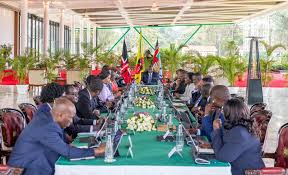
The Cabinet approved the establishment of the National Infrastructure Fund (NIF) and the Sovereign Wealth Fund (SWF).
These are key long-term transformation wagons shepherded by President William Ruto’s administration.
A Cabinet despatch said the NIF was approved as a limited liability company and will serve as the key engine for aligning the administration’s financial resources with national development priorities.
The government will source private sector capital to finance priority investments, with a key focus on reducing its reliance on borrowing and taxation.
According to the communiqué, all proceeds will be invested in “public infrastructure projects that generate and preserve long-term value”. “Every shilling invested through the Fund is expected to crowd in up to Ksh.10 additional shillings from long-term investors, including pension funds, sovereign partners, private equity funds and development finance institutions,” read the document in part.
The Sovereign Wealth Fund establishes a framework for the prudent management and investment of revenues from mineral and petroleum resources, dividends from public investments and a portion of privatisation proceeds through a dedicated national fund.
The principal purpose for the creation of an SWF is to protect a country’s economy, in this case, Kenya’s economy, from unforeseen and unpredictable events, such as a pandemic, or random wars that disrupt supply chains around the world such as the Russia/Ukraine war.
This will be the second time in Kenya’s history that the SWF will be introduced through the newly enacted SWF Bill, 2025. The Fund will be managed and invested for the benefit of current and future generations of citizens of Kenya.
In comparison to the first SWF Bill of 2014, the SWF bill of 2025 is coming back after ten years seeking to satisfy three broad purposes, including the stabilisation, strategic infrastructure Investment and the Future Generation (Urithi) or savings for the public.
“This financing architecture marks a decisive shift toward a sustainable, investment-led development model that mobilises capital, accelerates delivery, preserves national value and secures lasting prosperity for present and future generations,” the despatch added.
The NIF will be overseen by a competitively appointed Board and CEO, while the SWF will operate under a “robust policy framework” to ensure prudent investment, fiscal discipline and inter-generational equity.
President Ruto’s plans to effect a Ksh.5 trillion development project using the funds within 10 years.
During his State of the Nation address on November 20, he stated that the government is keen and set to undertake four game-changing projects within the public sectors of education, transport, energy and water irrigation.
There is an ambitious plan of constructing 50 mega dams, 200 mini-dams and over 1,000 micro-dams to reinforce food and water security, upscaling farming on an additional 2.5 million acres.
Dualling of 2,500km of highways and the tarmacking of 28,000km of roads, extension of the Standard Gauge Railway, expansion of regional oil pipelines, and modernisation of airports will also be undertaken to reinforce efficient transportation.
Email your news TIPS to Editor@Kahawatungu.com — this is our only official communication channel
