


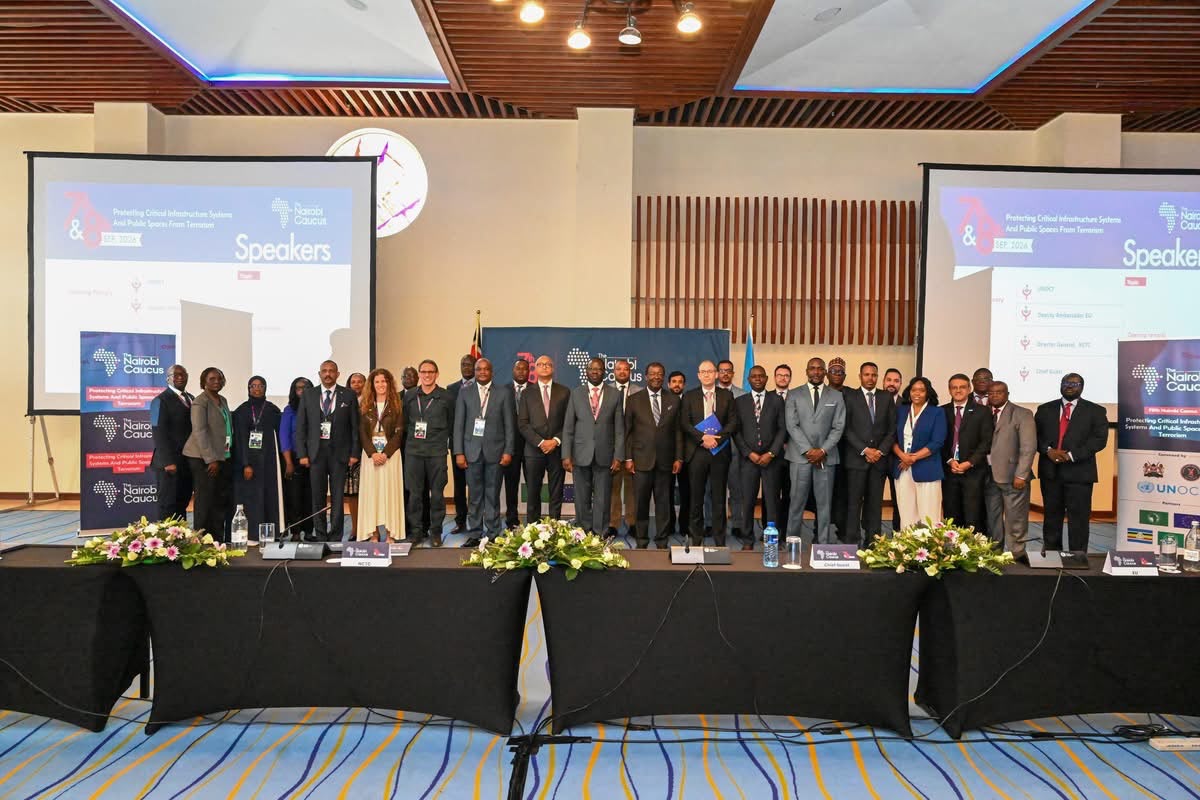
Prime Cabinet Secretary Musalia Mudavadi has warned that Kenya and the wider Horn of Africa face growing terrorism and cyber-terrorism threats targeting critical infrastructure, public spaces and essential services.
Mudavadi said Africa had become the global epicentre of terrorism, with six of the 10 countries most affected by terrorism located in sub-Saharan Africa.
He said the situation was particularly concerning in the Horn of Africa, where prolonged conflicts, weakening state institutions, humanitarian crises and the spillover of extremism linked to the Middle East conflict could worsen the security situation.
“The Horn of Africa is emerging as a global conflict and terrorism flashpoint,” Mudavadi said while addressing the Fifth Nairobi Caucus on Protecting Critical Infrastructure Systems and Public Spaces.
He cited the continued activities of Al-Shabaab and Islamic State-Somalia in Somalia and the wider region, noting that terrorist groups were increasingly targeting infrastructure and communication networks.
Mudavadi said al-Shabaab had in July targeted and damaged a Safaricom telecommunications mast in Garissa, disrupting regional communications and surveillance.
He added that the group continued to target communication networks, transport routes, public service vehicles, security patrols and security installations in Kenya’s northeastern and coastal border counties.
The Prime Cabinet Secretary also pointed to attacks in Mozambique’s Cabo Delgado Province, where a terrorist group calling itself Al-Shabaab had burned infrastructure, including a tourist lodge, saying the incidents demonstrated the need to strengthen protection of critical tourism facilities.
Mudavadi warned that the threat was no longer limited to conventional terrorist attacks, with digital systems and other virtual infrastructure increasingly vulnerable to cyberattacks.
“As our economies become more digitised, digital assets and other virtual critical infrastructure continue to face cyber-terrorism threats which are becoming more frequent and devastating,” he said.
He said cyberattacks could disrupt electricity grids, water systems, transport networks, financial services and other essential infrastructure, making it necessary to protect not only physical facilities but also the data, software, networks and human systems supporting them.
Mudavadi said Kenya had established a legal and institutional framework to combat terrorism, money laundering and cybercrime, including the Prevention of Terrorism Act, the Proceeds of Crime and Anti-Money Laundering Act and the Computer Misuse and Cybercrimes Act.
He also highlighted the Virtual Assets Service Providers Act, 2025, saying it represented an important step towards regulating and safeguarding digital assets.
The government, he said, was also considering establishing a Foreign Agents Registration framework requiring the registration and disclosure of foreign agents, lobbyists and foreign-funded activities.
Mudavadi said the proposed framework was intended to enhance transparency and safeguard Kenya’s national interests while ensuring legitimate international partnerships were not restricted.
“A nation that understands the foreign forces shaping its decisions is a nation that safeguards its sovereignty,” he said.
The Prime Cabinet Secretary further warned about the security of public spaces as Kenya approaches the 2027 General Election, noting that large campaign gatherings could present opportunities for terrorist attacks.
He urged security agencies and other stakeholders to remain vigilant against organised criminal gangs, warning that some gangs could evolve from petty crime into violent extremism.
Mudavadi also raised concerns over threats to critical maritime infrastructure, citing disruptions around the Strait of Hormuz and Bab el-Mandeb amid the Middle East crisis.
He said attacks or blockades affecting key maritime routes could have consequences far beyond the affected countries, given their importance to global trade and logistics.
Kenya’s Port of Mombasa, he noted, remains a critical regional logistics hub and therefore requires enhanced protection.
He similarly identified aviation hubs as critical infrastructure whose disruption could have far-reaching economic consequences.
Mudavadi said Kenya needed to move away from reactive responses to threats and instead develop proactive protective security systems.
He called for stronger information-sharing between government and the private sector, arguing that protecting critical infrastructure should be treated as a strategic investment rather than an operational expense.
He proposed five priorities: strengthening national and regional capacity to anticipate terrorist threats, institutionalising readiness, hardening critical infrastructure and public spaces, improving response capabilities, and developing comprehensive recovery and adaptation frameworks.
“These systems form the backbone of governance and the delivery of essential services. Their destruction or degradation can paralyse economies, compromise public safety and gravely undermine institutions and state stability,” Mudavadi said.
The Nairobi Caucus brings together Kenyan, African and international stakeholders to discuss ways of strengthening the protection of critical infrastructure and public spaces against evolving terrorism and security threats.
The meeting was addressed by the National Counter Terrorism Centre Director General Kibiego Kigen who called for sustained public engagement to create awareness of the terror menace.

Email your news TIPS to Editor@Kahawatungu.com — this is our only official communication channel
