

Bob Hawke Siblings: Get to Know Neil Hawke

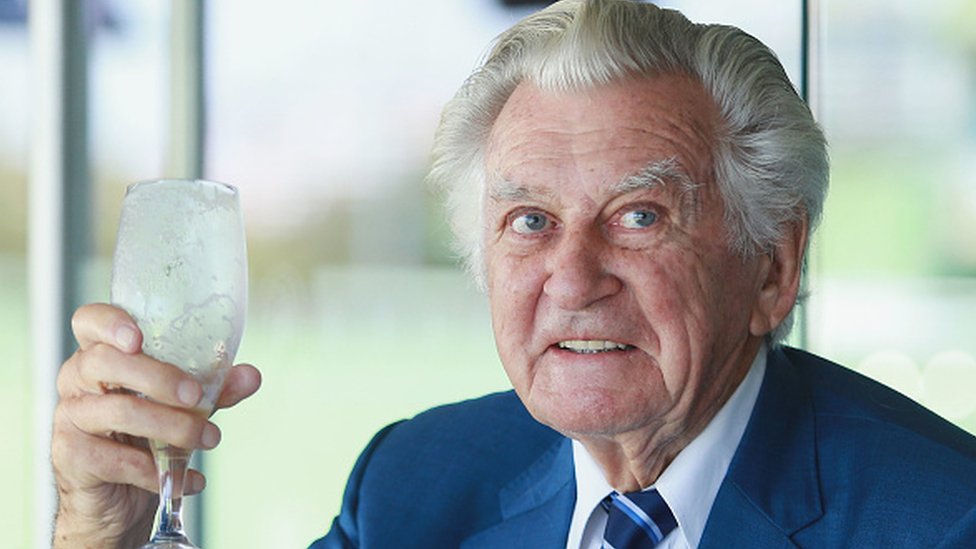
Bob Hawke PHOTO/BBC
Robert James Lee Hawke, universally known as Bob Hawke, was an Australian trade union leader and politician who served as the 23rd Prime Minister of Australia from 11 March 1983 to 20 December 1991.
Born on 9 December 1929 in Bordertown, South Australia, he was the younger son of Arthur Clarence “Clem” Hawke, a Congregationalist minister, and Edith Emily “Ellie” Lee, a schoolteacher, both of Cornish ancestry.
After the death of his older brother the family moved to Perth, Western Australia, where Hawke was educated at Perth Modern School and the University of Western Australia, graduating in arts and law.
He won a Rhodes Scholarship and studied at University College, Oxford, completing a Bachelor of Letters with a thesis on wage fixation.
Returning to Australia he joined the Australian Council of Trade Unions as a research officer and rose to become its president from 1969 to 1980, establishing a national reputation as a skilled negotiator and public figure.
He entered federal parliament in 1980, became Labor leader in early 1983, and led the party to four consecutive election victories.
Hawke died in Sydney on 16 May 2019 at the age of 89.
Siblings
Bob had one sibling, an older brother named Neil.
Neil was approximately seven to nine years older than Bob and died in 1939 at the age of seventeen or eighteen from meningitis, a disease for which there was then no effective cure.
The loss occurred when Bob was about nine or ten years old and had a profound effect on the family.
Their mother, Ellie, subsequently focused intense hopes and expectations on her remaining son, reinforcing a sense of destiny that Hawke himself later acknowledged.
After Neil’s death the family relocated from South Australia to Perth, Western Australia.
Also Read: Mario Draghi Siblings: Get to Know Andreina and Marcello Draghi
Career
Hawke joined the Australian Labor Party as a young man and, after university and Oxford, abandoned doctoral studies at the Australian National University to take a research position with the Australian Council of Trade Unions in 1958.
He quickly became the ACTU’s leading advocate in national wage cases and was elected president in 1969, a post he held until 1980.
In that role he resolved major industrial disputes, sat on bodies such as the Reserve Bank Board and the International Labour Organisation Governing Body, and became one of the most recognisable public figures in Australia.
He entered the House of Representatives in 1980 as the member for Wills in Melbourne.
In February 1983 he replaced Bill Hayden as Labor leader and, five weeks later, led the party to a landslide victory over Malcolm Fraser’s Coalition government.
As prime minister he convened a National Economic Summit that helped build consensus for major structural change.
His governments floated the Australian dollar, deregulated the financial system, reduced tariffs, introduced the Prices and Incomes Accord with the trade unions, re-established and expanded Medicare, created universal superannuation, advanced environmental protection including World Heritage listings, and pursued closer engagement with Asia.
Hawke won further elections in 1984, 1987 and 1990.
In December 1991 he was defeated in a Labor leadership ballot by his treasurer, Paul Keating, and retired from parliament the following year.
Accolades
Hawke was appointed a Companion of the Order of Australia (AC) in 1979, while still ACTU president.
He later received the Knight Grand Cordon of the Order of the White Elephant from Thailand, the Grand Companion of the Order of Logohu from Papua New Guinea, and the Grand Cordon of the Order of the Rising Sun from Japan.
He was widely regarded during and after his lifetime as one of Australia’s most successful and transformative prime ministers, credited with modernising the economy and strengthening the social safety net while maintaining strong popular appeal.

