

Brett Hull Siblings: All About the Hull Siblings


Former Ice Hockey player Brett Hull PHOTO/Pinterest
Brett Andrew Hull, born on August 9, 1964, in Belleville, Ontario, Canada, is a Canadian-American former professional ice hockey player, widely regarded as one of the National Hockey League’s (NHL) greatest goal scorers.
The son of hockey legend Bobby Hull, known as “the Golden Jet,” and professional figure skater Joanne McKay, Brett carved his own legacy in the sport, earning the nickname “the Golden Brett.”
With dual citizenship, he represented the United States in international competitions and played for NHL teams including the Calgary Flames, St. Louis Blues, Dallas Stars, Detroit Red Wings, and Phoenix Coyotes from 1986 to 2005.
Beyond his playing career, Hull transitioned into executive roles, currently serving as the executive vice president of the St. Louis Blues.
Siblings
Brett grew up in a family steeped in athletic talent, with four siblings, three brothers, Bobby Hull Jr., Blake Hull, and Bart Hull, and a younger sister, Michelle Hull.
Unlike Brett, who was born in Belleville, Ontario, during a family vacation, his siblings were all born in Chicago, Illinois, where their father played for the NHL’s Chicago Black Hawks.
Bobby Hull Jr. and Blake Hull both pursued hockey, playing at the junior and senior levels.
Bobby Jr. achieved success by winning the Memorial Cup with the 1980 Cornwall Royals, and later, he and Blake played together for the Allan Cup-winning Brantford Mott’s Clamatos in 1987 in the OHA Senior A Hockey League.
Bart Hull took a different path, excelling as a standout running back for Boise State University’s football team before briefly playing professional football in the Canadian Football League with the Ottawa Rough Riders and Saskatchewan Roughriders.
After injuries cut his football career short, Bart also played professional hockey briefly with the Idaho Steelheads.
Michelle Hull, the youngest, followed in their mother’s footsteps as an accomplished figure skater, becoming the British Columbia Pre-Novice Champion at age 11.
After their parents’ divorce in 1979, Brett, Bart, and Michelle moved to Vancouver with their mother, while Bobby Jr. and Blake remained connected to hockey in Canada.
Also Read: Nick Bateman Siblings: All About Amanda, Samantha and Nicole Cerny

Career
Despite his father’s fame, Hull faced challenges with his conditioning and skating, often criticized as a “one-dimensional” player early on.
He played junior hockey with the Penticton Knights in the British Columbia Junior Hockey League, where he set scoring records, and later starred at the University of Minnesota-Duluth, scoring 52 goals in the 1985–86 season.
Drafted by the Calgary Flames in the sixth round (117th overall) in 1984, Hull debuted in the NHL in 1986.
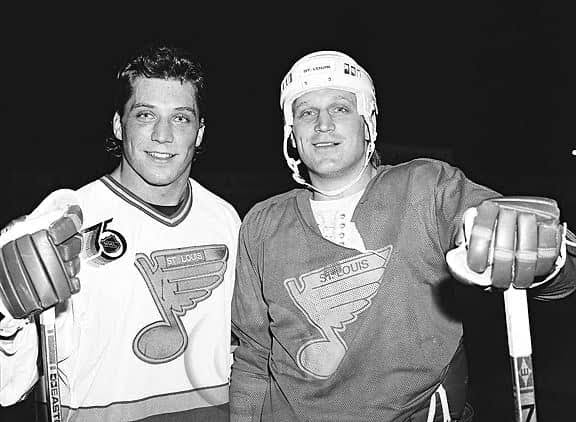
His breakout came after a 1988 trade to the St. Louis Blues, where he became a prolific scorer.
Paired with Adam Oates, Hull set an NHL record for a right winger with 86 goals in the 1990–91 season, the third-highest single-season total in league history.
He played 11 seasons with the Blues, cementing his legacy as their all-time leading goal scorer.
Hull later joined the Dallas Stars, scoring the controversial Stanley Cup-winning goal in 1999 against the Buffalo Sabres.
He won another Stanley Cup with the Detroit Red Wings in 2002.
His final NHL seasons included a brief stint with the Phoenix Coyotes, where he wore his father’s retired No. 9 in tribute, retiring in 2005 after five games.
Hull’s career total of 741 goals ranks fifth in NHL history, and he is one of only five players to score 50 goals in 50 games.
Internationally, he won a silver medal at the 2002 Winter Olympics and the 1996 World Cup of Hockey with the United States.
After retiring, Hull took on front-office roles, including co-general manager of the Dallas Stars and his current position with the St. Louis Blues, contributing to their 2019 Stanley Cup run.
Accolades
Hull won the Hart Memorial Trophy as the NHL’s most valuable player in 1991, joining his father as the only father-son duo to both claim the award.
That same year, he also earned the Lester B. Pearson Award (now Ted Lindsay Award) as the league’s most outstanding player, as voted by the NHL Players’ Association.
Hull received the Lady Byng Memorial Trophy in 1990 for sportsmanship and gentlemanly conduct combined with high playing ability.
He was a three-time NHL First All-Star Team selection and played in eight NHL All-Star Games.
His 86 goals in the 1990–91 season set a record for a right winger, and he led the league in goals for three consecutive seasons (1990–1992).
Hull’s two Stanley Cup victories (1999 with Dallas, 2002 with Detroit) highlight his clutch performance in high-stakes games.
In 2009, he was inducted into the Hockey Hall of Fame, alongside his father, marking them as the first father-son pair to each score over 1,000 career points in the NHL.
His No. 16 jersey was retired by the St. Louis Blues in 2006, and his No. 29 was retired by the University of Minnesota-Duluth.
In 2017, Hull was named one of the NHL’s 100 Greatest Players, and he was inducted into the U.S. Hockey Hall of Fame in 2008.

