


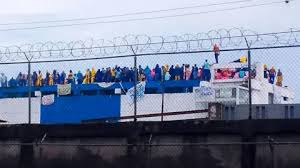
Violent clashes have erupted between inmates and security personnel at a prison in the Venezuelan state of Barinas.
Extra security forces were deployed to the jail after prisoners climbed the roof and burned mattresses in protest at their alleged mistreatment.
Witnesses reported hearing explosions and inmates said they had been shot at.
Organisations lobbying for prisoners’ rights have long denounced the poor conditions at many of Venezuela’s penitentiaries.
Non-governmental organisation Venezuelan Prison Observatory (OVP) said that the inmates at the jail, known as Injuba, had been complaining for more than a week about their treatment under the prison’s new director.
They allege they were violently searched, kept in solitary confinement and mistreated.
The prison director has so far not publicly commented, nor has the government of interim President Delcy Rodríguez.
In footage published by OVP, groups of inmates can be seen protesting on the roof, with some burning mattresses.
In one video, a man can be seen showing wounds on his torso and his arm, with another man shouting “they’re shooting at us”.
Others can be heard joining into chants of “we want justice”.
In another recording shared by OVP, a woman wearing dark glasses and a face mask addresses Rodríguez directly and demands that the minister of prisons and Injuba’s director resign.
She insists that their protest is peaceful before stating their demands, which include medicine for prisoners who have tuberculosis.
OVP has long drawn attention to the poor conditions in Venezuelan jails, with the organisation warning that many do not meet the “minimum standards” which should be guaranteed by law.
Since the United States seized Venezuelan leader Nicolás Maduro in a military operation in the capital, Caracas, on 3 January, US pressure has led to the release of hundreds of political prisoners.
However, more than 400 are still behind bars, according to pressure group Foro Penal.
While Injuba is not one of the prisons where most political prisoners are usually kept, Venezuela’s Committee for the Freedom of Political Prisoners expressed its solidarity with the inmates there, alleging that “punishment, hunger, solitary confinement, torture and inhumane conditions” were being used to control and subdue prisoners and “formed part of prison policy”.
In March, the United Nations’ High Commissioner for Human Rights, Volker Türk, said that his office had been receiving reports alleging that detainees had continued to be tortured in Venezuela following Maduro’s ouster by the US.
By BBC News

Email your news TIPS to Editor@Kahawatungu.com — this is our only official communication channel
