

Donald Tusk Siblings: Meet Sonia Tusk-Cieślak

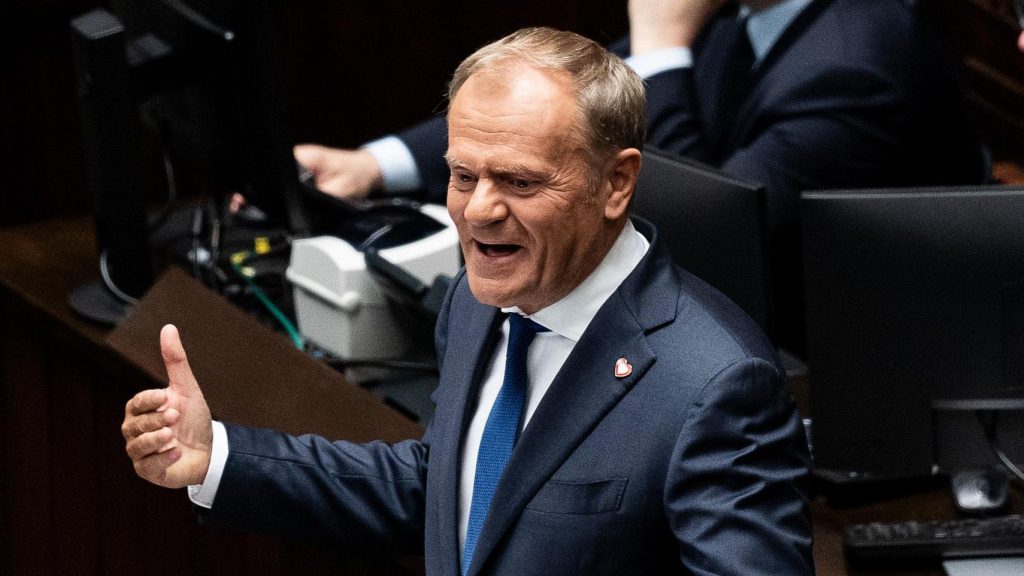
Donald Tusk PHOTO/BBC
Donald Franciszek Tusk is a Polish politician and historian born on 22 April 1957 in Gdańsk.
He comes from a Kashubian family with Polish and German roots through his maternal grandmother.
His father, also named Donald, worked as a carpenter and died in 1972 when Tusk was a teenager.
His mother, Ewa (née Dawidowska), worked as a secretary at the Gdańsk Medical Academy and raised the children after her husband’s death; she passed away in 2009.
Tusk studied history at the University of Gdańsk, where he became involved in anti-communist student activities.
He has long identified as Polish, Kashubian, and European.
Tusk currently serves as Prime Minister of Poland, a role he also held from 2007 to 2014, and previously led the European Council.
Siblings
Donald has one sibling, an older sister named Sonia Tusk-Cieślak.
Born in 1955, she is about two years older than her brother.
Sonia works as a German-language translator, including as a sworn translator, and lives in Gdańsk.
She has two children and has deliberately maintained a private life away from politics and the media spotlight, in contrast to her brother’s high-profile public career.
She rarely appears in public or gives interviews.
In 2005 she suffered a serious stroke; medical efforts, including support that involved Ewa Kopacz at the time, led to treatment abroad and her recovery.
Also Read: Stefan Löfven Siblings: Getting to Know Charlotte and Ulf Löfven

Career
Tusk’s public life began in the late 1970s and 1980s as an anti-communist activist linked to the Solidarity movement and independent student organizations while studying in Gdańsk.
After the fall of communism he entered formal politics, serving in the Sejm and later the Senate in the 1990s.
He co-founded the Liberal Democratic Congress and later the Civic Platform (Platforma Obywatelska) in 2001, becoming its long-time leader.
He served as Deputy Marshal of the Sejm and ran unsuccessfully for president in 2005.
In 2007 Civic Platform won parliamentary elections and Tusk became Prime Minister, holding the office until 2014 and becoming the longest-serving prime minister of democratic Poland at that time; his government oversaw continued economic growth even during the European financial crisis.
In 2014 he was elected President of the European Council, a post he held until 2019 (re-elected in 2017).
After leaving Brussels he led the European People’s Party for a period and returned to Polish politics, reclaiming leadership of Civic Platform and forming a coalition that returned him to the office of Prime Minister in December 2023.
Accolades
Tusk has received a number of national and international honours recognising his political work and commitment to European cooperation.
In 2010 he was awarded the Charlemagne Prize (Karlspreis) by the city of Aachen for his contributions to European understanding, partnership, and the process of European unification; he was described by the jury as a patriot and great European.
Other decorations include the Grand Cross of the Order of the Sun of Peru, the Grand Cross of the Royal Norwegian Order of Merit, the Order of the Cross of Terra Mariana (Estonia), the First Class of the Order of Prince Yaroslav the Wise (Ukraine), the Order of the Star of Romania, the Order of the Rising Sun (Japan), and Georgia’s Presidential Order of Excellence.
He has also received honorary doctorates and other recognitions linked to his roles in Polish and European public life.

