


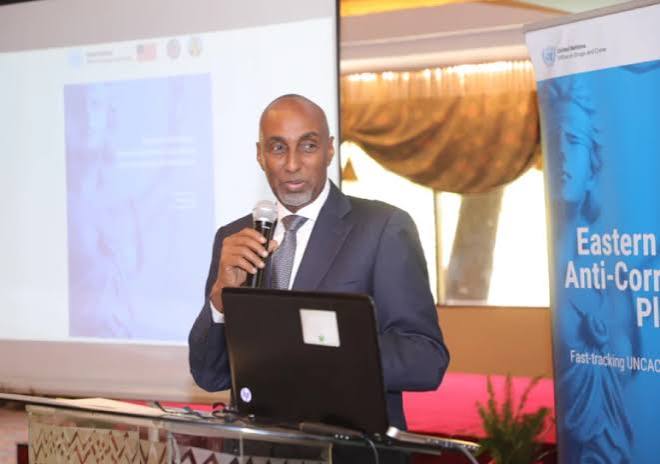
The Ethics and Anti-Corruption Commission (EACC) Chief Executive Officer Abdi Ahmed Mohamud was elected to the Executive Committee of the Association of African Anti-Corruption Authorities (AAACA).
Mohamud was elected to represent the Eastern Africa region during the 8th AAACA General Assembly held in Nairobi, where anti-corruption agencies from across the continent met to deliberate on strategies for tackling graft and strengthening institutional integrity.
His election, which is expected to strengthen Kenya’s influence in continental anti-corruption efforts, places the country among the five regional representatives charged with steering the affairs of AAACA over the next three years.
Mohamud will serve alongside Abdulla M. A. Gadir Bo of Libya for North Africa, Gaoretelelwe Leonard Lekgetho of South Africa for Southern Africa, Alexandra K. Zoe of Liberia for West Africa, and Bénie-Laure Kamwiziku Kusanzakana of the Democratic Republic of Congo for Central Africa.
The General Assembly also elected a new leadership team for the association, with Dr Modibo Sacko of Mali’s Central Office for the Repression of Illicit Enrichment (OCLEI) taking over as president.
Michael Reza of the Zimbabwe Anti-Corruption Commission was elected first vice president, while Khaled Benguernane of Algeria’s High Authority for Transparency, Prevention and Fight Against Corruption was elected second vice president.
In his acceptance remarks, Dr Sacko pledged to build on reforms initiated by the outgoing leadership and continue strengthening the association’s institutions and programmes.
He also committed to advancing the newly launched Centre for Anti-Corruption Studies and Research in Africa (CEREAC), which is expected to support research, training and knowledge-sharing among anti-corruption agencies across the continent.
The assembly consequently selected Libya as the host of the 9th AAACA General Assembly.
Mohamud’s election comes at a time when Kenya is seeking to play a more prominent role in continental governance initiatives, following Nairobi’s successful hosting of the AAACA assembly and the launch of CEREAC, the first Africa-wide anti-corruption research and training centre.
The appointment is expected to give Kenya a stronger voice in shaping anti-corruption policies, promoting cooperation among African anti-corruption agencies and supporting efforts to combat increasingly sophisticated cross-border corruption networks.
Meanwhile, AAACA and the World Bank Group’s Integrity Vice Presidency (INT) have signed a landmark Memorandum of Understanding (MoU) aimed at strengthening cooperation in the fight against corruption and safeguarding development resources across Africa.
The agreement, signed establishes a framework for collaboration in information sharing, capacity building, fraud detection and prevention, joint research, training, and technical cooperation among anti-corruption institutions across the continent.
Speaking on behalf of the World Bank Group Integrity Vice President, Maria Thestrup, Martha Chizuma emphasized the urgency of collective action, noting that: “Corruption remains one of the greatest obstacles to sustainable development, undermining public institutions, diverting resources from essential services, and reducing the impact of development investments.”
She further underscored the importance of strong anti-corruption systems in Africa, where the World Bank maintains its largest active development portfolio spanning infrastructure, health, education, and energy sectors.
The partnership is expected to strengthen institutional capacity, enhance accountability and transparency, and ensure that development resources reach their intended beneficiaries.
Email your news TIPS to Editor@Kahawatungu.com — this is our only official communication channel
