


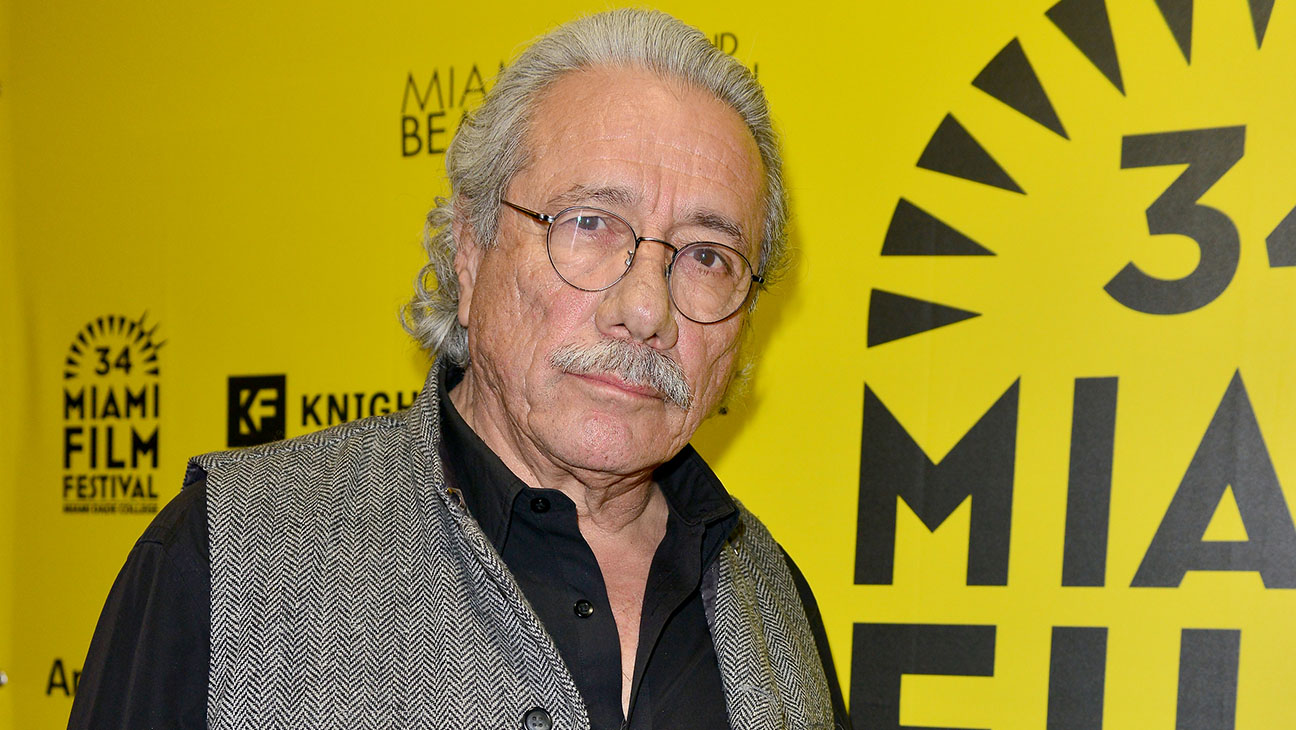
Edward James Olmos stands as a towering figure in American entertainment, renowned for his commanding presence and commitment to portraying complex Latino characters that challenge stereotypes.
Born on February 24, 1947, in East Los Angeles, California, Olmos grew up in a vibrant yet challenging barrio environment, the son of Pedro Olmos, a Mexican immigrant and welder who later worked as a mail carrier, and Eleanor Huizar, a Mexican-American woman of strong Southern Baptist faith.
His parents’ divorce when he was just seven years old left a profound mark, leading him to find solace in baseball during his formative years, where he even became the Golden State batting champion as a teenager.
However, Olmos’s path veered toward the arts after a knee injury ended his baseball dreams, drawing him into music and eventually acting.
Siblings
Edward has two siblings; his older brother, Peter Olmos, and younger sister, Esperanza Olmos.
The two grew up alongside Edward in a household that emphasized resilience amid poverty and ethnic diversity.
Olmos has occasionally spoken of how his siblings and the broader community influenced his worldview, fostering a deep-seated belief in human unity across divides.
Career
In his late teens, after abandoning baseball due to injury, Olmos dove into music, forming the bluesy psychedelic rock band Pacific Ocean in 1967 under the stage name Eddie James, where he handled vocals and keyboards.
The group released a self-titled album in 1968 and toured nationally, but an onstage accident sidelined his musical ambitions, prompting a shift to acting in the late 1960s and early 1970s through small theater productions and classes to enhance his stage presence.
His breakthrough arrived in 1978 with the role of El Pachuco, the enigmatic narrator in Luis Valdez’s play Zoot Suit, which explored the 1940s Zoot Suit Riots and Mexican-American tensions; the production’s unexpected year-long run in Los Angeles led to a Broadway transfer in 1981, catapulting him to national acclaim.
Also Read: Rosalinde Mynster Siblings: Meet Jasper Spanning and Line Spanning
That same year, the film adaptation solidified his film presence.
The 1980s marked Olmos’s ascent in both film and television.
He portrayed the enigmatic Detective Gaff in Ridley Scott’s dystopian masterpiece Blade Runner (1982), a role he reprised in Blade Runner 2049 (2017), cementing his status in sci-fi lore.
Television stardom followed with his portrayal of the stoic Lieutenant Martin “Marty” Castillo in Miami Vice (1984–1989), a character whose quiet intensity contrasted the show’s flashy aesthetic and earned him widespread praise.
Transitioning to more dramatic fare, Olmos delivered a career-defining performance as real-life educator Jaime Escalante in Stand and Deliver (1988), inspiring generations with the story of a teacher transforming underprivileged students through advanced math.
The 1990s saw him direct and star in the gritty gang drama American Me (1992), a controversial project that drew from his activism roots, followed by heartfelt roles like Abraham Quintanilla in the biopic Selena (1997), honoring the Tejano singer’s legacy.
Entering the new millennium, Olmos embraced commanding authority figures, most notably as Admiral William Adama in the reimagined Battlestar Galactica (2004–2009), a role he credits with broadening perceptions of Latino actors in genre television.
He directed the HBO film Walkout (2006), chronicling the 1968 East L.A. walkouts for educational equity, and continued with diverse projects like voicing in The Road to El Dorado (2000) and guest spots on The West Wing and Dexter.
Throughout, Olmos has balanced acting with producing and activism, co-creating initiatives like the book and exhibition Americanos: Latino Life in the U.S. (1999) to celebrate Latino contributions.
Accolades
Olmos’s portrayal of Lieutenant Castillo in Miami Vice secured him the 1985 Primetime Emmy Award for Outstanding Supporting Actor in a Drama Series and the Golden Globe for Best Supporting Actor in a Series, Miniseries, or Television Film, with a subsequent Golden Globe nomination in 1989.
The role of Jaime Escalante in Stand and Deliver earned him a historic Academy Award nomination for Best Actor in 1989—the first for an American-born Hispanic—alongside an Independent Spirit Award for Best Male Lead.
For Zoot Suit, he claimed the Los Angeles Drama Critics Circle Award, a Theatre World Award, and a Tony Award nomination, marking his theatrical pinnacle.
Olmos’s later achievements include a second Golden Globe for Best Supporting Actor in a Miniseries or Television Movie for The Burning Season (1994), multiple ALMA Awards—such as Outstanding Actor in a Drama Series for Battlestar Galactica in 2008—and an Imagen Award for his body of work.
Directorial efforts like Walkout brought a Directors Guild of America nomination in 2007.
Beyond industry trophies, he has received lifetime honors, including the Hollywood Walk of Fame star in 1994, the Mexican American Opportunity Foundation’s Man of the Year in 2015, and Montebello High School’s Alumni of the Year in 2014.
In 2024, his advocacy in amputation prevention inspired the annual Edward James Olmos Award from the American Limb Preservation Society, recognizing global innovators in diabetes care.
Email your news TIPS to Editor@Kahawatungu.com — this is our only official communication channel
