


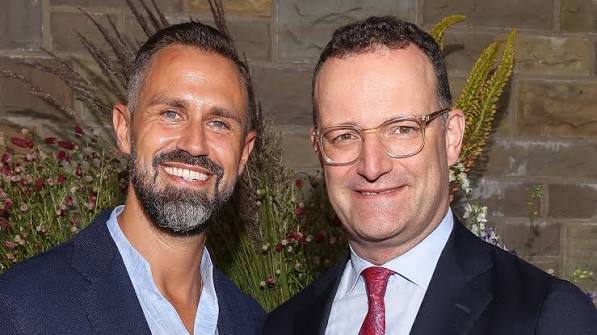
German centre-right politician Jens Spahn has resigned as parliamentary group leader of the country’s governing coalition after being accused of hypocrisy over his use of a surrogate mother in the US to have a child.
Surrogacy is prohibited in Germany – a policy backed by his Christian Democrat party (CDU) and, several years ago, by Spahn himself – although raising a child born to a surrogate mother abroad is not.
He wrote in a statement on Saturday: “I have realised that my personal happiness – founding a family together with my husband and becoming a father – is not compatible with my political office.”
Chancellor Friedrich Merz, who leads the CDU, called his decision “right” and “inevitable”.
“Credibility is the highest asset in politics,” he wrote on social media, and said he would begin the process of appointing Spahn’s replacement.
The 46-year-old former health minister revealed earlier this week that he and his husband Daniel Funke had become parents, with their use of a surrogate abroad prompting criticism from politicians from several parties, including his own.
Announcing his resignation on Saturday, Spahn wrote: “The balancing act between my private decision to have a child through surrogacy and the understandable expectations placed on me as Chairman of our parliamentary group has become greater than I anticipated,” he added.
He also said the “increasing relentlessness in public discourse” had given him “deep pause for thought”.
“Despite all clarity and decisiveness regarding the issues, let us always remain human in our tone,” he wrote.
German media reported Alexander Hoffmann, head of the Christian Social Union parliamentary group, would take over Spahn’s duties until a successor was chosen.
Hoffmann said: “Jens Spahn’s decision deserves the utmost respect.”
The CDU signed a resolution reaffirming its support for a ban on surrogacy in February. As health minister in 2020, Spahn had rejected calls by the liberal FDP for the ban to be relaxed.
In 2015, he wrote that “as a gay man and a Christian I find it personally very hard to warm to the idea of a rented womb”.
Spahn is one of the most powerful figures in the CDU and has survived other political scandals – but this proved one too many for his party.
It came at a difficult time for the CDU, with Merz struggling in the opinion polls, the controversy risked hurting him further ahead of key regional elections this autumn.
In Saxony-Anhalt, the far-right AfD party could win an outright majority, marking the first time a far-right party has held power in a German state since World War Two.
Writing for Bavarian public broadcaster BR24, journalist Christian Wölfel remarked: “One of the most powerful elected representatives is flouting the very rights denied to childless couples in Germany.
“In doing so, Jens Spahn is, shortly before the state elections in the east, confirming precisely the narrative that fringe political groups are using to win votes.”
Others believe Merz may welcome Spahn’s departure from the political arena.
He has “made no secret of his ambitions to become chancellor”, journalist Eva Fischer reported in the newspaper Taz, and is an increasingly dangerous threat to Merz.
She wrote: “In politics, the rule is: if someone could pose a threat to you, it’s best to get rid of them. Now Merz still has the power to do that.”
Other EU countries including France, Spain and Italy also ban surrogacy, which involves a woman carrying a baby and giving birth on behalf of parents unable to have children themselves.
France’s top court, the Court of Cassation, ruled this month that babies born to a surrogate mother abroad should be legally recognised as their intended parents’ children.
Meanwhile, Italy made it illegal in 2024 for Italians to have a baby abroad through surrogacy, in a policy driven by Giorgia Meloni’s right-wing government.
By BBC News

Email your news TIPS to Editor@Kahawatungu.com — this is our only official communication channel
