


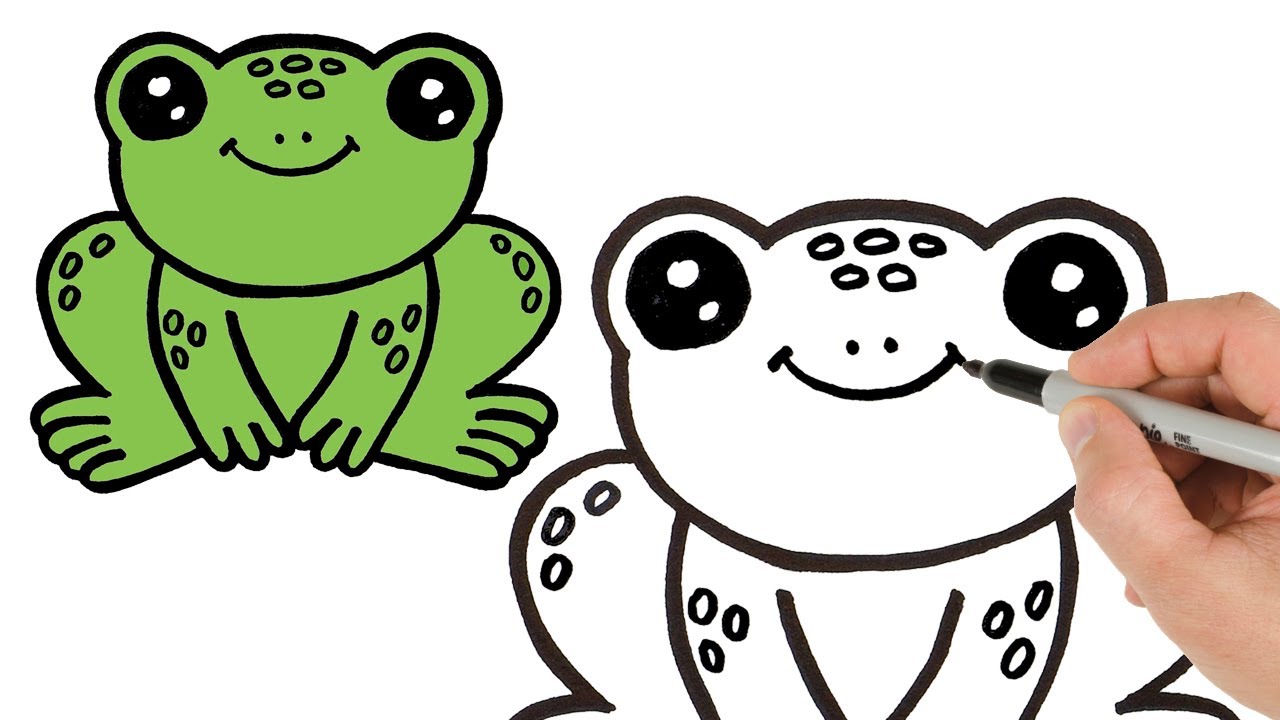
Drawing a frog is one of the most enjoyable activities for young learners because frogs have simple shapes, friendly faces and fun features that make them easy to turn into a charming cartoon character. A child can learn to draw a frog by focusing on circles, ovals and basic curved lines, which builds their confidence and creativity. This guide explains how to break the drawing into easy parts, how to add personality and how to keep the process playful. It works for beginners, parents helping children or teachers preparing a simple art lesson.
- Understanding the Simple Shapes of a Frog
Before a child begins drawing, it helps to understand that frogs can be broken down into a few familiar shapes. Seeing a frog as a collection of circles and ovals makes the task feel less complicated. Children naturally respond well to anything that feels like a puzzle made of simple pieces.
- A frog’s head can be imagined as a large circle or rounded oval
- The body can be drawn as a slightly wider oval under the head
- The eyes are small circles that sit high on the head
- The legs are long curved lines shaped like bent sticks
- The toes spread into rounded tips that are fun to exaggerate in a cartoon style
These shapes give the child a foundation that is easy to build upon and also easy to erase and adjust.
- Drawing the Frog’s Head and Eyes
Once the child knows the shapes, they can begin forming the head. The head is usually the largest feature because it gives the frog an expressive look. Placing the eyes correctly also makes the frog instantly recognizable. Kids enjoy frogs with big friendly eyes, so encourage imagination here.
- Ask the child to draw a big round shape at the top of the page
- Help them place two circles on top of the head to form the eyes
- Add small dots inside the circles for pupils
- Show them how to tilt the pupils slightly if they want the frog to look curious, sleepy or excited
Keeping this part simple helps the child stay relaxed and enjoy the process.
- Shaping the Body and Adding Legs
Once the head feels right, the child can work downward to form the body and limbs. Frogs are known for their long legs, so this is a fun chance to stretch the drawing and make it expressive.
- The body is drawn as a medium-sized oval just below the head
- The front legs can be created with short curved lines coming from the middle of the body
- The back legs should be longer and bent outward, which gives the frog its characteristic hopping posture
- Each foot can be drawn with three or four rounded toe tips
Children enjoy this stage because it allows dramatic shapes and playful proportions.
- Adding Details and Personality
With the basic shapes complete, the child can begin adding small features that bring the frog to life. Kids love giving their drawings personality, so this part is where creativity grows.
- A smile can be added with a curved line across the face
- Tiny nostrils can be drawn with small dots
- Spots can be scattered across the frog’s back
- A simple lily pad can be drawn beneath the frog to form a mini background
- Optional features like a crown, a hat or a little insect in front of the frog can make the drawing feel like a story
These small touches make children feel proud of their work.
- Finishing the Drawing With Colour
Colouring helps the frog feel complete and gives the child a sense of accomplishment. Frogs can be green, brown, yellow or any colour a child can imagine, which keeps the activity lighthearted.
- Green is the most familiar choice
- Yellow or light brown can be used for the belly
- Darker greens or browns can be added for spots
- Blue or light green works well for water and lily pads
Also Read: How To Delete Read-Only Contacts
Email your news TIPS to Editor@Kahawatungu.com — this is our only official communication channel
