


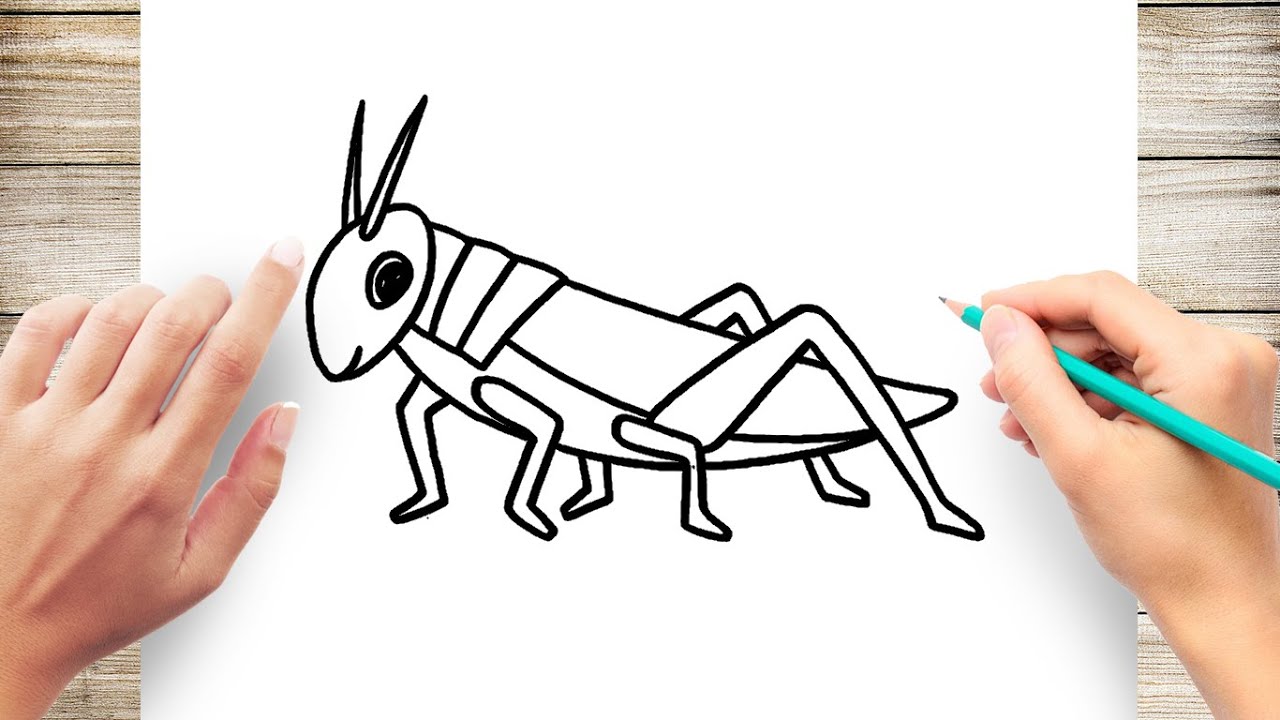
Drawing a grasshopper may look challenging at first because of its long legs, detailed wings and segmented body, but once you break the insect into simple shapes it becomes an enjoyable and easy exercise. A grasshopper has a very recognizable form and is perfect for anyone wanting to practise drawing insects with more structure. This guide helps you understand what to look for, how to sketch the main parts and how to complete the final details in a relaxed and manageable way.
- Understanding the Basic Shape of a Grasshopper
A grasshopper is mainly made up of three parts: the head, the thorax and the abdomen. The legs and antennae extend from these sections, giving it a distinctive silhouette. Before you begin, picture the grasshopper sitting on a leaf in a side view because that is the simplest angle to draw. You will notice the curved body, the large hind legs and the small folded wings. Thinking about these shapes before your pencil touches the paper helps you draw with more confidence and less confusion.
- It has a small rounded head.
- The thorax is slightly thicker and supports the legs.
- The abdomen is long and curved.
- The back legs are large and powerful.
- The antennae are long and thin.
- Drawing the Head and Antennae
Start at the front by sketching the head. Make it a small oval or a slightly pointed circle. Add a curved line to suggest the mouth area. The eyes can be drawn as simple rounded shapes on the sides of the head. Once these are done, bring in the antennae. They should be long, thin and gently curving upwards or outwards. They do not need perfect symmetry; natural insects often have relaxed, uneven positioning, so drawing them slightly different gives the picture more life.
- Sketching the Thorax and Abdomen
After the head, move backwards to the thorax. This is the central body section and should be slightly larger than the head. Draw it as a rounded block shape that connects smoothly with the abdomen. The abdomen is long and cigar-shaped, gently bending as it moves toward the tail end. Try to keep the body in proportion by imagining the abdomen being about two or three times longer than the thorax. This section can later be divided into segments using light curved lines, but keep it simple during the early sketch.
- Adding the Legs and Wings
The legs give the grasshopper its character, especially the hind legs. Begin by drawing the front and middle legs as thin lines with small bends. These legs can be simple because they are not the main focus. The hind legs, however, should be large. Draw a strong upper leg, a sharply bent knee and a long, narrow lower leg. The wings can be added above the abdomen as long leaf-like shapes lying flat along the body. They do not need too much detail at first; soft lines are enough until you refine them later.
- Keep the hind legs long and exaggerated.
- Make the front and middle legs lighter.
- Draw the wings as long oval shapes along the back.
- Final Details and Shading
Once the full structure is complete, add details to bring the grasshopper to life. You can place small lines across the abdomen to show segmentation, add texture on the legs and wings and darken the eye slightly. Light shading under the body and along the legs gives depth. Finally, tidy up the lines, keeping only the ones you want to remain. At this stage, your grasshopper should look natural, balanced and expressive without needing perfect accuracy.
Also Read: How To Draw A Frog For Kids
Email your news TIPS to Editor@Kahawatungu.com — this is our only official communication channel
