


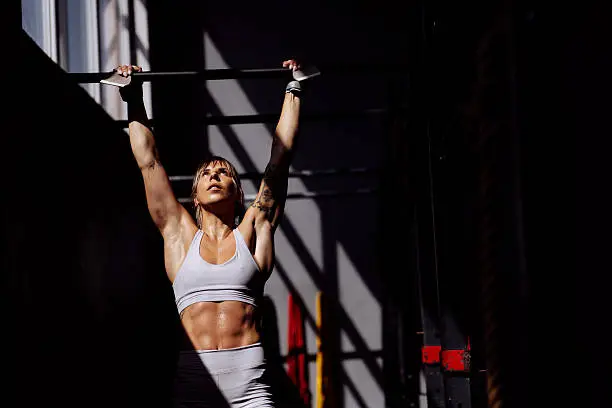
Learning how to improve dead hang time can help you build grip strength, forearm endurance, and greater confidence on the pull-up bar. A dead hang involves supporting your body weight while holding onto a secure overhead bar, making grip and shoulder control important. The best way to improve is to practise consistently while gradually increasing your hanging time instead of repeatedly training to complete failure.
-
Test Your Current Dead Hang Time
Before starting a training programme, find out how long you can comfortably hang with good form. Use a secure pull-up bar and time yourself.
Record your result so you can compare it with your performance after several weeks.
- Use the same bar when possible
- Start the timer when your feet leave the ground
- Stop when your grip can no longer remain secure
- Record your best controlled time
-
Practise Dead Hangs Regularly
Specific practice is one of the most useful ways to improve your hanging endurance. Include dead hangs in your workouts several times per week rather than performing one maximum attempt every day.
Start with a duration you can control comfortably and gradually increase it.
- Perform several short hangs
- Rest between sets
- Practise consistently
- Increase duration gradually
-
Avoid Going to Failure Every Time
You do not need to hang until your hands completely give out during every workout. Repeated maximum-effort attempts can create excessive fatigue and may interfere with recovery.
Instead, finish most sets while you still have some control.
- Leave some time in reserve
- Use maximum attempts occasionally
- Focus on quality rather than exhaustion
- Allow your grip to recover
-
Improve Your Grip Strength
Your hands and forearms play a major role in how long you can remain on the bar. Adding other grip exercises can complement your dead-hang practice.
Farmer’s carries, controlled rows, and other pulling exercises can help develop overall grip strength.
- Try farmer’s carries
- Use dumbbell or kettlebell holds
- Practise controlled pulling exercises
- Train both hands evenly
-
Use Assisted Hangs if Necessary
If your current dead hang is very short, use a method that reduces the amount of body weight you have to support. You can place your feet lightly on a box or elevated surface while maintaining your grip on the bar.
This allows you to practise the hanging position for longer.
- Keep your feet lightly supported
- Maintain a secure grip
- Gradually reduce assistance
- Progress toward full bodyweight hangs
-
Improve Your Grip Technique
How you hold the bar can affect your endurance. Wrap your fingers around the bar and keep your grip secure without unnecessarily squeezing as hard as possible from the beginning.
Experiment with a grip width that feels comfortable and controlled.
- Wrap your fingers around the bar
- Keep your thumb secure
- Avoid an excessively wide grip
- Maintain consistent hand positioning
-
Strengthen Your Forearms
Strong forearms can help you maintain your grip for longer. Exercises such as wrist curls, reverse wrist curls, farmer’s carries, and controlled gripping exercises can complement your hanging practice.
Avoid adding too much volume at once.
- Train wrist flexors
- Train wrist extensors
- Use controlled repetitions
- Allow adequate recovery
-
Build Shoulder Control
A dead hang is not only a grip exercise. Your shoulders also need adequate mobility and stability to tolerate the position comfortably. Good shoulder control can help you maintain a safer and more controlled hang.
If fully relaxing into a passive hang causes shoulder discomfort, work on shoulder strength and mobility rather than forcing longer hangs.
- Keep your shoulders comfortable
- Practise controlled scapular movements
- Strengthen the muscles around the shoulder
- Avoid painful positions
-
Add Scapular Pulls
Scapular pulls can help you practise controlling your shoulder blades while hanging. Start from a supported hanging position and gently move the shoulders down and back without bending the elbows significantly.
Keep the movement controlled rather than trying to perform a full pull-up.
- Begin with a secure grip
- Keep your elbows mostly straight
- Move your shoulder blades deliberately
- Perform controlled repetitions
-
Improve Your Overall Body Strength
A stronger upper body can make hanging and pulling movements easier. Include exercises such as rows, assisted pull-ups, lat pulldowns, and other pulling movements in your programme.
Building overall strength can complement your grip training.
- Perform rows
- Practise assisted pull-ups
- Use lat pulldowns
- Strengthen your upper back
-
Manage Your Body Weight
The lighter the load you have to support relative to your strength, the easier a bodyweight hang may become. However, avoid extreme dieting or rapid weight loss simply to improve your hanging time.
Focus instead on developing strength while maintaining healthy nutrition and body composition.
-
Use Different Bar Grips Carefully
Once your basic dead hang improves, you can gradually experiment with different grips. A neutral grip, when available, may feel different from a standard overhand grip.
Do not introduce difficult variations too quickly.
- Master the basic hang first
- Try different grips gradually
- Monitor how your shoulders and hands feel
- Use the grip that matches your goal
-
Follow a Simple Progression
For example, if you can currently hang for 20 seconds, you could perform several sets of shorter hangs rather than repeatedly attempting 20 seconds to failure.
As your endurance improves, gradually increase the duration.
A simple progression could look like:
- Week 1: 3 sets of 10–15 seconds
- Week 2: 3 sets of 15–20 seconds
- Week 3: 3 sets of 20–25 seconds
- Week 4: 3 sets of 25–30 seconds
Adjust the times according to your current ability rather than following these numbers rigidly.
-
Give Your Grip Enough Recovery
Your hands and forearms need time to recover after demanding grip training. Avoid performing hard dead-hang sessions repeatedly if your grip remains very tired or your hands are painful.
Rest days can help you return to training with better quality.
- Space out demanding sessions
- Rest when your grip is excessively fatigued
- Avoid training through hand or shoulder pain
- Increase training gradually
-
Retest Your Maximum Time
After several weeks of consistent practice, test your maximum controlled dead hang again. Use the same bar and similar conditions so that your results are easier to compare.
An increase in time is useful evidence that your grip and hanging endurance are improving.
Also Read: How to Improve Fertility in Women

Email your news TIPS to Editor@Kahawatungu.com — this is our only official communication channel
