


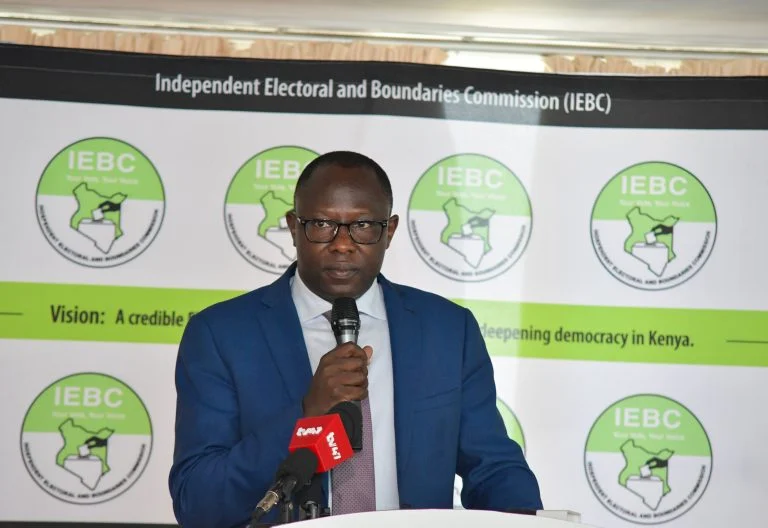
The Independent Electoral and Boundaries Commission (IEBC) has strongly dismissed allegations of corruption, political interference and voter suppression linked to preparations for the 2027 General Election, accusing Democracy for Citizens Party (DCP) leader Rigathi Gachagua of spreading unsubstantiated claims.
In a statement issued Thursday, IEBC Chairperson Erastus Edung Ethekon said the commission had taken note of reports circulating in mainstream and social media following remarks made by Mr Gachagua during a press briefing on Wednesday.
Ethekon said the commission was properly constituted and focused on delivering its constitutional mandate ahead of the August 10, 2027 General Election.
He dismissed attempts to question the appointment of the current commissioners, saying the process was conducted publicly and subsequently subjected to judicial scrutiny, which found it lawful.
“The Commission having been properly constituted is focused on its mandate and owes its allegiance to the Constitution and the people of Kenya,” Ethekon said.
IEBC challenges Gachagua over house allegations
The commission also challenged Gachagua to provide evidence for his allegation that politicians had purchased a house for the IEBC chairperson to influence his decisions.
According to the IEBC, the alleged value of the house had initially been put at Sh80 million but had since risen to Sh200 million.
Ethekon demanded that the DCP leader provide the alleged property’s location and transaction documents, including sale and transfer agreements, payment receipts and details of the buyer and seller, and submit them to the Ethics and Anti-Corruption Commission for investigation.
The IEBC said that without evidence, the allegations amounted to a smear campaign against its leadership and staff.
It urged politicians with specific complaints against commissioners or employees to use established legal and constitutional mechanisms rather than making public accusations.
The commission further rejected allegations of misconduct against Mr Ethekon and Vice Chairperson, saying similar claims made against the vice chairperson during last year’s Magarini by-election remained unsubstantiated.
The IEBC said the Magarini by-election was conducted in a free, fair and credible manner and no election petition was filed challenging the outcome.
Election technology tender halted
The commission also addressed growing scrutiny over the procurement of technology and ballot papers for the 2027 elections.
It said two major tenders had temporarily been halted after requests for review were filed before the Public Procurement Administrative Review Board.
The affected tenders are IEBC/OIT/01/2026-2027 for the supply, installation, testing, commissioning, support and maintenance of the Integrated Elections Management System, including hardware and accessories.
The second is IEBC/OIT/02/2026-2027 for the supply and delivery of ballot papers, tactile folders, the Register of Voters and statutory election result declaration forms.
The commission insisted that the procurement processes were being conducted in accordance with Article 227 of the Constitution, the Public Procurement and Asset Disposal Act and other applicable regulations.
It said documents relating to the technology tender were uploaded to the IEBC website and the Public Procurement Information Portal on August 11.
The commission further rejected claims that the technology tender had already been awarded to a particular company.
According to Ethekon, the procurement is still at an early stage and no award has been made.
He said the technical specifications were generic and performance-based, allowing any qualified supplier to compete.
The specifications, he added, had been developed with reference to Supreme Court directives, lessons learnt from previous elections and feedback from IEBC field officers.
“The tendering processes are elaborate, and the final decisions will be reached after rigorous, open and transparent processes are concluded in accordance with the procurement laws,” he said.
The commission warned bidders against seeking political influence or associating themselves with politicians in an attempt to influence the procurement process.
It said all decisions would be based on the law and established procurement procedures.
IEBC denies plans to tamper with voter register
The commission also moved to reassure Kenyans over the security of the Register of Voters, amid allegations that voter information could be manipulated or shared with external parties during system migration.
Ethekon said the Register of Voters remained under the exclusive custody of the IEBC and there was no plan or directive to suppress voters from any region or tamper with their data.
He said allegations that the commission was sharing voter registration data with external parties were false and unsubstantiated.
The chairperson outlined the process through which the register is developed, beginning with in-person registration and verification of voters using official identification documents.
Biographical and biometric information, including fingerprints and facial images, is captured before the data is transmitted to a central database.
The system then conducts biometric de-duplication through fingerprint matching and alphanumeric comparisons to identify duplicate registrations, conflicting records and other anomalies.
Flagged records are subjected to data cleaning, validation and adjudication before a valid record is retained.
The validated register is subsequently subjected to a 30-day biometric verification exercise, during which voters can confirm their details and raise claims or objections.
The commission said the register would also undergo an independent audit before being finalized and certified as the official register to be used during the election.
The IEBC said the elaborate safeguards made it impossible to interfere with the register without detection.
Commission vows to withstand political pressure
The commission said allegations of bribery, predetermined tender awards and voter suppression were false and potentially dangerous because they could undermine public confidence in the electoral process.
Ethekon invoked Article 249 of the Constitution, which establishes the independence of constitutional commissions and requires them to remain independent and impartial.
He said the IEBC leadership would not be intimidated, coerced or influenced by what he described as politically motivated allegations.
The commission is now implementing its roadmap towards the August 10, 2027 General Election and says it is prepared to conduct a free, fair, peaceful and credible poll.
It called on Parliament, civil society organisations, the media, development partners and the public to work with the commission while also exercising their right to scrutinise its work.
However, the IEBC warned that while it welcomed constructive criticism and accountability, it would challenge what it described as malicious propaganda, harassment, threats and intimidation directed at its commissioners and staff.
The statement comes as political parties and other stakeholders increasingly turn their attention to preparations for the 2027 election, with electoral technology, voter registration and the integrity of the electoral process expected to remain among the most closely watched issues ahead of the poll.

Email your news TIPS to Editor@Kahawatungu.com — this is our only official communication channel
