

John Curtin Siblings: Get to Know George, Mary and Hannah

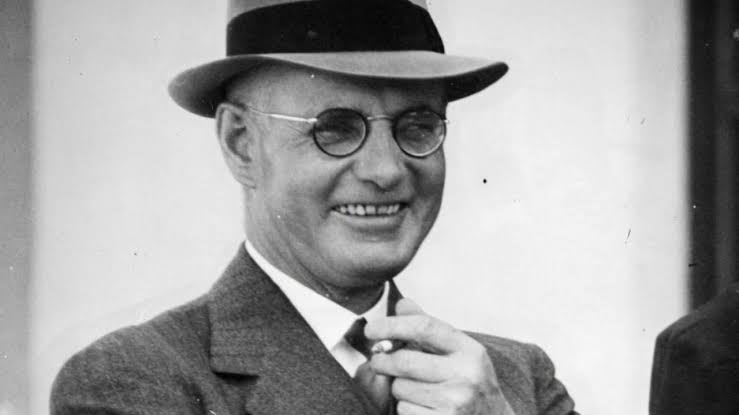
John Curtin PHOTO/ABC News
John Joseph Ambrose Curtin was an Australian politician, trade unionist and journalist who served as the 14th Prime Minister of Australia from 7 October 1941 until his death on 5 July 1945.
Born on 8 January 1885 in the former gold-mining town of Creswick, Victoria, he was the eldest child of Irish immigrants John Curtin senior, a police constable and later hotel manager, and Catherine Agnes “Kate” Bourke.
Known within his family as Jack, he grew up in modest and often difficult circumstances as the family moved frequently because of his father’s ill health and changing employment.
Curtin left school at around the age of 13 or 14 and worked in a variety of jobs, including as a copyboy and clerk, while educating himself through voracious reading at public libraries.
He became deeply involved in the labour movement and socialist politics in Melbourne before moving to Western Australia in 1917.
He died in office at The Lodge in Canberra, only weeks before the end of the war in the Pacific, and is frequently ranked among Australia’s greatest prime ministers.
Siblings
John was the oldest of four children.
His younger brother George was born in 1887, followed by his sisters Mary in 1889 and Hannah in 1891.
The family experienced economic hardship, especially after their father’s health forced him to leave the police force and take up irregular work managing hotels in various Victorian towns before they settled in the Melbourne suburb of Brunswick.
Details of the later lives of George, Molly and Hannah are less prominent in public records than those of their famous brother, but the siblings shared a working-class Irish-Australian upbringing marked by frequent moves and financial strain.
Curtin maintained a sense of family loyalty throughout his life, though his political career and long absences in Canberra meant he spent much of his adult life physically separated from his relatives in Victoria and Western Australia.
Also Read: Scott Morrison Siblings: All About Alan Morrison
Career
Curtin began his public life in the labour movement in Melbourne.
He joined the Victorian Socialist Party and the Political Labor Council, worked as organising secretary of the Timber Workers’ Union from 1911 and later became its federal president.
He was a leading opponent of conscription during the First World War and was briefly imprisoned for refusing a medical examination.
In 1917 he moved to Perth to edit the labour newspaper the Westralian Worker, a position he held for a decade.
After several unsuccessful attempts at federal election, he won the seat of Fremantle for the Australian Labor Party in 1928.
He lost the seat in the 1931 landslide that ended the Scullin government but regained it in 1934 and held it for the rest of his life.
Elected federal parliamentary leader of the Labor Party by a single vote in 1935, he gradually reunited a divided party.
Following the collapse of the Fadden government in October 1941, Curtin became prime minister.
His wartime leadership was defined by the rapid mobilisation of Australia’s resources, the difficult decision to recall Australian troops from the Middle East for the defence of the homeland, the forging of a close alliance with the United States, and the management of the home front under the growing threat of Japanese attack.
He also laid foundations for postwar reconstruction. His health deteriorated under the strain of office, and he died on 5 July 1945, six weeks before Japan’s surrender.
Accolades
Curtin was appointed a Privy Councillor in 1942.
Beyond formal honours, his reputation rests on the near-universal respect he earned across the political spectrum for his integrity, personal austerity and wartime leadership.
Contemporaries on both sides of politics, including his predecessor Arthur Fadden, praised him as one of the finest Australians of his generation.
He is commemorated by Curtin University in Western Australia, the John Curtin School of Medical Research, numerous schools, streets and public buildings, and the preserved Curtin Family Home in Cottesloe..

