

John Turner Siblings: All About Michael and Brenda Turner

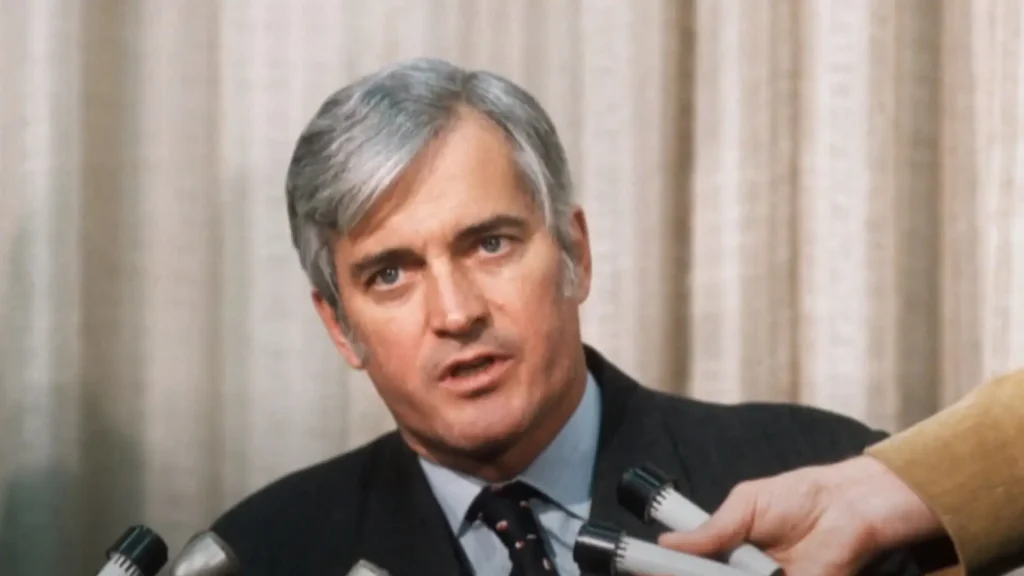
John Turner PHOTO/CBC
John Napier Wyndham Turner was a Canadian lawyer and politician who served as the 17th prime minister of Canada from June 30 to September 17, 1984.
Born on June 7, 1929, in Richmond, Surrey, England (now part of London), to English journalist Leonard Hugh Turner and Canadian economist Phyllis Gregory, he moved to Canada as a young child after his father’s death in 1932.
His mother, who later remarried industrialist Frank Mackenzie Ross (a future lieutenant governor of British Columbia), raised him primarily in Ottawa and later Vancouver.
Turner became a prominent figure in Canadian public life, known for his athletic background as a track sprinter, his academic achievements as a Rhodes Scholar, and his decades-long career in law and Liberal Party politics.
He died on September 19, 2020, in Toronto at the age of 91.
Siblings
John had two siblings. His brother Michael was born in 1930 and died shortly after birth.
His sister Brenda was born in 1931.
After their father’s death from complications related to hyperthyroidism, Phyllis Turner returned to Canada with the two surviving children, first settling briefly in her childhood home in Rossland, British Columbia, before moving to Ottawa.
Brenda, who later took the surname Norris after marriage, grew up alongside her brother under their mother’s high expectations for excellence.
She outlived John and was noted in family accounts as surviving him at the time of his death.
Career
Turner attended Ashbury College and St. Patrick’s College in Ottawa before enrolling at the University of British Columbia at age 16, graduating with an honours BA in economics and political science in 1949.
A standout sprinter who held the Canadian record for the men’s 100-yard dash and qualified for the 1948 London Olympics (though a knee injury prevented him from competing), he won a Rhodes Scholarship and studied at Magdalen College, Oxford, earning a BA in jurisprudence in 1951, a Bachelor of Civil Law in 1952, and later an MA.
He also studied briefly at the University of Paris.
Also Read: Paul Martin Siblings: Getting to Know Mary-Anne Bellamy
Returning to Canada, he practised law, beginning with the firm Stikeman Elliott in Montreal, and was called to the bars of Quebec and Ontario, later becoming a Queen’s Counsel.
He entered federal politics as a Liberal Member of Parliament in 1962, representing a Montreal riding.
Under Prime Minister Lester B. Pearson and later Pierre Trudeau, he held cabinet posts including minister of justice and attorney general (1968–1972), where he oversaw major Criminal Code reforms that liberalized laws on homosexuality, abortion, and divorce, and minister of finance (1972–1975).
He left politics in 1976 to return to corporate law practice in Toronto.
In 1984, following Trudeau’s resignation, Turner won the Liberal leadership and became prime minister.
His brief 79-day tenure (the second-shortest in Canadian history) ended with a decisive electoral defeat by Brian Mulroney’s Progressive Conservatives.
He remained Liberal leader and Leader of the Opposition until 1990, notably opposing the Canada–United States Free Trade Agreement in the 1988 election, before retiring from the House of Commons in 1993.
He then resumed legal practice, including at Miller Thomson LLP, until around 2013, while serving on corporate boards and as a political advisor.
Accolades
As a Rhodes Scholar, Turner gained one of the Commonwealth’s most prestigious academic awards.
He was appointed a Companion of the Order of Canada (C.C.) in 1994 (invested in 1995) for his distinguished parliamentary career, legal contributions, and support of charitable causes such as Mount Sinai Hospital and the Community Foundation of Toronto.
He held the style The Right Honourable for life as a former prime minister and was a member of the Queen’s Privy Council for Canada (P.C.) as well as a Queen’s Counsel (Q.C.).
Additional recognitions included the Centennial Anniversary of the Confederation of Canada Medal, Queen Elizabeth II Silver, Golden, and Diamond Jubilee Medals for Canada, and the 125th Anniversary of the Confederation of Canada Medal.
In 2017, he became the first Canadian politician awarded the Royal Canadian Geographical Society’s Gold Medal for his parliamentary service and contributions to Canadian geography through extensive Arctic travels.
He also received an alumni UBC Award of Distinction and participated in later public roles, such as monitoring Ukraine’s 2004 presidential election runoff as part of a Canadian delegation.

