


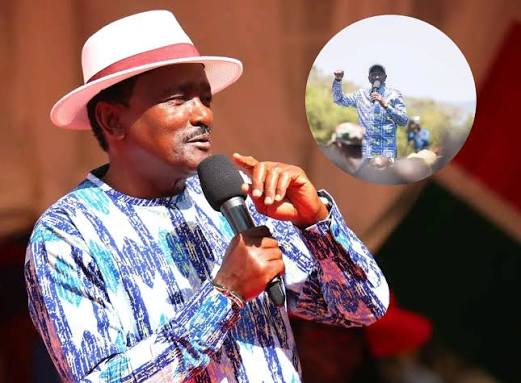
Wiper Party leader Kalonzo Musyoka has criticised the government’s crackdown on foreign traders, accusing the Kenya Kwanza administration of handling the exercise without a clear strategy and creating unnecessary tensions with neighbouring countries.
Musyoka said the sight of hundreds of small-scale traders seeking emergency travel documents outside the Burundian Embassy in Nairobi ahead of a government deadline demonstrated what he termed the chaotic manner in which the crackdown was being implemented.
He argued that the government could protect Kenyan businesses without resorting to measures that risk disrupting legitimate trade or creating tensions between Kenyan and foreign traders.
“There are better, more deliberate ways to protect Kenyan small businesses and create an environment where entrepreneurs, Kenyan and foreign alike, can thrive within the law,” Musyoka said.
He identified corruption, an unpredictable business environment, tariff and taxation policies and rising political tensions ahead of the 2027 General Election as bigger threats to small-scale traders than the presence of foreign nationals.
“The real threats facing our small traders are corruption, an unpredictable working environment including this regime’s erratic tariffs and taxation policies, and the pre-election tensions being deliberately stoked by the outgoing regime, not the presence of foreign traders alone,” he said.
Musyoka called for diplomacy, dialogue and respect for the rule of law in the government’s handling of foreign traders, warning that heavy-handed measures could strain relations between communities and neighbouring countries.
He said the government needed to exercise greater caution, particularly as Kenya approaches the 2027 elections.
“Diplomacy, dialogue, and respect for the rule of law must take centre stage, not just because we are approaching the 2027 General Election, but because that is how a government that respects the law conducts itself every day,” he said.
The Wiper leader also demanded greater transparency in the processing of foreign nationals affected by the crackdown.
He said authorities should disclose how affected traders are being processed, including any documentation or changes in immigration status issued to them.
Musyoka warned that without adequate safeguards, the exercise could later be exploited for purposes unrelated to trade or border management.
He further accused President William Ruto’s administration of using the crackdown to project strength and divert public attention from what he described as failures in governance.
“Let us also be honest: this crackdown is not about protecting Kenyan businesses. It is about projecting power where competence is clearly lacking by a regime that manufactures crises in an attempt to distract Kenyans from its self-imposed failures,” he said.
He blamed the government’s economic policies for worsening the challenges facing Kenyan entrepreneurs, citing corruption and what he termed punitive taxation.
“Corruption, punitive taxation, and an economy gasping for breath because of Ruto are the real threats to Kenyan livelihoods and further evidence that this regime is unfit to lead,” Musyoka said.
His remarks come amid heightened scrutiny of foreign traders operating in Kenya and renewed debate over how the government should balance enforcement of immigration and business regulations with the need to protect legitimate cross-border trade.
“The country and the region are watching,” Musyoka said.

Email your news TIPS to Editor@Kahawatungu.com — this is our only official communication channel
