


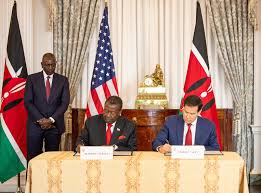
Kenya and the United States sealed a historic Health Cooperation Framework that President William Ruto says will accelerate the country’s march toward universal health coverage (UHC) and deepen long-standing bilateral health ties.
The agreement, signed in Washington, D.C., brings together key pillars of Kenya’s health reform agenda, including the modernization of medical equipment, reliable delivery of health commodities, expansion of the health workforce, and broadening of national health insurance coverage.
Under the Framework, the United States will provide USD 1.6 billion over the next five years, funding that will be channelled directly through Kenyan government institutions to enhance transparency, accountability, and impact.
President Ruto hailed the deal as a milestone, thanking the U.S. government—under President Donald J. Trump—for selecting Kenya as the first country to sign such an accord. He said the move reflects growing global confidence in Kenya’s ambitious transformation of its health sector.
“This partnership cements our shared vision of a healthier, more resilient nation,” Ruto said, noting that the direct financing model aligns with Kenya’s commitment to strengthen local systems and ensure sustainable health service delivery.
The signing ceremony brought together U.S. Secretary of State Marco Rubio and Kenya’s Prime Cabinet Secretary Musalia Mudavadi, who represented the two governments.
The new Framework builds on 25 years of health cooperation between Nairobi and Washington, during which the U.S. has invested over USD 7 billion in programmes targeting HIV/AIDS, malaria, maternal health, and health systems strengthening.
Officials from both sides described the agreement as a “next-generation partnership” intended to support Kenya’s shift to preventive and primary health care, reduce out-of-pocket costs for families, and drive long-term improvements in health outcomes.
Health Cabinet Secretary Aden Duale said under the framework there will be a strengthened national sovereignty
Integrated digital and surveillance systems, stronger health workforce, faster emergency response, improved laboratories and supply chains and enhanced diplomatic and economic ties.
He said there will be better access to essential medicines, improved service delivery at public hospitals, stronger protection from epidemics and long-term sustainability of essential health services.
He said all data sharing follows Kenyan laws and only de-identified, aggregated data is shared.
“Approvals must go through DHA and the Data Commissioner. Digital Health Act and Data Protection Act fully apply,” he said.
This came amid concerns of data of Kenyans.
Email your news TIPS to Editor@Kahawatungu.com — this is our only official communication channel
